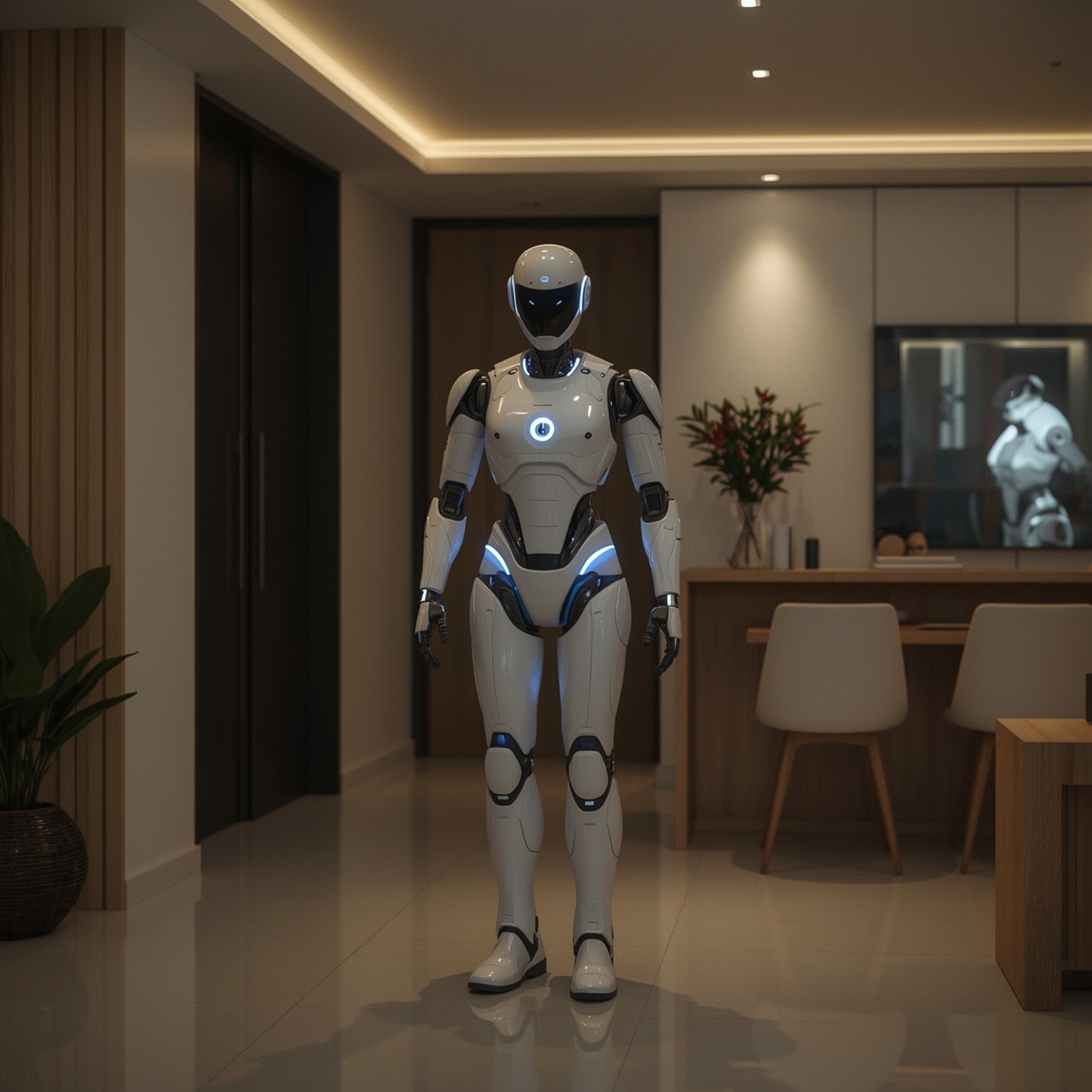
Standing at an unassuming yet distinct height of five feet and six inches, and weighing roughly the same as an average golden retriever, this mechanical creation already sets itself apart by its presence alone. Priced close to what one might pay for a brand-new budget automobile, it is not a mere toy or novelty item—it represents an ambitious convergence of engineering and artificial intelligence within a household form. This remarkable invention is Neo, the humanoid robot designed and manufactured by the California-based company 1X. Marketed as a personal assistant made to converse, cooperate, and ultimately take over many of the routine domestic tasks that occupy daily life, Neo aspires to become an indispensable household companion capable of loading the dishwasher, sorting and folding laundry, and performing other chores that quietly consume human hours.
However, such futuristic convenience comes with a significant price tag. Purchasing Neo outright will cost approximately $20,000, and even after acquisition, the journey is far from complete—you, the owner, must still train your new robotic ally. If this ambitious proposition sounds tempting, 1X has already opened preorders, requiring only a $200 deposit. Those who enroll now will join the group of pioneering early adopters helping to shape a new generation of companion robotics. Neo is being promoted as the first genuinely consumer-ready humanoid robot, distinct from competing prototypes such as Tesla’s Optimus and the Figure models, which remain primarily focused on industrial and manufacturing roles rather than the intimate complexity of life inside a family home.
Neo represents a vast leap forward from the familiar automated devices many households already use, such as robot vacuums produced by Roomba, Eufy, or Ecovacs. While those devices clean floors with efficiency, Neo seeks to realize a much older vision—one deeply embedded in science fiction and the collective imagination—of robot butlers and maids graciously assisting with daily domestic upkeep. For those curious about the shape of an everyday future increasingly intertwined with AI and robotics, Neo may well serve as a preview of what lies ahead.
In terms of customization, potential buyers can select from multiple color options designed to blend harmoniously with their existing home décor, ensuring the robot’s presence feels natural rather than intrusive. According to 1X, Neo is built to handle a surprisingly broad range of household duties, including folding laundry, vacuuming floors, tidying cluttered shelves, and even carrying grocery bags into the kitchen. It can navigate the layout of a home, open doors, climb stairs, and act as an interactive home entertainment device. Observers who have seen it in motion describe its movements as graceful and smooth, almost human-like in gait—an effect achieved through 1X’s advanced tendon-driven motor system, which provides subtle flexibility and considerable strength without sacrificing gentleness. Despite that power—it can lift up to 154 pounds and transport 55 pounds—the machine operates quietly, producing less noise than an average refrigerator. With its exterior created from soft materials and subdued, neutral colors, Neo avoids the cold, mechanical aesthetic of earlier metallic robots, instead projecting a more approachable and friendly form.
Neo is powered for about four hours of active operation on a single charge, and its hands are IP68-rated, meaning they are resistant to dust and can safely operate underwater—a thoughtful feature for household usage. Connectivity comes through Wi-Fi, Bluetooth, and 5G networks, ensuring that users can interact seamlessly from anywhere in the home. For conversational engagement, Neo integrates a large language model—the same class of AI technology that lies behind well-known systems such as ChatGPT and Google Gemini—allowing natural spoken interaction. In practice, the primary means of controlling Neo is not through buttons or remotes but through voice, communicating as though one were speaking to another human being residing in the household.
Nevertheless, Neo’s present-day practicality still depends greatly on expectations. Joanna Stern of The Wall Street Journal visited 1X’s development headquarters and observed the robot up close, noting that its current functions often rely on teleoperation—a human operator guiding Neo remotely via virtual-reality headsets and hand controllers. While Neo can perform some isolated actions autonomously, such as opening a door, its full independence remains a goal for the near future. According to 1X CEO Bernt Børnich, the company expects Neo to conduct most household tasks autonomously by 2026, although he candidly admits that the precision and efficiency of those early autonomous behaviors may initially fall short of perfection.
Part of the implicit arrangement that early purchasers agree to involves allowing Neo to learn from real household environments in order to improve performance over time. That process, while crucial to creating a truly capable home robot, inevitably raises legitimate privacy and trust concerns. Neo’s sensory and cognitive systems employ a blend of visual, auditory, and contextual intelligence—essentially enabling it to see, hear, and recall details about its interactions and surroundings. As Børnich explained, purchasing Neo entails accepting a kind of social contract: buyers permit the robot to observe and learn within their homes, not for the immediate convenience of having chores completed instantly, but for the long-term payoff of shaping a capable assistant that performs tasks safely and effectively.
To mitigate anxieties surrounding surveillance, 1X has implemented several privacy safeguards. The company claims that Neo remains passive until it recognizes that it is being directly addressed, meaning it does not actively record or transmit information unless prompted. Additionally, its cameras automatically blur human faces and can be restricted from entering specified rooms or viewing particular areas. The firm also emphasizes that remote teleoperation will never occur without explicit owner approval. Even with such measures in place, inviting an AI-driven humanoid to observe and navigate one’s personal living space represents a major psychological and technological threshold.
According to 1X’s rollout schedule, initial customer shipments are expected to begin within the United States in 2026. For those hesitant to commit to the full purchase cost, an alternative subscription model—priced at $499 per month—is planned for a later date, although details have yet to be finalized. Broader international availability is projected for 2027. For now, Neo remains at the cutting edge of domestic robotics—an ambitious attempt to transform a long-imagined fantasy into tangible reality. While it may not yet match the effortless efficiency of Rosie the Robot from the 1960s cartoon The Jetsons, Neo embodies a real, measurable step toward a future where humanoid companions share our homes, assist with our routines, and perhaps quietly redefine what daily life means in the age of intelligent machines.
Sourse: https://www.cnet.com/tech/a-20k-humanoid-robot-to-help-around-the-house-the-price-isnt-the-only-caveat/#ftag=CAD590a51e


