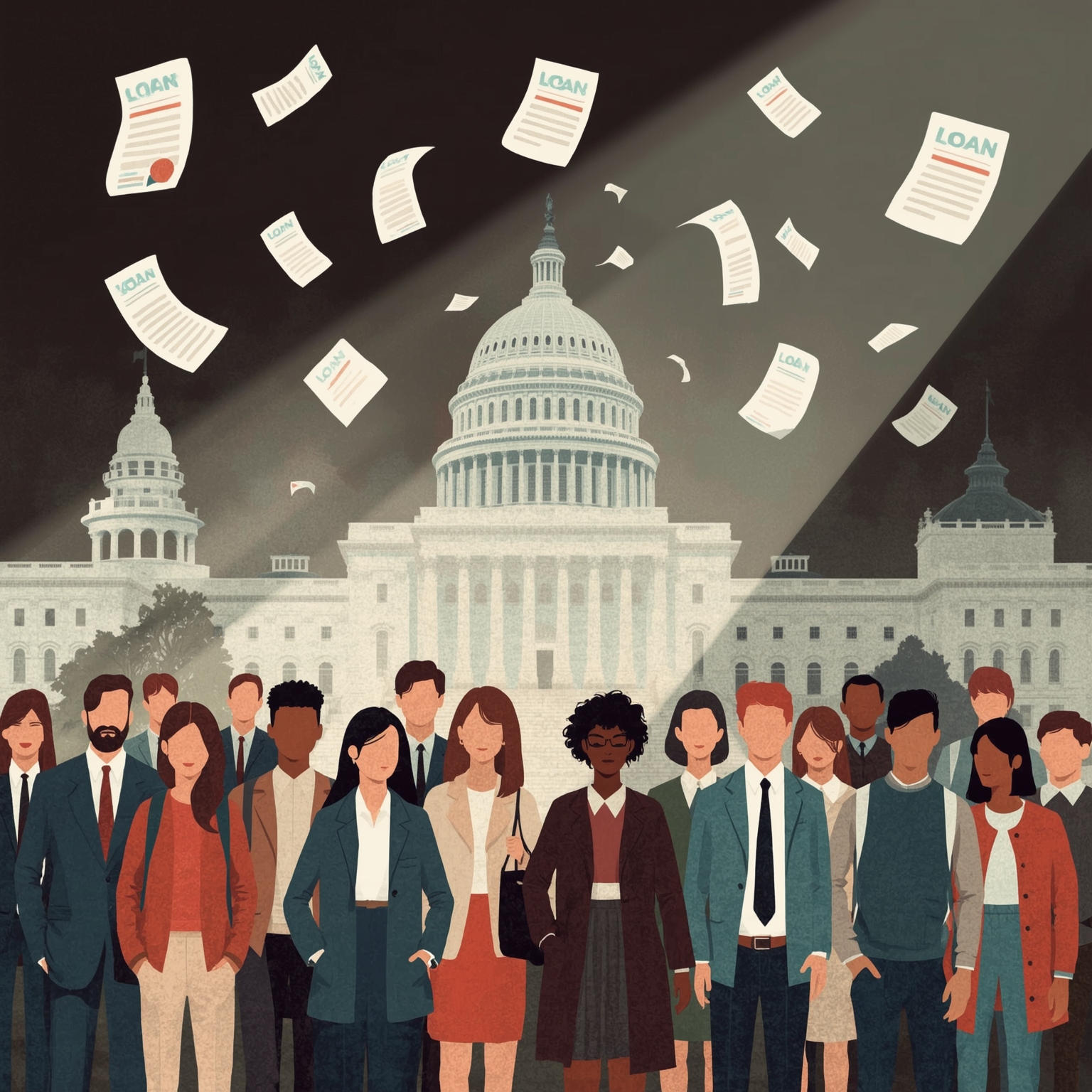
Eligibility for one of the federal government’s largest student loan forgiveness initiatives, designed explicitly for public servants, is being meaningfully curtailed. On October 30, the U.S. Department of Education, operating under President Donald Trump, announced the completion of a final regulatory rule that formally imposes new limitations on the Public Service Loan Forgiveness (PSLF) program. This long-standing initiative was originally created to allow individuals employed by government agencies and nonprofit organizations to have the remaining balance of their federal student loans forgiven after ten years of qualifying monthly payments. The new rule, however, implements stricter eligibility conditions that narrow the scope of what types of public service employment qualify for debt relief.
The policy announcement fulfills a directive contained in an executive order that President Trump signed earlier in March, which directed the Department of Education to redefine the very meaning of “public service.” This redefinition aims to ensure that only organizations whose missions and operations are in harmony with the administration’s interpretation of lawful conduct and the public good remain eligible. Under this new approach, employers whose services or practices are considered inconsistent with the administration’s policy objectives—particularly those engaged in contentious or politically sensitive activities—will find themselves barred from PSLF participation.
Undersecretary of Education Nicholas Kent elaborated on the rationale behind the decision, stating that the Public Service Loan Forgiveness program was never intended to subsidize organizations involved in unlawful or controversial undertakings. According to Kent, PSLF was designed to reward and sustain Americans who commit their professional lives to serving the public interest, rather than support institutions engaging in what the department characterizes as violations of the law—such as harboring undocumented immigrants or performing medical procedures deemed impermissible under federal guidelines, particularly those involving gender transitions for minors.
The announcement has provoked considerable backlash from advocacy organizations and borrower protection groups. Representatives from Democracy Forward and Protect Borrowers issued a joint statement condemning the new regulation as an unlawful and direct assault on workers in public service professions, including nurses, educators, first responders, and other essential employees. They argued that this change dismantles years of progress toward loan relief for those who serve their communities. The organizations further indicated their intent to initiate litigation against the administration to prevent the rule from taking effect, emphasizing that they expect to challenge the Trump-Vance administration in court in the near future.
According to the Department of Education, the regulation is officially scheduled to become effective on July 1, 2026. Borrowers currently enrolled in or pursuing qualification for PSLF are strongly advised to review their employment status and verify whether their organizations may be affected. The department also encourages individuals with experiences or concerns regarding PSLF eligibility or student loan challenges to contact the reporter overseeing this issue at asheffey@businessinsider.com.
In practical terms, the central alteration introduced by the rule concerns a fundamental change to the definition of a “qualifying employer.” Previously, a qualifying employer included virtually any government entity—federal, state, local, or tribal—as well as nonprofit organizations. Under the newly finalized language, however, the Department of Education will explicitly exclude from PSLF eligibility any organizations determined to have a “substantial illegal purpose.” This phrase encompasses entities that the department believes engage in or support actions deemed inconsistent with state or federal law. Examples cited include organizations allegedly involved in terrorist support activities, those working with or assisting undocumented immigrants, entities helping transgender individuals undergo gender transition procedures, or employers that recurrently violate state legal provisions.
A departmental fact sheet accompanying the rule explains that an organization will be viewed as having a substantial illegal purpose when a significant portion of its ongoing activities is dedicated to or dependent upon illegal conduct. The reasoning behind this interpretation is that actions characterized as unlawful inherently conflict with the concept of serving the public interest. At the same time, the department emphasized that employers operating within the bounds of the law, or those with only minor compliance issues that do not rise to the level of a pattern of illegality, will remain eligible to participate in the PSLF program without penalty.
Determining whether an organization meets the threshold for disqualification will fall under the authority of the education secretary, who is tasked with assessing evidence of illegality in each case. Employers flagged for review will be formally notified of the allegations and provided an opportunity to examine and respond to the department’s findings before a final decision is reached. In addition, employees—namely, loan borrowers working for those organizations—will receive notice that their employer’s eligibility status is under scrutiny and could potentially affect their progress toward loan forgiveness. The Department of Education plans to update the PSLF Help Tool, an online resource used to identify qualifying employers, to display pending determinations and ensure transparency during the review process.
If an employer is ultimately deemed ineligible for PSLF participation, the fact sheet outlines two possible courses of action. First, the employer may be allowed to reapply for qualification after a ten-year period. Alternatively, before disqualification is finalized, the organization can undertake a “corrective action plan,” designed to rectify the issues leading to its ineligibility and thereby maintain access to PSLF for its employees. Borrowers themselves, however, will not be permitted to independently appeal their employer’s disqualification—a rule that underscores how employer eligibility directly determines borrower access.
For current PSLF participants, any payments made after July 1, 2026, to an employer that has lost eligibility will cease to count toward progress in the forgiveness program. However, the Department of Education has clarified that past qualifying payments, made before that date while the employer still met program requirements, will remain valid and will not be retroactively canceled. In essence, while the new rule does not strip away prior progress toward forgiveness, it imposes a much tighter framework around future participation, reshaping who can justifiably claim to serve the public under the federal program’s reinterpreted standards.
Sourse: https://www.businessinsider.com/what-are-the-pslf-loan-forgiveness-changes-trump-debt-relief-2025-11


