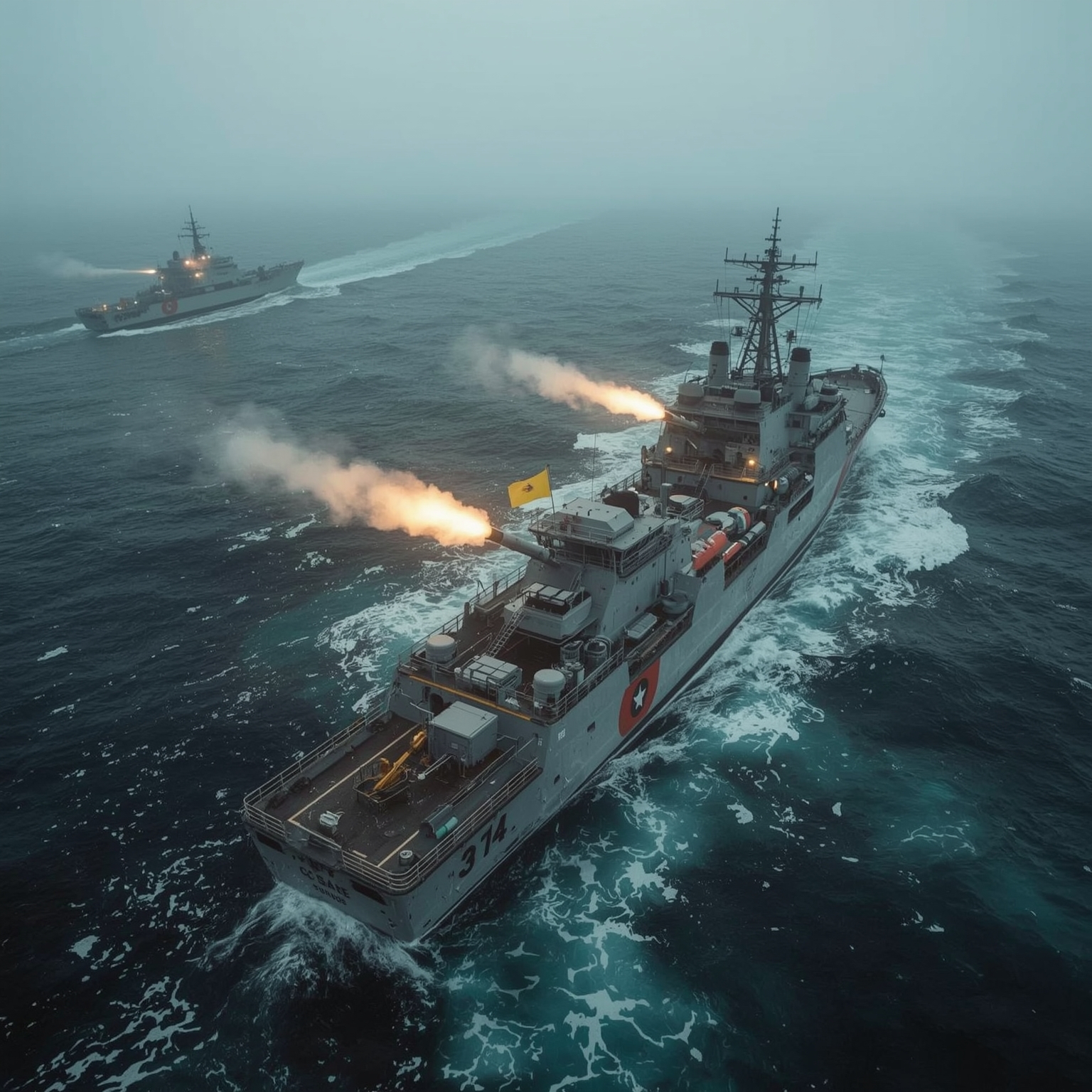
Recently released video recordings provide an unusually vivid glimpse into the range of weaponry, interdiction methods, and maritime tactics deployed by the China Coast Guard throughout the turbulent waters of the South China Sea. The images depict Chinese vessels employing high-pressure water cannons against their Philippine counterparts and even resorting to deliberate ramming maneuvers in an area already regarded as one of the world’s most fiercely contested maritime zones. These scenes underscore an intensifying struggle where territorial assertion, national pride, and the pursuit of maritime control intersect.
Over the past several years, the Philippine government has repeatedly and publicly accused China of pursuing increasingly assertive and confrontational measures directed against its official coast guard ships as well as ordinary Filipino fishermen. Manila contends that Beijing’s aim is to consolidate its claim over the South China Sea—a body of water of extraordinary geostrategic significance, abundant in natural resources such as fisheries and potential hydrocarbon reserves, and indispensable to global maritime trade routes linking East Asia to the rest of the world.
The most recent incident unfolded on a Sunday, when a flotilla of Philippine fishing and coast guard vessels operated near waters surrounding Pag-asa Island, also internationally known as Thitu Island. This small outpost, situated among the Spratly Islands to the west of Manila, remains one of the few areas in the archipelago consistently maintained under Philippine administrative control. During the operation, a number of Chinese coast guard and so-called maritime militia vessels entered the same sector. One of these ships discharged a concentrated water cannon blast toward a Philippine government vessel, and moments later, the same Chinese ship deliberately rammed the stern of the Philippine craft, leaving visible yet relatively minor structural damage. Despite the aggression, authorities confirmed that no personnel were harmed.
Jay Tarriela, the spokesperson for the Philippine Coast Guard, subsequently disseminated footage capturing these aggressive maritime exchanges through social media. He denounced the actions as “bullying tactics” emblematic of China’s broader pattern of coercion, while emphasizing that the Philippines would not yield to intimidation or abandon its rightful presence in waters it considers sovereign.
While Beijing’s use of water cannons against foreign vessels has been documented for years, these powerful weapons are far more than mere nuisances. Their immense hydraulic force can shatter equipment, disable navigation components, and even injure crew members. Combined with the persistent practice of ramming—a maneuver calculated to physically obstruct, intimidate, and occasionally incapacitate another vessel—such strategies communicate a clear message of dominance. In certain encounters, incidents have escalated further: Philippine officials have described some confrontations as tantamount to piracy, citing occasions when Chinese personnel were reportedly armed with bladed weapons. Other confrontations have involved the use of dazzlers, devices that temporarily blind, and acoustic systems designed to disorient crews through intense sound waves.
Despite being classified as actions within the so-called “gray zone”—forms of coercion that fall below the formal threshold of declared warfare—these encounters nevertheless pose grave dangers. Maneuvers such as ramming, blocking, or high-speed pursuit risk provoking disastrous accidents that could, whether through miscalculation or intent, inflict serious casualties. Indeed, even China’s own forces have at times paid the price of such belligerent tactics. One notable episode occurred in August, when a Chinese navy destroyer and a Chinese coast guard vessel, both engaged in a high-speed chase of a Philippine patrol boat near the Scarborough Shoal, collided catastrophically after the warship cut across the path of the smaller vessel. Recorded footage revealed the coast guard ship’s hull torn apart, evidencing the magnitude of the impact.
In the aftermath of the most recent clash, Chinese authorities sought to deflect responsibility, asserting that the Philippine vessel had intruded into waters claimed by China without authorization and had itself made an unsafe approach that resulted in what Beijing termed a mere “scrape.” China continues to reaffirm sweeping territorial claims covering the vast majority of the South China Sea—claims that have been repeatedly questioned by international legal rulings and by neighboring states with overlapping interests.
China’s maritime frictions have not been limited to the Philippines alone. Its coast guard and military units have also engaged in tense interactions with other regional navies and air forces operating within the same contested airspace and sea lanes. Nevertheless, the Chinese government consistently dismisses complaints of aggression, insisting that its patrols and enforcement actions are entirely justified under domestic law and necessary to safeguard what it regards as its sovereign territory and maritime rights. These ongoing and often hazardous confrontations continue to heighten tensions in one of the world’s most critical maritime crossroads, perpetuating the risk that a single misjudgment could ignite a broader regional crisis.
Sourse: https://www.businessinsider.com/video-shows-china-spraying-water-cannons-ramming-philippine-ships-2025-10