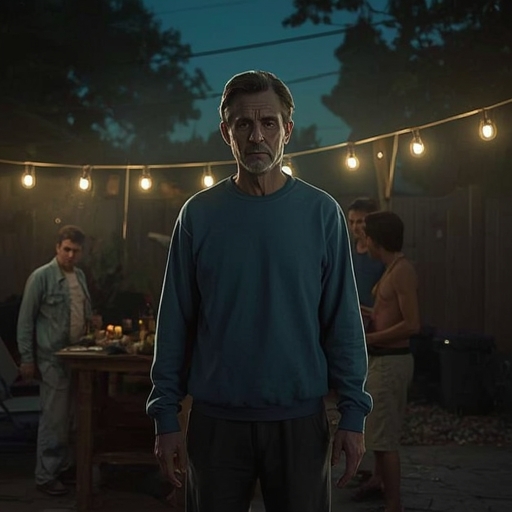
Park Chan-wook’s twelfth full-length cinematic achievement, *No Other Choice,* unfolds with deliberate precision, introducing the audience to Man-su (portrayed by Lee Byung-hun), a man at the peak of his domestic stability, reigning as a self-assured patriarch presiding over a family barbecue. The opening tableau radiates warmth and order—an almost idealized depiction of middle-class tranquility—that becomes the emotional and thematic anchor of the film. It is this vision of contentment and control, so seemingly attainable yet so precarious, that Man-su will spend the rest of the story striving, and ultimately failing, to defend.
As the narrative progresses into the long, meandering midsection—the portion of life where routine and reality intersect—Park constructs a delicate equilibrium between humor and heartbreak. The film delivers laughter and tears in near equal measure while exposing the deep fissures of a society obsessed with productivity, ambition, and survival. And, woven through these tonal contrasts, lies violence—unexpected, disturbing, yet presented with a darkly absurd logic. When Man-su loses his position at a paper company, his composure shatters. Confronted with the terror of redundancy, he determines that the only viable path to employment lies in eliminating, quite literally, his competition: three equally qualified candidates standing between him and the security he so desperately craves.
Based on Donald Westlake’s novel *The Ax,* Park’s adaptation transforms this sardonic premise into a meditation on contemporary economic despair. The film captures, with unsettling delight and catharsis, the ceaseless anxiety of existing within a capitalist system predicated on turning human labor into surplus profit. Park interrogates the cruel paradox at the heart of that system: when a corporation erases a worker from its payroll, it is labeled efficiency; when an individual commits a parallel act of erasure, it becomes criminal.
In *No Other Choice,* as in his earlier works such as *Oldboy* and *The Handmaiden,* Park demonstrates his acute understanding that tragedy and comedy are not mutually exclusive but inextricable. Life, he suggests, is inherently tragic because it must be endured, because we are compelled to work and to define our worth through that work. Yet this tragedy constantly borders on farce—the comedy of watching one bewildered man attempt to solve an existential riddle with increasingly misguided determination. Through Man-su’s struggle, Park distills the absurdity of human perseverance in a world that renders that perseverance meaningless.
In an interview with *The Verge,* the director reflects on his career and creative process. When asked whether he had ever been dismissed from a job, Park humbly admits he has been fortunate not to experience such professional rejection firsthand, though he has lived under its perpetual shadow. The film industry, he explains, is steeped in uncertainty; disagreements with studios and producers arise frequently, and each time he insists on maintaining his vision, he risks alienation or dismissal. Even after a film is completed, a director remains haunted by fears of failure—by anxieties that poor box office performance might foreclose future opportunities. For Park, this fear is not episodic but constant, accompanying him from initial concept through production and release, sharpening painfully if the project falters commercially.
Discussing his introduction to Westlake’s work, Park recounts how his admiration for John Boorman’s *Point Blank*—his favorite noir—led him to discover *The Ax.* His love for both Boorman and the lead actor, Lee Marvin, fueled his curiosity. Yet, in Korea, access to such films was once difficult, which made finally watching the movie a small triumph. The discovery that *The Ax* had been translated into Korean proved equally rare, given the scarcity of Westlake works available in the language. That serendipitous translation opened a creative path that would occupy Park for more than sixteen years.
Originally, he envisioned adapting the story as an American production, believing that the novel’s setting necessitated that context. By then, he had already directed acclaimed films such as *Oldboy,* *Thirst,* *Lady Vengeance,* and *Stoker,* and felt both artistically and logistically prepared to approach Hollywood. In 2010, after acquiring adaptation rights, Park and his team began pursuing financing, even engaging French investors through producer Michèle Ray-Gavras, whose connections spanned Europe and the United States. However, the journey was stalled by creative disagreements and financial limitations; every offer fell short of his desired conditions.
Studio feedback often betrayed skepticism. Many questioned whether audiences would credibly accept the premise of a man turning to murder simply because he lost his job. How, they asked, could such an extreme response remain believable—or sympathetic? This doubt persisted through development, complicated by differing cultural sensibilities toward humor and morality. What one reader deemed slyly funny, another found uncomfortably dark. Park and his collaborators faced repeated challenges in maintaining the tonal balance that defines the film’s distinctive tragicomic rhythm.
On a more personal note, the filmmaker reveals his meticulous attention to detail, describing how props and set pieces—such as an oven mitt featured in a key sequence or a Christmas stocking later appearing in a family photograph—were intentionally placed to create narrative continuity. These are not mere “Easter eggs,” he insists, but devices for immersive realism, allowing actors to inhabit a world that feels convincingly lived-in. Even unseen details, like a specially staged family portrait in Santa costumes, contribute to the authenticity that allows performers to merge more completely with their characters.
When asked about the film’s late incorporation of artificial intelligence, Park explains that the concept only emerged because production had been delayed for so long. Had the film been made earlier as an American project, this theme might never have arisen. In today’s climate, however, ignoring the encroachment of AI upon labor and creativity would have seemed disingenuous. The inclusion of AI, he explains, acts as a poetic counterpoint to Man-su’s futile struggle: after painstakingly eliminating his human competitors, the protagonist finds himself replaced by a force far more efficient and impersonal than any individual—a machine. Thus, the film concludes with cruel irony, underlining how every violent act undertaken in the name of survival ultimately leads to obsolescence. The notion that his sacrifices amount to nothing resonates both as tragic and absurd, a mirror of the film’s central tension between fate and futility.
When conversation shifts to AI’s role in filmmaking, Park expresses firm skepticism. He hopes never to rely on artificial intelligence in creative work, emphasizing that cinema’s power lies in its human imperfection—its reflection of authentic emotion and lived experience. Yet, he concedes, new technology democratizes opportunity: for aspiring filmmakers who lack resources, AI-assisted tools might open doors that were previously sealed shut. His ambivalence reflects both the ethical and existential dilemmas animating his film.
Turning to the thematic heart of *No Other Choice,* Park articulates the moral question that undergirds the narrative: for those who have clawed their way into the middle class, surrendering that hard-earned status is nearly unthinkable. The fear of downward mobility—of losing the comforts and identities intertwined with financial stability—can drive otherwise ordinary people to desperate extremes. He uses an example both mundane and heartbreaking: the belief that a child’s private cello lessons are a necessary investment in their future autonomy. To give that up feels, for someone like Man-su, equivalent to betraying his parental duty or self-definition. Park invites viewers not to condemn but to empathize, to confront the uncomfortable inquiry: under comparable pressures, how far might *we* go?
Reflecting on his own career, Park identifies his most difficult period as the years following his first two commercial failures, before the success of *Joint Security Area (JSA)*. During that time, he was forced to shop his scripts from studio to studio, facing rejection after rejection—an experience mirroring Man-su’s job hunt. Newly married and financially burdened, he turned to film criticism to make ends meet. Though intellectually fulfilling, the occupation was spiritually dispiriting. Watching masterful films filled him with envy, as each reminded him of the art he longed to create but could not. He describes this chapter of life as a form of torment—survival tinged with humiliation—yet it also steeled his resolve to persevere.
Looking ahead, Park reveals he already has two new projects in development: a Western, whose script has undergone multiple revisions, and a science-fiction action feature for which he has drafted a detailed treatment. Between productions, he restores himself in simple ways—sharing good wine with his friend and collaborator Lee Byung-hun, whose seriousness about vintages ensures their conversations flow as richly as their glasses.
Finally, Park offers contemplative advice to emerging filmmakers. Film school may impart technique and theories, and mentors may share personal wisdom, but these are secondary to the artist’s inner voice. Authentic creativity, he argues, arises from an unfiltered honesty with oneself. Aspiring directors must resist the temptation to chase trends or mimic popular success. Instead, they should identify what compels them instinctively—the stories born from their own truths—and follow that impulse wherever it leads, even when it defies convention. True spontaneity, he insists, is the lifeblood of great cinema. Yet he acknowledges, with characteristic humility, that speaking such wisdom is the easy part; living by it remains the most exacting challenge.
*No Other Choice* will open in select theaters on December 25, 2025, before expanding to a wider release in January. The film, like its maker, invites both laughter and reflection—a cinematic confrontation with the contradictions of modern existence and the quiet, relentless tragedy of trying to preserve the life we believe we deserve.
Sourse: https://www.theverge.com/entertainment/847424/park-chan-wook-no-other-choice-interview