On Sunday, North Korea presented a newly developed air-launched weapon that immediately drew international attention for its striking resemblance to Western-manufactured cruise missiles, with particular similarities to the German-Swedish Taurus system. Although this unveiling emphasized the visual and structural likeness of the missile to advanced Western models, it is important to note that Pyongyang has released no verified information regarding the missile’s technical specifications, operational range, or combat capabilities. The absence of such data leaves open numerous questions about whether the system represents a genuine leap in North Korean aerospace engineering or merely a symbolic demonstration intended to convey technological parity.
Should this weapon indeed possess the functional sophistication of a modern cruise missile, its introduction would mark a considerable evolution in North Korea’s aerial strike capacity. Such a platform could dramatically expand the effective combat range of the nation’s aging Su-25 Grach attack aircraft, potentially enabling them to conduct precision strikes on strategically significant facilities while keeping their pilots safely beyond the reach of sophisticated air defense systems operated by the United States and South Korea. The strategic value of such an enhancement cannot be overstated: it would transform a fleet of aircraft once thought limited to close-support missions into potential long-range strike assets.
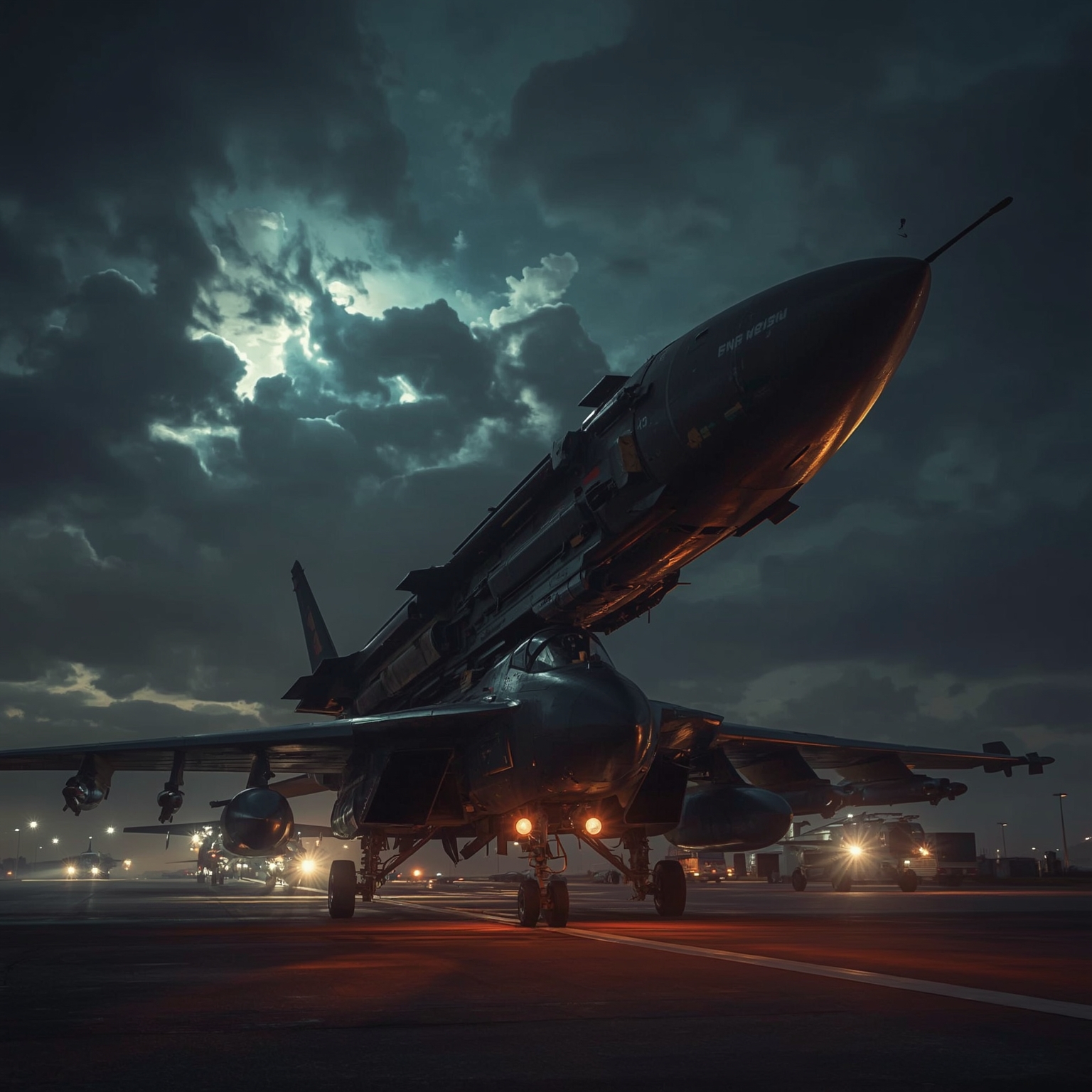
Photographs published by state media captured the scene at Kalma Airfield, where the presentation took place in conjunction with a ceremony commemorating the eightieth anniversary of North Korea’s air force. In these official images, leader Kim Jong Un can be seen touring the facility, shaking hands with military officers, and examining the displayed weaponry. Behind him, the newly revealed missile is visible mounted beneath the wing of a Sukhoi Su-25—an aging Soviet-era aircraft that has long served as the backbone of Pyongyang’s attack fleet. The deliberate placement of this unfamiliar weapon in proximity to Kim suggests it was intentionally highlighted to underscore the nation’s purported advancements in air-delivered munitions.
Further imagery, including annotated analysis from Business Insider, provides an even clearer view of the missile both attached to and dismounted from the Su-25. The weapon’s long, rectangular form factor closely mirrors the design features of several well-known cruise missiles in Western arsenals—among them the Taurus KEPD 350, the British-French Storm Shadow, and the American-made Anduril Barracuda 500M. In concept, a cruise missile of this nature is engineered to penetrate heavily fortified structures using a substantial explosive payload while maintaining low-altitude, jet-powered flight paths within the Earth’s atmosphere to avoid radar detection.
Russia, a nation that has in recent years cultivated increasingly close military cooperation with Pyongyang, maintains within its own arsenal the Kh-59 Mk2, a system whose external configuration bears notable similarity to the missile unveiled at Kalma. Nonetheless, careful observation reveals that the North Korean model does not entirely replicate any specific foreign design. One distinguishing characteristic stands out—the presence of what appears to be a circular sensor or optical seeker embedded in the nose section, protruding slightly in a fashion reminiscent of the Taurus. This feature may serve as a targeting mechanism, though its actual function remains speculative.
The comparison is particularly relevant given that South Korea itself operates the Taurus system aboard its advanced F-15K Strike Eagle fighters. The Taurus, officially capable of ranges near 300 miles, is optimized for the neutralization of deeply buried or reinforced enemy targets, including bunkers and underground command installations. Its long reach allows the South Korean Air Force to initiate precision strikes on Northern infrastructure while maintaining aircraft well within its own territory—an essential advantage in the event of high-intensity conflict. Other comparable munitions such as the Storm Shadow and Russia’s Kh-59 Mk2 are believed to possess broadly similar range profiles, although export variants reportedly fall short, limited to roughly 155 and 180 miles respectively.
If North Korea has indeed succeeded in developing a weapon approximating these standards, the implications are far-reaching. Such capability would represent a substantial leap in both technological sophistication and deterrence power for an air force historically dependent on older, short-range systems. Until now, Pyongyang’s Su-25s have been largely regarded as platforms restricted to low-level attack missions—providing close air support to ground troops and performing limited tactical bombing operations. The emergence of a viable air-launched cruise missile could effectively redefine their strategic role.
However, the question remains whether North Korea truly possesses the industrial base, technological infrastructure, and scientific expertise necessary to design and manufacture an indigenous air-launched cruise missile. To date, there exists no public evidence confirming a successful test flight of the weapon, leaving open the possibility that the showcased missile may represent a nonfunctional prototype or even a deliberate deception intended to project military strength.
Western, Ukrainian, and South Korean authorities have raised persistent concerns that Moscow has been facilitating the transfer of advanced military knowledge, design data, and engineering expertise to Pyongyang. In exchange, according to numerous reports, North Korea has been supplying artillery ammunition, missiles, and potentially even combat personnel to support Russia’s continued military operations in Ukraine. This exchange, if ongoing, could dramatically accelerate North Korea’s ability to close the gap with technologically superior armed forces in the region.
Seoul, in particular, views this deepening partnership with alarm. South Korean officials have repeatedly emphasized the danger of Pyongyang gaining access to cutting-edge technologies that could enhance its weapons range, accuracy, and survivability. The timing of these developments is especially worrying amid a period of rapidly escalating tensions and renewed military demonstrations by both Koreas.
During the air force commemoration ceremony, which North Korean state media later clarified had occurred on Friday, Kim Jong Un inspected a comprehensive display of the nation’s aerial inventory. This included MiG-29 fighter jets, reconnaissance and strike-capable drones, and various mobile ground-based missile launching systems. Accompanying the leader was his daughter, Kim Ju Ae, whose frequent public appearances have fueled speculation that she is being groomed to eventually assume a leadership role within the regime.
Inquiries directed to Saab, the Swedish aerospace company that co-develops the Taurus alongside European defense consortium MBDA, were met with a standard response: Saab declined to comment on the military capacities of foreign governments. MBDA, reached outside normal business hours, did not issue a statement. Their silence reinforces an atmosphere of guarded observation as international analysts continue to debate whether North Korea’s newly unveiled missile represents a tangible strategic breakthrough or a carefully orchestrated display of illusion crafted for geopolitical effect.
Sourse: https://www.businessinsider.com/north-korea-new-cruise-missile-kim-jong-un-su-25-2025-12