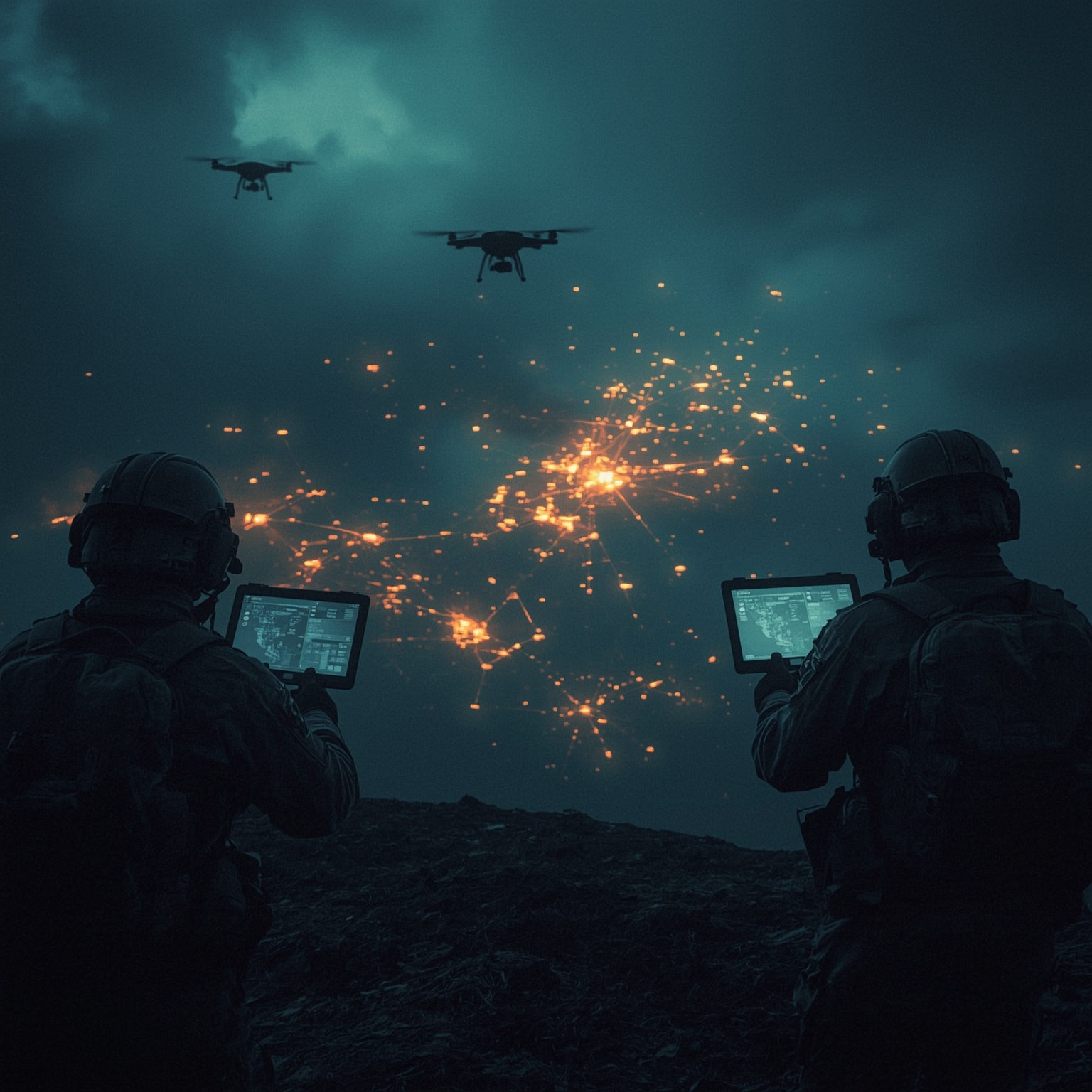
Ukrainian officials announced on Thursday that military personnel from North Korea are now operating drones in service of Russian forces and assisting in directing strikes on Ukrainian targets. This revelation, delivered as part of Kyiv’s latest intelligence briefing, provides expanded insight into Pyongyang’s concrete role in the ongoing conflict. The details suggest that North Korea’s participation has evolved from the mere supply of matériel to a direct operational contribution on the battlefield.
According to the Ukrainian military’s statement, North Korean troops have been actively deployed within Russia’s Kursk region — a strategically significant area that became the center of attention following Ukraine’s unexpected cross‑border assault in August 2024. That offensive momentarily disrupted Russian control over several key territories. In response, Pyongyang allegedly dispatched soldiers a few months later to assist Moscow in countering these Ukrainian incursions and stabilizing the defensive lines. Their arrival marked a notable intensification of the bilateral military relationship between Russia and North Korea, both of which remain isolated from much of the international community due to extensive Western sanctions.
From their positions in the Kursk region, the North Korean contingents have reportedly been engaging in drone‑based reconnaissance operations across the frontier, particularly targeting Ukraine’s adjacent Sumy region. These aerial missions, conducted with relatively inexpensive but effective quadcopters, are said to focus on identifying Ukrainian troop concentrations, logistical hubs, and artillery emplacements. Once these positions are confirmed, Russian units follow up with coordinated precision strikes. Ukrainian intelligence described these missions as part of a deliberate and organized effort to enhance the lethality of Russian firepower through real‑time targeting data supplied by foreign operators.
In a communication shared through the Telegram platform, Kyiv claimed to have intercepted audio and digital transmissions between North Korean drone pilots and elements of the Russian military. These intercepted exchanges allegedly capture drone operators relaying coordinates and making rapid adjustments to the trajectories of multiple launch rocket systems aimed at Ukrainian defensive positions. Ukrainian authorities also released video evidence purporting to show a North Korean soldier crouching beside an array of first‑person‑view (FPV) drones — compact quadcopters capable of both surveillance and suicide‑style strike missions that have become a ubiquitous hallmark of modern warfare.
When approached for comment about these developments, neither the Russian Ministry of Defense nor Russia’s embassy in Washington provided an immediate response. This silence leaves several key questions unanswered, including how long North Korean specialists have been engaged in supporting Russian operations on Ukrainian soil. President Volodymyr Zelenskyy recently asserted that Ukrainian forces had successfully thwarted a renewed Russian push in the Sumy region, but new findings suggest Pyongyang’s forces remain embedded in the area.
Earlier footage released by Ukraine’s General Staff depicted stacks of drones positioned beside uniformed individuals identified as North Korean soldiers. Ukrainian intelligence estimates that approximately 11,000 North Korean personnel were deployed to the Kursk area during the autumn of the previous year. Their objective was to reinforce Russian units and assist in reclaiming several hundred square miles of territory lost during Ukraine’s surprise offensive. This deployment represented one of North Korea’s largest overseas military ventures in decades.
Prior to its cooperation with Russia, Pyongyang possessed little to no combat experience in large‑scale modern warfare. Upon arrival, its troops reportedly underwent expedited training administered by Russian instructors, covering essential battlefield disciplines such as unmanned aerial systems operation, artillery coordination, close‑quarters infantry tactics, and trench‑clearing procedures. Despite this instruction, many of these soldiers were assigned to execute some of the most perilous tasks along the front lines — roles that Ukrainian officials have harshly characterized as expendable assignments, describing the foreign fighters as little more than cannon fodder.
Western intelligence assessments earlier in the year suggested that thousands of North Korean soldiers have been killed or wounded in the course of fighting against Ukrainian forces. The latest intelligence update shared by Kyiv on Thursday indicates that Pyongyang’s role has shifted somewhat, becoming more logistical and reconnaissance‑oriented as Russian manpower continues to decline. According to the official statement, the Russian occupation command, facing severe personnel attrition and the failure of offensive operations in Sumy Oblast, has intensified its reliance on North Korean contingents to sustain active combat capabilities.
North Korean leader Kim Jong Un has publicly conceded that his nation’s forces have sustained casualties while operating in Russia, confirming the heavy human cost of their involvement. The preceding year’s deployment followed the signing of a formal mutual defense agreement between Moscow and Pyongyang — a treaty viewed internationally as evidence of the steadily tightening axis between the two states. Beyond deploying troops, North Korea has reportedly furnished Russia with missiles, artillery systems, and ammunition, further deepening military cooperation despite near‑universal condemnation from Western powers.
Ukraine has consistently maintained that any foreign entity participating in military aggression against its territory will be treated precisely as Russian combatants are. Ukrainian defense officials emphasized in Thursday’s statement that they are meticulously documenting every verifiable instance of foreign involvement in active hostilities. Their aim, they said, is to ensure accountability under international law and to neutralize hostile formations in accordance with the established laws and customs of war.
Meanwhile, Russia’s own armed forces continue to incur staggering losses in their prolonged campaign. Britain’s Ministry of Defence, in an update issued earlier this week, estimated that roughly 332,000 Russian soldiers had been killed or wounded since the beginning of this year alone. Taken together with cumulative figures from the early phases of the full‑scale invasion, total Russian casualties are now believed to exceed 1.1 million. These figures, paired with the deepening reliance on foreign allied troops like those from North Korea, underscore the increasingly desperate and complex nature of Russia’s war effort against Ukraine.
Sourse: https://www.businessinsider.com/north-koreans-fly-drones-for-russia-direct-strikes-in-ukraine-2025-10