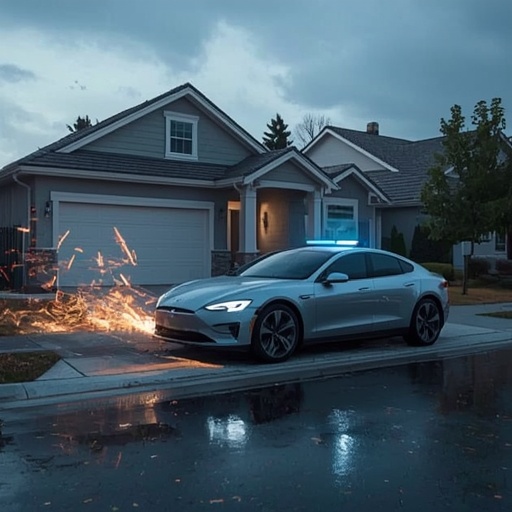
The National Transportation Safety Board (NTSB) has officially confirmed that the recent fatal Tesla crash in Texas was caused by deliberate driver action rather than a malfunction in the vehicle’s automated systems. According to the agency’s preliminary findings, the Tesla driver completely overrode the vehicle’s Full Self‑Driving (FSD) feature by forcefully pressing the accelerator pedal to its maximum capacity. This single act effectively disengaged the car’s autonomous safety protocols and placed full control of speed and movement back into human hands.
The report highlights the complex interplay between human behavior and emerging vehicle automation. Tesla’s Full Self‑Driving suite—though designed to assist drivers with advanced navigation, adaptive control, and accident avoidance—remains a semi‑autonomous system requiring active human supervision. The tragedy underscores that even the most sophisticated technology cannot counterbalance a moment of ill‑timed or reckless manual intervention.
In this case, the NTSB’s investigation makes clear that the vehicle itself responded as programmed: when the driver applied full throttle, the system correctly yielded to human authority. Unfortunately, that decision to accelerate at full force had catastrophic consequences. The findings emphasize an increasingly urgent truth—no matter how advanced autonomous driving platforms become, they function as cooperative systems, not replacements for fully engaged human judgment.
Transportation analysts suggest that the incident serves as a sobering case study in the psychology of trust between humans and machines. As automotive automation continues to evolve—from driver‑assist tools to self‑learning navigation networks—the boundary between safe reliance and overconfidence can blur dangerously. For instance, drivers accustomed to automated convenience features may subconsciously underestimate their obligation to remain alert. When that happens, even intelligent software designed to prevent accidents can be rendered powerless by a single human decision.
This event also reinforces the ethical and regulatory discourse surrounding technology’s role in mobility. While innovation promises safer, more efficient roads, it cannot eliminate the need for personal accountability. Engineers can implement layers of redundancy, fail‑safes, and predictive algorithms, but these innovations presuppose rational participation by the driver. Thus, the NTSB’s findings remind both manufacturers and consumers that automation enhances driving safety only when partnered with disciplined, mindful human oversight.
In summary, the Texas crash reveals a painful paradox within modern automotive progress: technology can save lives, yet it can also magnify the consequences of poor human judgment. The NTSB’s conclusion—that the driver fully depressed the accelerator and thus nullified the car’s Full Self‑Driving safeguards—illustrates that advanced systems are not infallible guardians. They remain tools, powerful but dependent on responsible hands. As the industry moves closer to full autonomy, this tragedy reiterates that technological potential alone cannot sustain safety; human responsibility must always remain the ultimate governor of the road.
Sourse: https://www.theverge.com/transportation/966563/tesla-texas-crash-ntsb-investigation