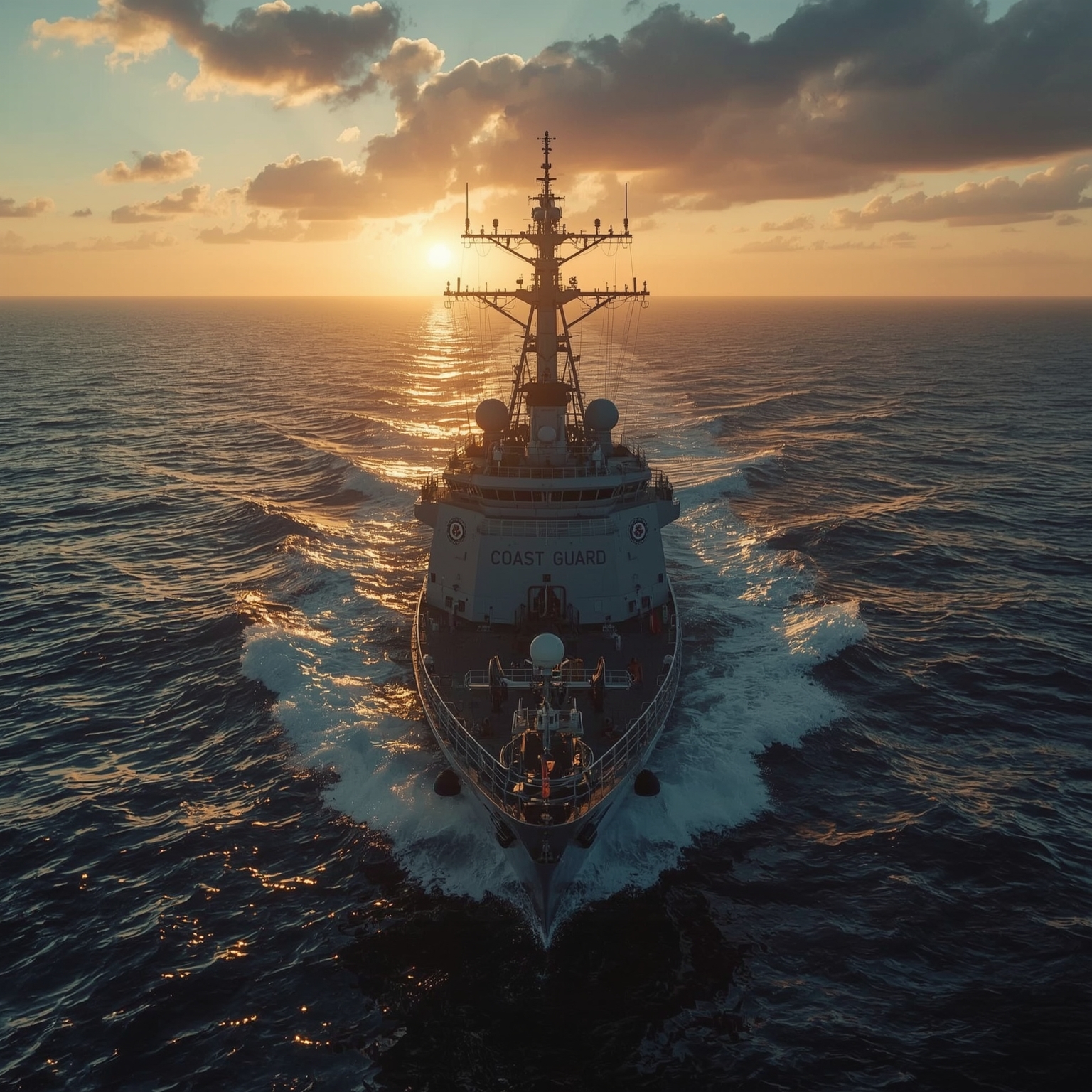
USCG HITRON JACKSONVILLE, Florida — The United States Coast Guard is intensifying its call for a larger and more capable operational force, urging the addition of new ships, expanded aircraft fleets, and enhanced personnel levels to keep pace with the unprecedented surge of narcotics headed toward American shores. Facing record-setting quantities of intercepted drugs, the service has found itself simultaneously celebrating remarkable successes and confronting the pressing need for greater capacity to maintain momentum.
In recent months, drug offloads from Coast Guard cutters have approached historic highs, ranking among the most substantial in the institution’s long record of maritime law enforcement. Senior leaders acknowledge that the trafficking of narcotics through key corridors in the eastern Pacific Ocean and the Caribbean Sea has continued to escalate. Cmdr. Chris Guy, commanding officer of the Coast Guard’s South Tactical Law Enforcement Team, described the situation succinctly: from a service standpoint, the Coast Guard requires more assets—particularly ships and aviation resources—to extend its operational reach. As Guy stressed, each additional vessel or aircraft directly translates into greater ability to disrupt and prevent the illicit flow of dangerous drugs into the United States.
That urgency was illustrated last week when the cutter *Stone*, a Legend-class National Security Cutter, docked at Port Everglades, Florida, to offload more than 49,000 pounds of cocaine valued above $362 million. The haul came at the conclusion of a demanding months-long deployment in the eastern Pacific that included fifteen separate interdictions—three of which astonishingly occurred within a single night. This operation represented the largest amount of cocaine ever seized by an individual Coast Guard vessel during one deployment, a milestone in a recent succession of record-breaking missions that highlight the enormity of the challenge.
For decades, the Coast Guard has served as the nation’s principal maritime counter-narcotics force, uniquely positioned to interdict drug shipments at sea before they approach the United States coastline. Yet the rapid growth of transnational criminal networks, coupled with increasingly sophisticated trafficking methods and larger quantities of contraband, has created mounting pressure on the service to modernize. In response, it has embarked on an aggressive campaign to strengthen its fleet, embrace cutting-edge technology, and recruit and train the next generation of maritime professionals to sustain this expanding mission.
This effort is encapsulated in the service’s Force Design Plan for 2028, endorsed earlier this year by U.S. Secretary of Homeland Security Kristi Noem. The blueprint calls for a major workforce expansion, procurement of additional ships and aircraft, comprehensive modernization of existing fleets, and significant investment in intelligence, surveillance, and reconnaissance (ISR) capabilities. Acting Commandant Adm. Kevin Lunday emphasized at the plan’s unveiling that it follows decades of chronic underinvestment and readiness challenges that have hindered full operational potential. Longstanding issues such as delayed shipbuilding projects, maintenance backlogs, and persistent recruiting and retention shortfalls—many of which have been documented by the Government Accountability Office—have all contributed to the strain.
Within this context, Coast Guard officials repeatedly underscore that enhanced ISR capacity lies at the heart of successful drug interdiction. Cmdr. Guy outlined precisely what the service requires to stay ahead of traffickers: more maritime patrol aircraft, continuous maritime surveillance, and sufficient surface vessels—whether Coast Guard cutters or Navy ships equipped with boarding teams—to carry out interdictions. He also highlighted the importance of decisive end-game assets such as high-speed pursuit boats and armed helicopters, both of which allow marksmen to disable fleeing vessels by targeting engines.
As implementation of the Force Design Plan continues, officials anticipate significant gains in combating the evolving narcotics threat. A convergence of factors has driven recent record interdictions: political instability in certain South American drug-producing regions, adaptive smuggling routes shaped by geography and law-enforcement patterns, and importantly, technological advances that now enable more effective detection of traffickers at sea. Among these innovations is the increasing deployment of uncrewed aerial systems like Shield AI’s MQ-35 V-BAT, which accompanied the *Stone* on its most recent mission. Operating primarily at night, these drones provided persistent airborne surveillance, dramatically improving the cutter’s ability to locate and shadow maritime targets.
Capt. Daniel Broadhurst, commanding officer of the Coast Guard’s Helicopter Interdiction Tactical Squadron, described these new systems as transformative. He emphasized that ISR—both advanced sensors and aerial platforms—constitutes the core enabler of every successful counter-drug operation. Consequently, expanding ISR availability on patrol ships, through improved onboard technology and integrated drone systems, has become one of the service’s foremost priorities.
This modernization push aligns with the federal government’s broader anti-narcotics agenda. Under President Donald Trump, stopping the influx of illegal drugs has been declared a national priority, with multiple agencies coordinating efforts across maritime and intelligence domains. The administration has taken a notably aggressive stance, even extending beyond traditional Coast Guard interdictions to employ limited military strikes against suspected traffickers in the Pacific and Caribbean regions—actions that have sparked debate due to their intensity and wartime undertones. National Intelligence Director Tulsi Gabbard, speaking aboard the *Stone*, noted that the president has embraced a comprehensive, “all-hands” approach to ensure every capable government entity contributes to fulfilling his commitment to making American communities safer.
Despite the heightened political focus, the Coast Guard continues to adhere to its established, lawful operational procedures, methodically executing interdictions that have produced remarkable results. Vice Adm. Nathan Moore, commander of the Coast Guard’s Atlantic Area, reaffirmed this dedication during the *Stone*’s latest offload, asserting that the service has truly accelerated its counter-narcotics operations. In the 2025 fiscal year alone, the Coast Guard seized nearly 510,000 pounds of cocaine—the greatest total in its history.
According to Coast Guard estimates, roughly eighty percent of all drugs bound for the United States are intercepted at sea, primarily in the eastern Pacific corridor. These narcotics typically travel aboard high-speed “go-fast” boats, disguised fishing vessels, or low-profile semi-submersibles. The increasing volume of seizures in recent years underscores not only the rising scale of these illicit networks but also the effectiveness and adaptability of Coast Guard operations. As Moore articulated, these numbers reflect the intensity, scope, and inherent danger of the evolving drug trade—a challenge that demands both unwavering vigilance and the sustained expansion of maritime capabilities to secure the nation’s waters against escalating threats.
Sourse: https://www.businessinsider.com/coast-guard-needs-more-ships-planes-people-keep-up-drugs-2025-11


