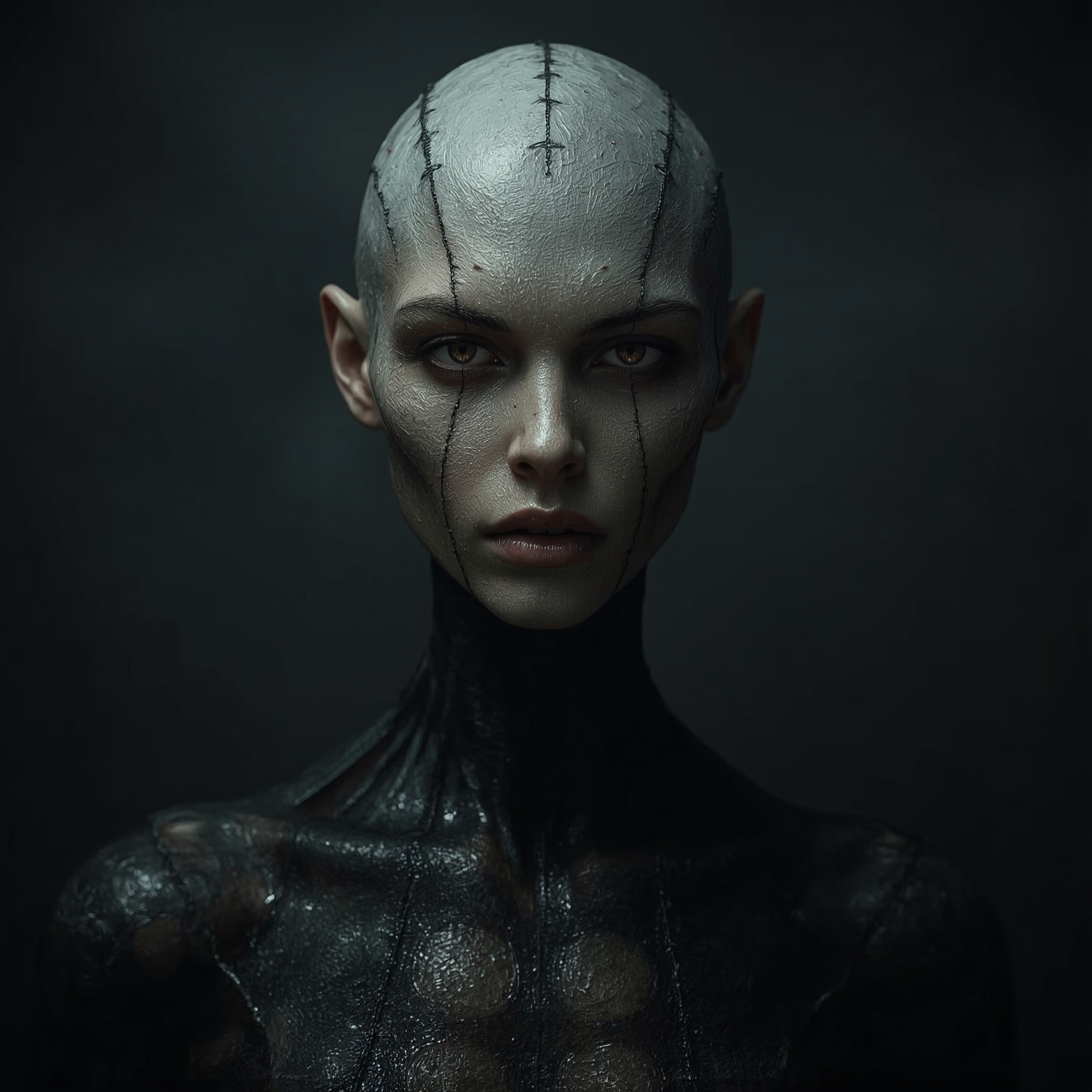
Nearly a full year ago—almost to the exact date—the buildup surrounding what would become 2024’s most feverishly discussed horror release, Robert Eggers’ adaptation of *Nosferatu*, remained shrouded in near-total mystery. The marketing campaign deliberately restrained itself, resisting the temptation to unveil Bill Skarsgård’s much-speculated portrayal of the mustachioed Count. Instead, audiences were enticed through secrecy, urged to experience the full cinematic revelation of his transformation only within the darkened confines of the theater. The restraint lent an air of mystique, evoking the vintage tradition of horror’s slow, tantalizing reveal.
Fast-forward to 2025, and the contrast could not be starker. The promotional team backing Guillermo del Toro’s eagerly awaited *Frankenstein* has opted for complete transparency—a striking pivot toward visual openness and bold anticipation. Without any trace of reticence, the campaign has released unapologetically detailed images of Jacob Elordi’s interpretation of the Creature, offering a generous, tantalizing preview long before the official premiere.
In a curated sequence of eye-catching posts disseminated via the film’s verified X/Twitter account, fans were treated to a full series of hauntingly atmospheric character portraits. Each member of the ensemble cast was unveiled in turn, their images emerging in the wake of Elordi’s imposing Creature, which dominated attention with its eerie magnetism. Prior to this digital unveiling, the audience’s only encounters with the character came from a few fleeting glimpses buried in trailers—brief shots shrouded in darkness, enhanced by a heavy cloak that both concealed and accentuated his physical presence. Even informal social media leaks, such as an image circulated by DiscussingFilm of Elordi warmly embracing his dog, offered little insight into his final form. His on-screen image evoked the pensive sensuality of Alexandre Cabanel’s *The Fallen Angel*, blending menace with tragic allure.
While *Nosferatu* had invited restraint and mystery, maintaining a tone of eerie subtlety, the online reaction to del Toro’s *Frankenstein* was instantly effusive and uninhibited. Commenters beneath the posts seemed entirely unafraid to articulate their admiration—or, in many cases, their unabashed infatuation—for the 6-foot-5 reanimated being. The discourse oscillated between playful thirst and more serious appreciation of Elordi’s physical transformation, a metamorphosis so intricate it bordered on the painterly.
For those shifting focus from Elordi’s striking presence to the craftsmanship underpinning it, *Variety* supplied detailed insight into the astonishing level of artistry involved. The publication revealed that del Toro’s set team employed an extraordinary total of 42 discrete prosthetic pieces to build the Creature’s assemblage, with 14 of those solely dedicated to the elaborate structure of his head and neck. The makeup process itself was a monumental feat: eight specialized artists labored for ten continuous hours each day to complete a single full-body application. Elordi had to undergo this transformation fifty separate times during production—a process demanding near-superhuman patience, endurance, and commitment. Put plainly, the Euphoria actor spent an immense portion of the production seated in the makeup chair, enduring a transformation that blurred the line between performance and physical ordeal.
As emphasized earlier, Elordi’s depiction was not the only character featured in this expansive social media promotion. Accompanying him were the other principal actors, whose personas lent further dimensionality to the ensemble: Oscar Isaac embodying the tortured genius Victor Frankenstein, Mia Goth as Elizabeth Harlander imbued with gothic melancholy, Christoph Waltz portraying the scholar Heinrich Harlander with chilling precision, and Felix Kammerer as the ill-fated William Frankenstein. Each portrait contributed its own tonal flavor—somber, reflective, or ferociously intense—collectively constructing a visual prelude to the film’s larger emotional architecture.
When *io9* published its critical review of *Frankenstein*, the verdict was overwhelmingly affirmative. The article hailed del Toro as an auteur at the zenith of his creative mastery, asserting that the film felt not merely like another project in his oeuvre, but rather a culmination—a work that embodied his lifelong artistic obsession. Even acknowledging minor shortcomings, the reviewer described it as a cinematic experience designed for enduring admiration, one that audiences would likely revisit with lasting appreciation for generations to come.
Currently, *Frankenstein* is screening in a carefully limited selection of theaters, with distribution planned to broaden steadily in the upcoming weeks. Following this initial theatrical rollout, the film is scheduled to make its streaming debut on Netflix on November 7, ensuring that its reach will expand from art-house cinemas to homes worldwide.
For viewers eager to remain engaged with evolving entertainment landscapes, *io9* encourages exploration across the broader cinematic universe. That includes keeping tabs on the forthcoming release schedules of *Marvel*, *Star Wars*, and *Star Trek*, tracking the direction of the reshaped DC film and television universe, and staying informed about the ever-unfolding narrative of *Doctor Who*. In essence, del Toro’s *Frankenstein* is not just another addition to the genre—it signals a new chapter in how myth, monstrosity, and human emotion intertwine on screen, reawakening our fascination with what it means to be both terrifying and profoundly alive.
Sourse: https://gizmodo.com/jacob-elordi-frankenstein-monster-creature-makeup-2000676850


