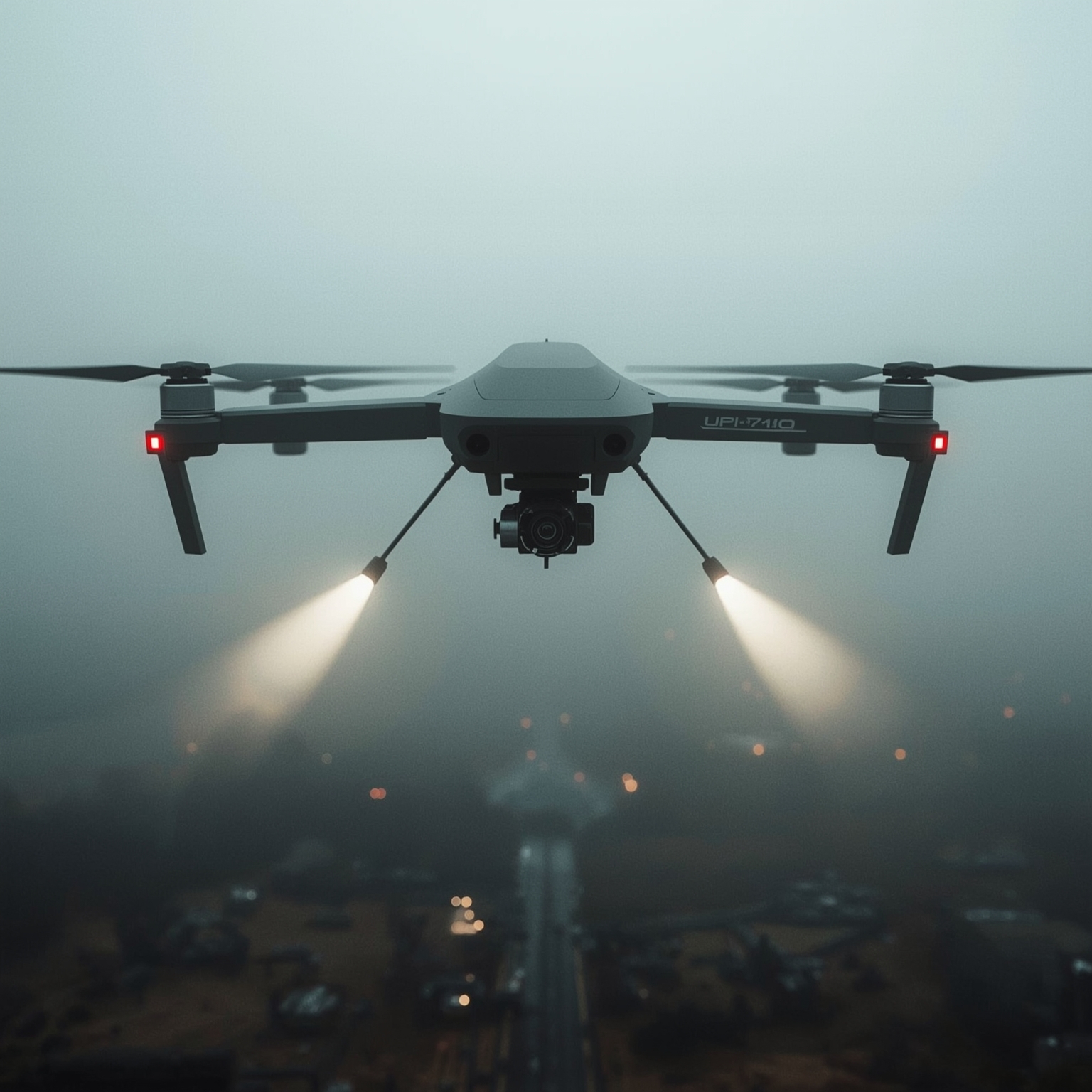
According to detailed assessments shared with Business Insider by senior defense officials, Russia has begun outfitting several of its Shahed-series attack drones with rear-facing cameras. This addition provides Russian drone operators with the crucial capability to visually monitor the airspace behind their unmanned aircraft, particularly to identify Ukrainian interceptor drones attempting to engage them from the rear. By gaining real-time situational awareness of these incoming threats, operators can take immediate evasive maneuvers, thus improving the drones’ chances of survival and mission completion.
Lt. Col. Yurii Myronenko, who currently serves as Ukraine’s Deputy Minister of Defense for Innovation and previously commanded a front-line drone unit, explained that Russia is continuously experimenting with and refining long-range strike assets. These initiatives encompass both upgrading the existing Iranian-designed Shahed-type drones—known for their cost-effectiveness and destructive payloads—and testing entirely new unmanned aerial platforms. Myronenko confirmed that a growing number of Shaheds have already been modified with rearward-directed visual systems, allowing them to detect and quickly respond to interceptor drones launched by Ukrainian forces. He noted that such technical adaptations exemplify Moscow’s persistent efforts to evolve its arsenal in response to Ukrainian countermeasures.
Ukrainian troops have previously recovered downed Russian decoy and reconnaissance drones that also contain rear-oriented optical sensors, offering early evidence of this evolutionary design philosophy. Myronenko’s observation underscores how Russia’s drone manufacturers and defense planners are reacting to one of Kyiv’s most rapidly advancing air defense technologies: the interceptor drone. These hunter drones are specialized aircraft designed to track, chase, and neutralize incoming Shaheds before they can inflict damage on Ukrainian infrastructure or civilian targets.
Over the past year, Russia has invested heavily in expanding and industrializing its drone warfare programs. Its defense industry continues to mass-produce thousands of Shahed replicas every month, drawing upon the original Iranian blueprints yet incorporating domestic modifications. Hundreds of these loitering munitions are regularly launched in nighttime raids against Ukrainian cities and critical facilities, creating waves of small, persistent aerial assaults that challenge even sophisticated air defense networks.
In response, Ukraine has intensified its reliance on low-cost interceptor drones, a pragmatic solution to offset Russia’s numerical advantage. Though relatively inexpensive to build, these drones have proven highly effective at hunting down the slower, explosively armed Shaheds. Each Shahed typically carries a warhead capable of causing significant destruction should it reach populated areas or strategic installations. By deploying lightweight, agile interceptors, Ukraine has been able to significantly alleviate the workload of its surface-to-air missile systems and other high-value anti-aircraft defenses, enabling them to focus on larger and more complex threats.
Ukraine’s escalating production capabilities now allow the country to manufacture hundreds of interceptor drones each day, reflecting the government’s prioritization of drone defense technologies. This industrial momentum has drawn attention from NATO members and Western defense corporations, who regard Ukraine’s combat-tested designs as valuable case studies and potential investment opportunities. These entities are observing how rapid prototyping, battlefield data sharing, and constant iterative redesign can transform aerial warfare in real time.
Western military experts have also taken close notice of Russia’s rear-camera adaptations. U.S. Army Sgt. Riley Hiner, speaking at a NATO conference held in Poland, confirmed that some Shahed-type drones now carry thermal imaging sensors on their aft sections. These sensors can track the heat signatures of pursuing interceptor drones, enhancing the drones’ ability to recognize threats even in low-visibility conditions. Hiner, who has helped train NATO allies on the use of Ukrainian-developed interceptor platforms that have logged thousands of combat engagements, explained that Russian drones occasionally attempt evasive maneuvers once they detect a pursuer. Consequently, interceptor drone pilots must continuously adjust their flight paths and velocities, navigating complex aerial battles where both machine and operator must predict the opponent’s next move.
The unfolding dynamic between Russian attackers and Ukrainian defenders illustrates what Ukrainian officials and Western analysts describe as a classic cycle of action and reaction — a relentless technological feedback loop seen in most prolonged conflicts. Each new advancement developed by one side sparks a swift adaptive response from the other. In the context of Ukraine, this cycle unfolds with remarkable speed, often within months rather than years, leading to near-continuous flux in tactical and operational methods.
As Myronenko aptly characterized it, modern military innovation has become a “cat-and-mouse game.” Every breakthrough confers a temporary advantage, typically lasting only three to four months, before opposing engineers devise an effective countermeasure. He cited earlier iterations of the Shahed drones that employed a basic four-channel antenna system. Ukrainian electronic warfare units rapidly identified ways to jam their control signals, forcing Russian engineers to upgrade the design. The newer models now utilize far more resilient sixteen-channel antennas, drastically increasing resistance to jamming and signal interference. This continual back-and-forth adaptation demonstrates that the contest over control of the electromagnetic spectrum is now just as critical as kinetic engagements.
This adaptive cycle has not limited itself to the Shahed program but has also extended across virtually every technological domain of the ongoing conflict. For example, the small first-person-view (FPV) quadcopters once used primarily for reconnaissance or small-scale kamikaze missions were initially reliant on traditional radio-frequency communication. Predictably, electronic warfare specialists on both sides soon became adept at disrupting those signals, temporarily compromising FPV effectiveness. In response, both Ukrainian and Russian engineers introduced systems connected by long spools of fiber-optic cable, linking drone operators directly to their craft. Because these fiber links are immune to radio jamming, they restored operational reliability and rendered these drones even more dangerous and precise on the battlefield.
A similar pattern of innovation and counter-innovation has occurred at sea. In the Black Sea theater, Ukraine developed unmanned naval drones capable of targeting and striking Russian warships at considerable distances. To counter this emerging menace, Moscow bolstered its aerial surveillance and patrol activity over key maritime approaches. Kyiv, unwilling to concede the advantage, subsequently armed its naval drones with small surface-to-air missile systems, designed to deter or eliminate Russian aircraft conducting low-level attacks against them. This rapid escalation of drone armament and defensive countermeasures epitomizes the accelerating technological arms race defining the modern Ukrainian conflict.
Overall, the integration of rear-view and thermal cameras into Russian Shahed drones and Ukraine’s swift evolution of interceptor capabilities both exemplify the essence of twenty-first-century warfare: a constant, rapid, and self-perpetuating technological struggle. Each side’s ability to learn, adapt, and immediately redeploy enhanced weapons determines short-lived advantages that vanish almost as quickly as they appear. The battlefield of Ukraine has thus become not only a contest of courage and resources but also a living laboratory of innovation, where every advancement immediately triggers its counterpoint and where progress itself has become the most contested terrain.
Sourse: https://www.businessinsider.com/russia-added-cameras-to-shahed-drones-to-see-ukrainian-interceptors-2025-11