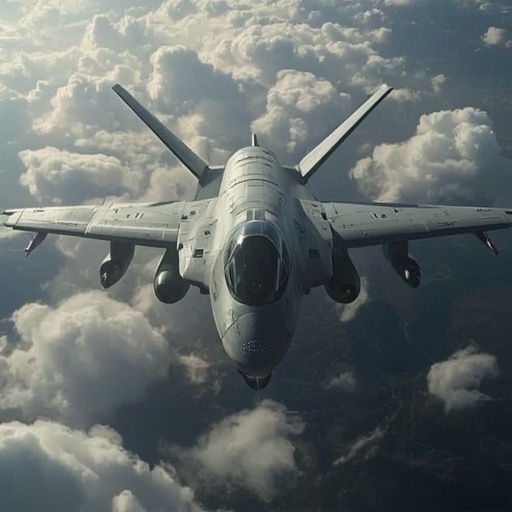
Russia’s strategic approach to drone warfare appears to be entering a transformative phase, signaling a major evolution in both the scale and sophistication of its aerial capabilities. Ukraine’s top military commander has disclosed that Moscow intends to make jet-powered Shahed drones account for roughly half of all forthcoming long-range strikes. This projected shift represents not merely a quantitative increase in drone usage but a qualitative leap toward faster, more versatile, and significantly more demanding weaponry.
Unlike their earlier propeller-driven counterparts, these new drones—equipped with compact turbojet engines—possess greater speed, range, and maneuverability. Such technical advantages make them substantially more difficult to track, intercept, or neutralize, even for experienced air defense systems. For Ukraine’s military, the challenge is immediate and multifaceted: defending critical infrastructure, urban centers, and troop positions against a wave of threats that travel faster, fly lower, and adapt more effectively to electronic countermeasures.
Until now, Ukraine’s layered defense network has relied heavily on radar-guided machine-gun fire and advanced signal-jamming technologies, both of which have been relatively successful against slower aerial targets. However, with the increasing emergence of jet-propelled platforms, this defensive framework faces unprecedented strain. The reaction time available to anti-aircraft units has shrunk dramatically, forcing strategic and technological reassessment. Every intercept has become a race against seconds, testing not only the efficiency of hardware but also the coordination and training of operators under pressure.
More broadly, this transition underscores an accelerating global trend: the integration of faster, partially autonomous, and cost-effective unmanned systems into conventional military doctrine. The battlefield is evolving into a complex ecosystem where agility and adaptability often determine survival. For Russia, the adoption of such drones may represent an effort to compensate for losses in traditional aviation or to overwhelm defenses through saturation tactics. For Ukraine, the need for innovation is equally pressing—requiring fresh investment in early-warning systems, adaptive interception algorithms, and enhanced cooperation with allies supplying defensive technology.
Beyond the immediate military implications, these developments carry symbolic and geopolitical weight. They illustrate how state-backed industries can rapidly iterate wartime technologies under pressure and how the distinction between strategic bombardment and autonomous warfare is fading. Moreover, the shift toward jet propulsion marks a decisive step in the weaponization of affordable drone production lines—a sign that the future of long-range combat will not be defined solely by aircraft or missiles but increasingly by swarms of intelligent, high-speed machines.
In essence, Russia’s move toward jet-powered Shaheds embodies the fierce technological competition transforming modern warfare. For Ukraine, meeting this challenge will demand a synthesis of tactical resilience, international collaboration, and relentless innovation in defense engineering. The skies over Eastern Europe are becoming a proving ground for the next generation of military drones, where speed, precision, and adaptability will dictate the outcome of tomorrow’s conflicts.
Sourse: https://www.businessinsider.com/russia-jet-powered-shahed-syrskyi-long-range-50-drone-attack-2026-6