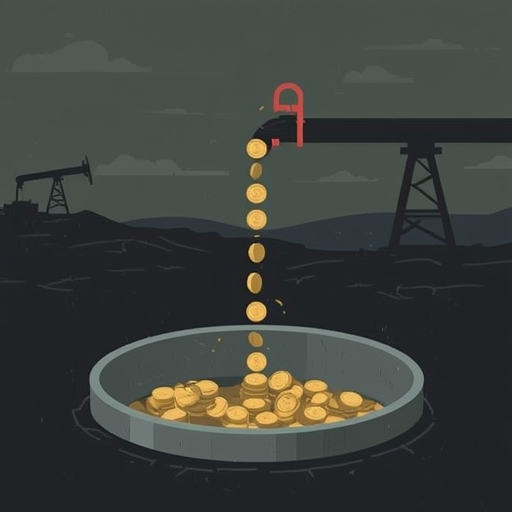
According to a recent and comprehensive analysis conducted by Goldman Sachs, Russia’s major oil producers are continuing to move almost the same volume of crude exports as before, even after the United States Treasury Department implemented stringent sanctions against the nation’s largest energy giants. Yet, despite the apparent stability in physical shipments, the financial returns from these exports are deteriorating at an alarming pace, signaling a deepening strain on the country’s energy revenue base.
At the end of October, the U.S. Treasury announced a new round of sanctions aimed at Russia’s two most influential oil producers — Lukoil and Rosneft. These firms represent the cornerstone of Russia’s energy sector, and the restrictions led to a sharp and immediate reaction in their maritime export activities. In the weeks following the policy change, seaborne deliveries from the two sanctioned companies plunged by approximately 42%, declining to nearly 1.7 million barrels per day. Such a dramatic decrease might have suggested a corresponding drop in Russia’s overall oil exports; however, the broader data tells a more nuanced story.
In reality, once the sanctions were introduced, Russia’s total crude oil exports declined by only about 100,000 barrels per day — a remarkably modest reduction given the severity of the measures. This discrepancy reveals that Moscow’s oil industry swiftly adapted to the constraints, redirecting a substantial portion of its shipments through smaller, non-sanctioned producers and intermediaries. Goldman Sachs analysts noted in their report that Russian oil trading networks are undergoing rapid reorganization, suggesting a flexible and opportunistic approach to sustaining export levels despite heightened regulatory pressures. Nevertheless, while the logistical adjustments have helped preserve outward flow volumes, the underlying financial picture has deteriorated sharply.
Goldman’s findings emphasized that beneath the steady stream of barrels leaving Russian ports lies a far more profound economic crisis. The revenues Russia earns from these oil exports, when measured in rubles, have collapsed by roughly 50% over the course of the year. The proportion of oil income relative to the country’s gross domestic product has fallen from 7.6% to a mere 3.7%, a contraction that underscores the extent of the fiscal setback. Simultaneously, the Russian Ministry of Finance disclosed that national tax revenues derived from both oil and gas sectors had slipped by 34% year-over-year, reinforcing the impression of a prolonged and systemic squeeze on state finances.
The primary causes of this dramatic revenue downturn appear to be twofold. First, the strengthening of the ruble against foreign currencies has reduced the local currency value of export earnings. Second, the global benchmark Brent crude price has weakened in recent months, while buyers of Russian oil have increasingly demanded sizable discounts to compensate for the risk associated with sanctions and potential supply disruptions. This double blow — unfavorable exchange rate dynamics coupled with diminished price realizations — has created a wide gap between export stability and income generation.
Such divergence between steady output and shrinking proceeds carries substantial consequences for Moscow’s fiscal and strategic capacities, particularly with respect to financing its ongoing military operations in Ukraine. Historically, revenues from oil and natural gas have accounted for more than one-third of Russia’s federal budget, forming a critical pillar of government spending and national development. Energy exports remain, therefore, one of the state’s most vital sources of foreign currency and budgetary inflows. Yet, even as the Kremlin intensifies armament production and channels increasing resources into defense expenditures, the steady depletion of its financial inflows threatens to undermine the sustainability of its war effort over time.
The broader geopolitical context amplifies this pressure. The timing of the revenue contraction coincides with Ukraine’s intensified drone attacks targeting Russian energy infrastructure — an escalation that Goldman Sachs highlights as an evolving and potentially destabilizing geopolitical risk. Interestingly, however, despite these strikes on critical assets, prices for Brent crude have shown little upward momentum. The muted market reaction suggests that global traders and investors remain largely unconvinced that Russian oil supply faces imminent disruption. This market sentiment, while keeping international oil prices subdued, simultaneously exacerbates Russia’s fiscal woes by prolonging the period of depressed revenue inflows.
Nearly four years after Russia launched its full-scale invasion, hopes for a negotiated resolution still appear distant. Continuing diplomatic attempts have yet to produce meaningful progress. In the latest indication of that deadlock, the Kremlin revealed that following an intensive five-hour discussion between President Vladimir Putin and senior envoys representing former U.S. President Donald Trump, no compromise was reached regarding potential terms for a peace deal. The impasse, combined with the mounting economic and fiscal strain from energy market headwinds, paints a picture of a nation attempting to sustain its wartime economy amid declining income and increasing external pressures.
Sourse: https://www.businessinsider.com/russia-economy-oil-exports-war-funding-collapse-sanctions-ukraine-war-2025-12