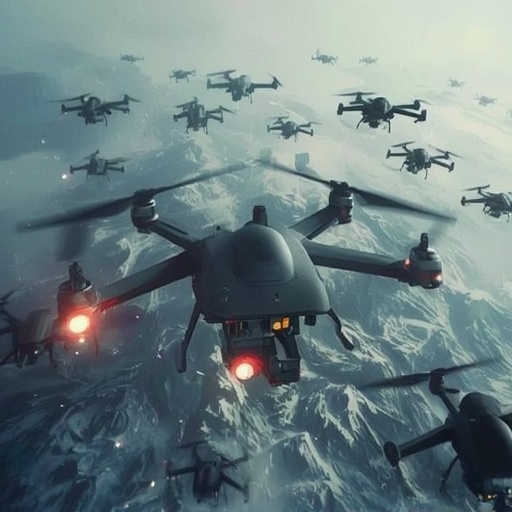
Russia’s transformation in drone warfare strategy marks a distinct and troubling advance in the ongoing conflict, demonstrating how military technology continues to reshape the nature and ethics of modern combat. Once characterized by calculated precision and restraint, Russian drone operations reportedly targeted only high-value or strategic objectives — typically command structures, armored vehicles, or supply lines — where each unmanned aircraft was deployed with a view toward maximizing tactical gain while limiting expenditure. However, the latest intelligence suggests a dramatic departure from that approach: in certain engagements, as many as fifteen drones are being unleashed against a single Ukrainian soldier. This represents not merely an adjustment in battlefield tactics but rather a profound escalation in the psychological and logistical dimensions of warfare itself.
This shift from selective precision to overwhelming saturation underscores the accelerating integration of automation and artificial intelligence in military strategy. By committing multiple drones to strike an individual target, Russia signals both its growing capacity for mass deployment and its willingness to redefine proportionality in engagement. The deliberate use of technology to achieve such concentrated intensity conveys a chilling message: efficiency and success in conflict may now be measured not by precision but by the capacity to sustain relentless, mechanized pressure. The human cost of such methods, however, becomes magnified — not only through increased lethality but through the erosion of moral and strategic boundaries long associated with conventional combat.
Moreover, the significance of this development extends far beyond any single battlefield encounter. It illuminates broader global concerns about the evolution of warfare in the age of automation, where machines increasingly determine the tempo and scope of violence. The reliance on swarm dynamics — once an experimental concept used primarily for reconnaissance and data collection — has evolved into an offensive paradigm capable of overwhelming opponents at minimal human risk to the operator. Such tactics create a staggering imbalance: an individual soldier confronted not by another human adversary but by a coordinated, algorithmic network designed for precision elimination.
This intensification of drone warfare also reveals an unsettling reality about technological proliferation during prolonged conflicts. As both sides innovate in an environment defined by survival and adaptation, boundaries that once constrained military conduct continue to blur. The battlefield has become a proving ground for unmanned systems, electronic warfare, and AI-assisted decision-making. What was previously a supplementary instrument of surveillance or support now occupies the forefront of tactical doctrine. Within that evolution lies both a testament to human ingenuity and a warning about its consequences: the further technology advances, the more difficult it becomes to distinguish between strategic necessity and moral transgression.
Ultimately, Russia’s recent drone saturation tactics highlight the ongoing transformation of conflict from a human-driven enterprise to a technologically mediated one. The deployment of fleets of drones against single individuals demonstrates not only new technical capabilities but also a shift in the very philosophy of warfare — from the surgical precision prized in earlier decades to the sheer volume and persistence made possible by autonomous systems. As nations around the world observe these developments, one truth becomes increasingly clear: in the wars of the future, superiority may no longer rest upon numbers of troops or the sophistication of weaponry alone, but on the capacity to harness technology in ways that render even the smallest targets impossible to escape.
Sourse: https://www.businessinsider.com/russia-is-sending-swarms-of-cheap-drones-after-single-soldiers-2026-5