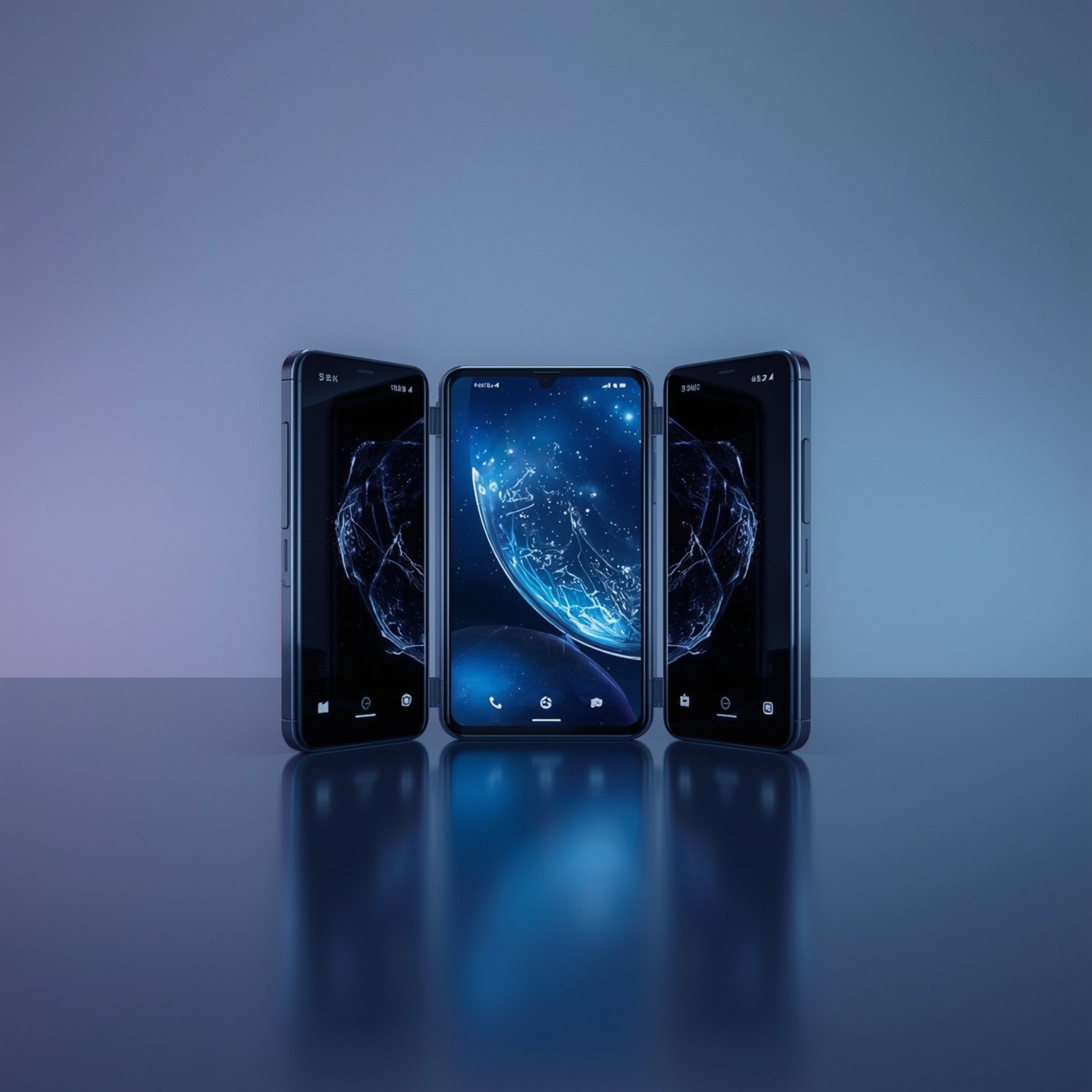
After repeatedly asserting over an extended period that it intends to introduce its first trifold smartphone within the current year, Samsung has moved notably closer to fulfilling that promise by unveiling a tangible representation of the device’s hardware. This debut occurred at the Asia-Pacific Economic Cooperation (APEC) summit, which is taking place this week in Korea and serves as a platform for international economic and technological collaboration. Although the device was presented in front of an audience likely filled with curiosity and anticipation, Samsung maintained strict restrictions: attendees were not permitted to handle the model, operate it, or even test its folding mechanism. The company’s cautious approach extends further — it has declined to clarify whether the unit displayed represents a finalized production model or merely an advanced prototype still undergoing development and refinement.
The trifold device occupies a glass display case, strategically arranged to exhibit both its compact folded configuration and its fully extended, tablet-like state, offering observers a static but revealing glimpse into its potential functionality. Complementing the physical showcase, an accompanying digital animation demonstrates the graceful transition between these two forms, visually illustrating the folding motion that defines this innovation. However, despite this visual aid, the actual piece of hardware remains entirely stationary, emphasizing that it is not yet ready for physical interaction. Consistent with prior leaks and industry speculation, the design’s folding mechanism appears to adopt a dual inward-folding pattern that, when closed, takes on a “G”-like shape. This approach distinguishes Samsung’s concept from competitors such as Huawei’s Mate XT — now entering its second generation — which utilizes an outward, accordion-style configuration. The distinction underscores Samsung’s commitment to pursuing its own mechanical and aesthetic design direction within an increasingly competitive foldable market.
Notably, Samsung has remained deliberately reserved about specific details surrounding the prototype. The company has refrained from assigning an official name to the device, and it has not officially confirmed whether this iteration is intended for imminent commercial release. When addressed for clarification, an unnamed corporate spokesperson told SamMobile that the display merely represents “ongoing research and development progress.” They reaffirmed, however, that Samsung still plans to make this next-generation product available to consumers before the year’s end — a statement that both tempers expectations and simultaneously builds anticipation for what could soon become a landmark in mobile design evolution.
Samsung’s display division has previously presented conceptual versions of trifold technologies at various international events, including its participation at the Mobile World Congress (MWC) 2025. Nevertheless, this latest exhibition appears to mark a significant departure from earlier conceptual teasers: it may well be the first public instance of Samsung showing hardware closely resembling a retail-ready product. For technology enthusiasts, journalists, and early adopters alike, this controlled preview signals that the long-theorized era of triple-folding smartphones is shifting from speculative innovation to tangible reality.
Sourse: https://www.theverge.com/news/807868/samsung-trifold-phone-apec-summit


