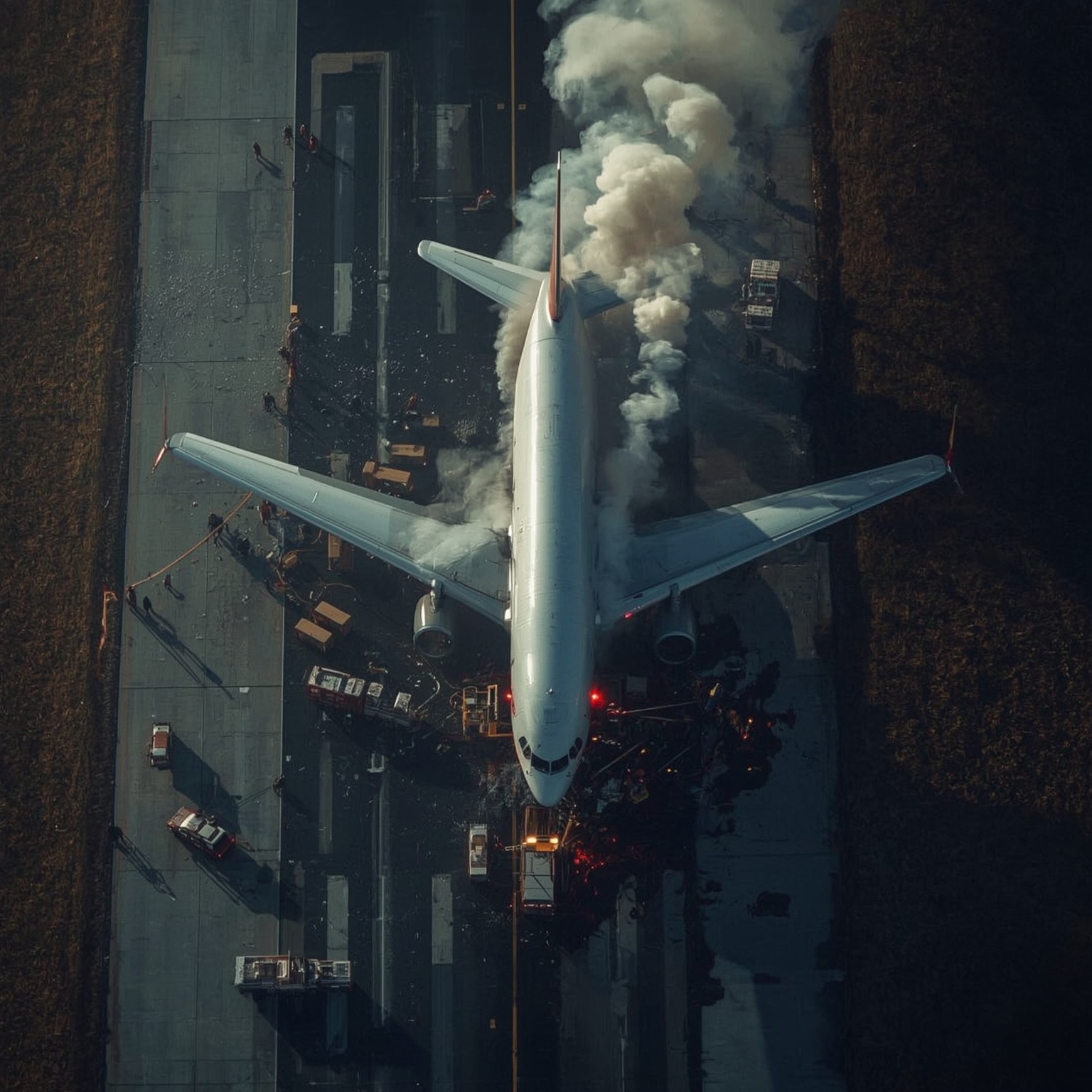
On the morning of November 7, 2025, at approximately 9:23 a.m. UTC, a tragic aviation disaster unfolded near Louisville, Kentucky. A United Parcel Service (UPS) cargo aircraft, designated as Flight 2976, crashed shortly after takeoff from Louisville’s Muhammad Ali International Airport, resulting in an immense loss of life and widespread destruction. Preliminary reports confirm that at least twelve individuals perished in the accident, including members of the flight crew and individuals on the ground who were caught within the devastating impact zone.
According to early investigations and verified satellite imagery, the aircraft—a McDonnell Douglas MD-11, a widely used long-haul freight carrier—collided with multiple businesses and warehouses located in an industrial complex roughly three miles south of the airport’s main runway. Commercial satellite provider Vantor has released a series of before-and-after images that visibly document the extensive structural damage: countless scorched rooftops, mangled vehicles, and a distinct path of wreckage stretching nearly 2,800 feet, or roughly 850 meters, across the industrial corridor. The images capture the aftermath of a catastrophe that transformed an active logistics hub into a scene of twisted debris and lingering smoke.
Investigators from the National Transportation Safety Board (NTSB) have confirmed that the critical mechanical failure leading to the crash involved the aircraft’s left engine, which detached completely from its wing during the takeoff roll—a term referring to the distance traveled by the plane on the runway prior to liftoff. Recovered data from the flight’s black boxes, which store cockpit voice recordings and key flight parameters, is currently under analysis to determine the precise sequence of events. Surveillance footage provided to officials reportedly captured the exact moment when the engine separated, causing the heavy three-engine aircraft to yaw sharply to the left and lose lift almost immediately after takeoff.
Eyewitness videos circulating on social media corroborate these findings. In several clips, the MD-11 can be seen banking aggressively leftward before striking the ground and erupting into a massive fireball. The aircraft was carrying an estimated 220,000 pounds—approximately 38,000 gallons—of jet fuel intended for its transoceanic journey to Honolulu, a considerable volume that intensified the ensuing explosion and produced a towering column of smoke visible for miles around the city. The inferno consumed both the fuselage and nearby industrial properties, including structures belonging to Kentucky Petroleum Recycling, Grade A Auto Parts, and a UPS logistics warehouse situated adjacent to the runway, where workers were reportedly present when the plane came down.
The warehouse roof suffered a catastrophic 295-foot gash as the aircraft’s fuselage skidded through the building before disintegrating. Flight-tracking data from Flightradar24 revealed that the airplane never climbed higher than approximately 175 feet above ground level, giving the crew virtually no time to correct the mechanical failure or attempt an emergency return. The immense kinetic force of the crash, combined with the ruptured fuel tanks, generated a firestorm that local first responders battled for several hours. In response, authorities issued a temporary shelter-in-place order spanning a five-mile radius around the airport and extending northward toward the Ohio River due to heavy smoke and potential air-quality hazards. By Wednesday afternoon, the precautionary order had been reduced to a smaller perimeter as environmental teams worked to monitor air safety and assess contamination risks.
The logistical consequences for Louisville’s transportation network were immediate and widespread. Operations at Muhammad Ali International Airport were suspended throughout Tuesday, leading to dozens of flight cancellations and stranding passengers who were forced to stay overnight or seek alternative modes of travel. Normal traffic resumed gradually on Wednesday morning as emergency crews cleared debris and completed runway safety inspections. Despite these swift measures, nine individuals remained unaccounted for as of Thursday, fueling an ongoing and emotional recovery effort.
In a press briefing, NTSB official J. Todd Inman emphasized that while the complete detachment of a jet engine is extraordinarily uncommon, it is a scenario for which certain aircraft—such as the MD-11—are structurally engineered. The design allows an engine to shear away cleanly from the wing under extreme stress or vibration to prevent further damage to the fuselage or other critical systems. Former MD-11 pilot and Delta Air Lines instructor Mark Stephens noted that, although the MD-11 is capable of sustained flight on just two engines, the sudden loss of one during takeoff—a period when lift, thrust, and stability are all delicately balanced—presents almost insurmountable challenges for the crew.
The investigation remains ongoing, with federal authorities meticulously examining recovered components, analyzing maintenance records, and interviewing witnesses to reconstruct the chain of events that led to this calamity. The UPS Flight 2976 disaster stands as a stark and sobering reminder of the immense risks inherent in modern aviation and the critical importance of rigorous engineering, inspection, and operational safety standards intended to safeguard lives even in the most extreme conditions.
Sourse: https://www.businessinsider.com/satellite-images-show-huge-impact-of-ups-plane-crash-2025-11


