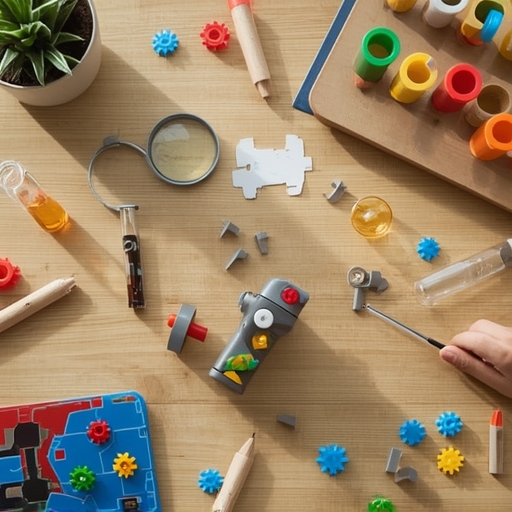
Whenever my children and I make a trip to our neighborhood library, they inevitably gravitate toward the Snap Circuit kit that sits enticingly on one of the shelves behind the counter. The box bears a charming label announcing that it is suitable for ages 8 to 108, a playful reminder that curiosity and learning truly have no upper limit. At our local branch, the kit is neatly organized in a sturdy, transparent plastic carrying case, which patrons can request to check out just like a book or a movie. I usually borrow it several times throughout the year, often turning it into a highlight of school vacations or a delightful indoor project on rainy or frigid days when outdoor activities are less appealing. Without fail, my kids greet the return of this kit with eager excitement, their eyes lighting up as though it were a treasure chest of miniature wonders they can’t wait to explore again.
Once we are home and the box is open across the dining table, my son and daughter spread out the multicolored pieces and begin positioning them onto the circuit board. Although they are capable of managing most of the assembly themselves, I remain nearby to provide occasional guidance or to offer gentle explanations about why a particular circuit might not yet be completing the path correctly. The set includes numerous carefully designed projects—some so reminiscent of the simple physics experiments I once conducted in school laboratories that they stir a pleasant sense of nostalgia. Yet beyond these prepared examples, the kit also allows for open-ended creation, encouraging young users to experiment with new configurations and invent circuits of their own design.
Through playing and tinkering, my children gain a concrete understanding of how everyday mechanisms function—the subtle click of a switch, the gradual illumination of a bulb, or the shrill buzz of a miniature alarm that suddenly comes to life once the circuit snaps into place. In exploring these connections, they are not merely memorizing isolated facts about electricity, physics, or basic engineering principles; rather, they are absorbing how those disciplines intersect in tangible, real-world contexts. The kit thus becomes more than a toy—it transforms into an early, hands-on introduction to scientific reasoning. It urges them to hypothesize, test, and revise their ideas, nurturing their ability to analyze problems and think critically. Each time they reconstruct a circuit or correct a mistake, they strengthen the habit of persistence and the thrill of discovery that lie at the heart of both learning and invention.
Sourse: https://www.businessinsider.com/best-stem-science-based-toys-kids-love-holiday-christmas-gift-2025-12