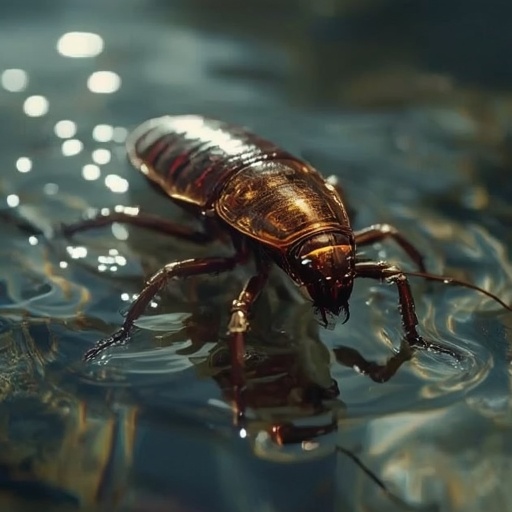
In a remarkable leap forward for biological engineering and robotics, scientists have successfully unveiled amphibious cyborg cockroaches—tiny hybrid organisms capable of traversing both terrestrial and aquatic environments with astonishing efficiency. This achievement marks a profound moment in the evolving field of biohybrid technology, where the boundaries between living biology and synthetic machinery continue to blur in fascinating ways. What was once the domain of speculative fiction has now materialized in the laboratory as a tangible, functioning reality.
The creation process involves integrating precise microelectronic components and control systems into the anatomy of real cockroaches. These carefully engineered augmentations enable the insects to respond to external commands while preserving their innate mobility and resilience. The newly developed amphibious variant extends the cockroaches’ natural capabilities, allowing them to not only crawl across solid surfaces but also glide or swim across water. Such versatility opens new avenues for practical deployment: envision swarms of these bionic insects navigating flooded zones, exploring hazardous terrains, or monitoring ecosystems inaccessible to humans.
This advancement underscores the current momentum of biohybrid robotics, a multidisciplinary field combining biophysics, microengineering, and computer science. By harnessing biological organisms as frameworks for technological innovation, researchers can minimize power consumption, maximize adaptability, and achieve levels of maneuverability that traditional robots struggle to match. The amphibious cyborg cockroach epitomizes this synergy by combining the durability and tenacity of an insect with the precision and programmability of modern robotics.
Beyond the immediate intrigue of the experiment itself, the broader implications extend into medicine, environmental science, and search‑and‑rescue technology. For instance, in disaster situations where larger machines could fail or become trapped, these miniature biohybrid explorers might traverse debris, locate survivors, or collect data in spaces far too confined for human responders. Similarly, ecological scientists may one day use such organisms to monitor pollution levels or track changes in aquatic ecosystems without disrupting the habitat.
While the concept may prompt a mix of wonder and discomfort—after all, the idea of controllable, semi‑mechanical insects evokes complex emotions—it undeniably represents a milestone within the expanding landscape of life‑integrated technology. The achievement demonstrates not merely the technical possibility of fusing organic life with engineered control but also humanity’s growing capacity to reimagine nature itself as a collaborative partner in innovation. The future that once seemed distant and speculative is already creeping before our eyes—quite literally, on six tiny, electronic‑enhanced legs.
Sourse: https://gizmodo.com/scientists-built-amphibious-cyborg-cockroaches-and-we-regret-to-inform-you-they-work-2000781804