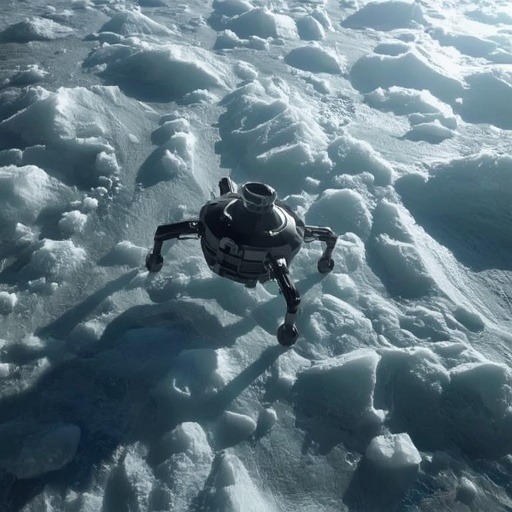
Future space missions aiming to explore the enigmatic icy moons circling Jupiter and Saturn now face a newly identified and rather unconventional danger. Scientists have recently reported the potential existence of exceptionally soft, porous, and loosely packed “fluffy ice” on the surfaces of these remote worlds—a substance so delicately structured that any robotic lander descending onto it might not find stable footing at all. Instead of providing a firm, frozen platform for exploration, this fragile layer could behave like an extraterrestrial form of quicksand, quietly enveloping the spacecraft and drawing it downward into its chilly depths.
This revelation significantly alters scientists’ understanding of the complex geophysical environments present on moons such as Europa, Ganymede, and Enceladus. Previously, researchers believed their outer shells to be dominated by hard, compacted ice, but the discovery of extremely low-density frost particles accumulated through sublimation and recondensation processes suggests a far more intricate and treacherous surface landscape. In practical terms, this means that landers designed with standard descent systems could be at risk of sinking or becoming immobilized upon contact, undermining years of preparation and billions of dollars in mission investment.
From an engineering perspective, such a finding compels aerospace designers to rethink everything from anchoring mechanisms and landing gear to sensor calibration for surface evaluation. A lander expecting a solid sheet of ice will now need adaptive systems capable of detecting softness, redistributing weight, and generating propulsion sufficient to overcome unexpected submersion. Laboratory simulations on Earth may soon focus on replicating this peculiar form of cryogenic terrain, as teams scramble to understand how fluffy ice forms and behaves under reduced gravity, extreme cold, and variable radiation fluxes across the outer Solar System.
At a broader level, this warning underscores how exploration of the Solar System’s farthest, coldest regions continues to defy expectations. Every new discovery—whether of subterranean oceans, cryovolcanoes, or now delicate snow-like crusts—reminds scientists that alien landscapes are far more dynamic than previously imagined. It also highlights the delicate balance between ambition and caution that defines humanity’s quest to extend robotic presence into the vast expanse that surrounds our planet. The journey outward, as this revelation attests, will demand not only curiosity and courage but also ingenuity in the face of worlds that can appear deceptively serene yet hold hidden perils beneath their glistening surfaces.
Sourse: https://gizmodo.com/missions-to-ocean-moons-face-a-strange-hazard-scientists-didnt-expect-2000759272