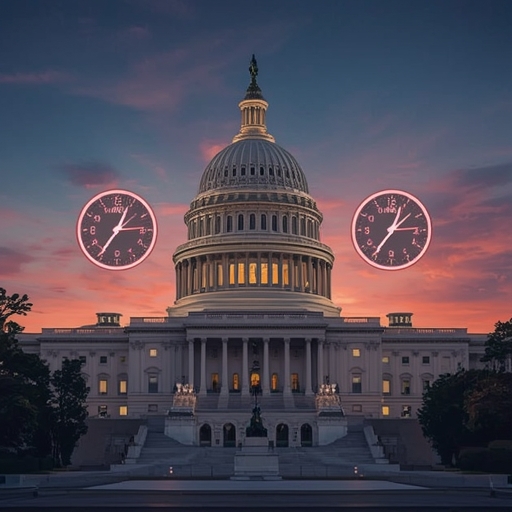
In a significant yet complex move, the United States Senate has officially approved the new federal budget, ensuring that the machinery of government remains operational and that most federal agencies continue to receive full financial support. However, this decision comes with one substantial caveat that has quickly become the focal point of policy discussions in Washington. The Department of Homeland Security, the central agency responsible for national protection and border security, has been granted only a temporary reprieve — a short-term, two-week funding extension — rather than the full-year allocation given to other departments.
This temporary measure, while preventing an immediate lapse in Homeland Security operations, leaves the department in a state of precarious uncertainty. Lawmakers deliberately limited the agency’s funding timeline to maintain pressure for further negotiations, particularly surrounding one of the most contested issues within the federal budget: new regulations for Immigration and Customs Enforcement (ICE). The ongoing debate revolves around the ethical and operational boundaries of ICE’s enforcement powers, and the proposed reforms seek to recalibrate the balance between immigration control and humanitarian responsibility.
In practical terms, all government departments — from Defense and Education to Health and Urban Development — will continue their work without interruption. Only Homeland Security remains tethered to political deliberations that must reach a resolution within the next fourteen days. If congressional leaders fail to agree on a permanent deal by the approaching deadline, the agency’s funding could run out, affecting border security programs, immigration enforcement personnel, and related operations that are fundamental to national safety.
The Senate’s vote reflects the deep intersection of fiscal management and ideological disagreement that defines much of the current political climate. It underscores how appropriations legislation is not merely about budgets and numbers, but also about moral priorities, institutional power, and the scope of government responsibility toward both citizens and immigrants. For many observers, the two-week extension functions not just as a temporary fix but as a symbolic ticking clock — an embodiment of the urgency that legislators face in reconciling security concerns with fundamental human rights principles.
As the countdown begins, all eyes now turn to Capitol Hill, where the next round of negotiations will determine whether compromise can be achieved before time runs out. The outcome will not only shape the operational future of the Department of Homeland Security but may also set the tone for future debates surrounding immigration, enforcement policy, and the ethical limits of governmental authority in an era of heightened political polarization.
Sourse: https://www.theverge.com/policy/870419/senate-passes-budget-with-two-more-weeks-of-homeland-security-funding