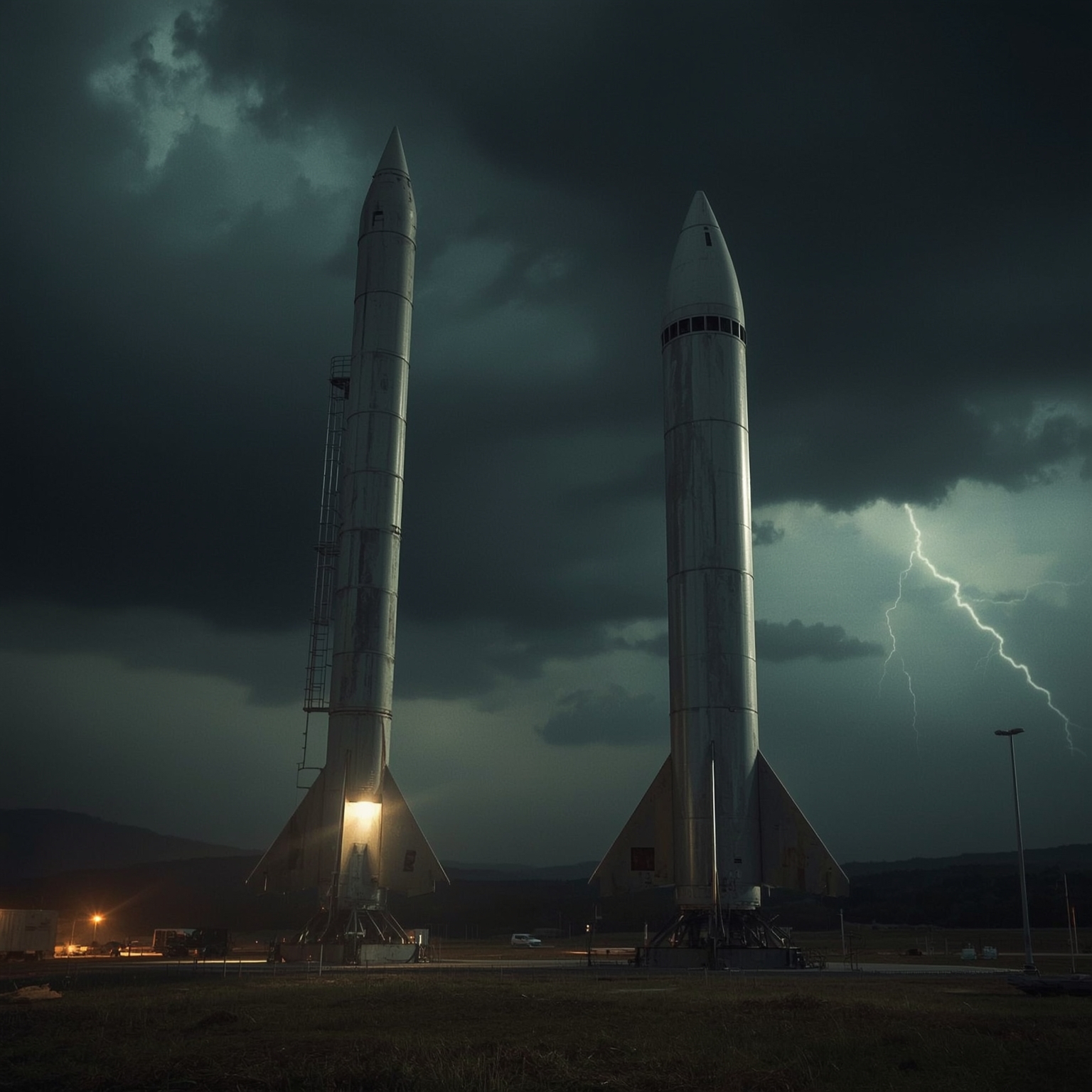
For more than half a century, the United States Air Force has relied on its arsenal of nuclear-armed Minuteman III intercontinental ballistic missiles (ICBMs) as a core component of the nation’s strategic deterrent. These land-based missiles, fielded during the height of the Cold War, have remained continuously on alert, forming one leg of the American nuclear triad. Now, a recent report indicates that the Air Force may be compelled to sustain this Cold War–era system even longer than originally envisioned, potentially well into the 2050s, as efforts to replace the Minuteman III face unprecedented challenges.
The long-planned successor to the Minuteman III is the Sentinel ICBM program, which the Pentagon awarded to Northrop Grumman in 2020. The transition was initially expected to be relatively straightforward: upgrade underground silos, integrate modern command-and-control systems, and begin rolling out the first new missiles by the end of the 2020s. At the time of contract approval, the entire endeavor was projected to cost approximately $78 billion, with full replacement of the 450 deployed Minuteman III missiles by the following decade. However, cost overruns, scheduling setbacks, and unforeseen technical difficulties have dramatically altered the trajectory of this project. Current Department of Defense estimates now place the program’s price tag at well over $140 billion, accompanied by delays of potentially several years, pushing first deployments into the 2030s.
According to the Government Accountability Office (GAO), the congressional watchdog agency overseeing federal programs, these mounting setbacks have forced Pentagon planners into a difficult dilemma: the Air Force must continue sustaining and upgrading the aging Minuteman III fleet far longer than expected, despite prior assumptions that the system was no longer sustainable beyond the near term. Each additional decade of maintenance requires expensive subsystem overhauls and resource allocation, further straining budgets that were originally intended for modernization.
The causes of Sentinel’s difficulties are multifaceted. The Pentagon acknowledges that the original delivery schedule was overly ambitious, effectively setting the program up for delays. Engineering challenges, ranging from system architecture complexities to integration of new technologies, have compounded these issues. Moreover, the industrial base supporting ICBM development has withered since the Cold War, leaving limited manufacturers and skilled labor to handle such sophisticated projects. The GAO also highlighted organizational problems inside the Air Force — from management inefficiencies to coordination gaps — that have amplified the program’s difficulties.
The Sentinel missile itself, on paper, represents a significant leap forward in design and capabilities. Conceived as a three-stage, solid-fuel weapon, it is expected to utilize lightweight carbon-composite structures, cutting-edge electronics, and modular systems engineered for easier upgrades across decades of service. Planners further anticipate that, compared to the Minuteman III, the Sentinel will be capable of carrying a larger number of warheads, thereby enhancing its deterrent effect. Yet, the technical advantages envisioned for the Sentinel remain theoretical until the program successfully achieves full-scale testing and deployment.
Transitioning from an active Minuteman III fleet to the Sentinel has proven to be far more complex than initially estimated. Beyond procuring new missiles, the Air Force must redesign missile silos, build associated launch facilities, update sophisticated networks of underground wiring and communication nodes, and simultaneously maintain the operational credibility of the current Minuteman III force. As Lt. Gen. Andrew Gebara, the Air Force’s deputy chief of staff for strategic deterrence and nuclear integration, explained during a recent event hosted by the Mitchell Institute for Aerospace Studies, much of the unexpected cost growth stems from infrastructure requirements: constructing launch centers, reconstructing silos, installing new command links, and ensuring that each element meets rigorous safety and security demands.
For years, external analysts have raised concerns about these difficulties. The Federation of American Scientists, for example, has documented how initial Air Force plans rested on faulty assumptions that old Minuteman silos and facilities could simply be refurbished and repurposed for Sentinel use. In reality, wear, age, and technological incompatibilities now mean that brand-new launch sites, including hardened underground silos spread across the central United States, will need to be built — a far more expensive and logistically demanding undertaking than originally promised.
Meanwhile, maintaining the Minuteman III system is becoming increasingly challenging. Spare parts for the missile are scarce, with many components out of production or technologically obsolete. Conducting test launches, which verify performance and assure readiness, is also becoming problematic, as the dwindling supply of test-capable hardware limits available options. Air Force officials have acknowledged to the GAO that the Minuteman III can likely be kept operational through 2050 but only with significant subsystem refurbishments at enormous cost. Concerns remain particularly acute over the missile’s aging ground-based electrical networks and electronics, where degradation could eventually compromise reliability. Ironically, officials had previously argued that sustaining Minuteman III for decades longer would be financially impractical — yet current delays are forcing exactly that outcome.
Nonetheless, despite frustrations, the Air Force remains committed to developing the Sentinel. Leaders argue that abrupt halts or major slowdowns would only worsen delays and inflate costs further. General Gebara emphasized that although structural changes to the program are now unavoidable, work must continue under the current contract to preserve momentum. A full program reset, officials caution, would jeopardize modernization efforts even more severely.
In sum, the U.S. nuclear deterrent faces a precarious crossroads. With Sentinel’s ballooning costs and shifting schedules, the Pentagon may be obliged to rely on its five-decade-old Minuteman III arsenal far longer than planned, even as maintaining that legacy system grows increasingly difficult. The situation underscores the broader challenges of balancing modernization with fiscal discipline, managing complex industrial supply lines, and sustaining a reliable deterrent posture in a geopolitical environment where certainty and readiness remain paramount for national security.
Sourse: https://www.businessinsider.com/us-air-force-extend-50-year-old-icbms-new-delayed-2025-9