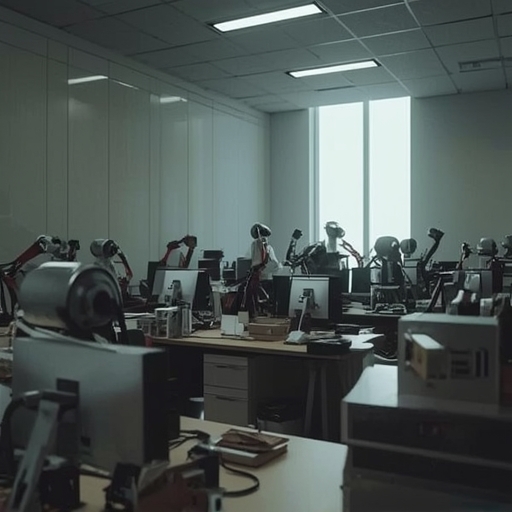
Sequoia Capital partner Julien Bek has issued a timely and thought-provoking warning that resonates deeply across today’s innovation landscape. He cautions that startups currently focused on developing and selling tools might soon find themselves in direct competition with the very artificial intelligence technologies that were initially meant to enhance, support, or even integrate with their products. This insight strikes at the core of modern entrepreneurial anxiety — the notion that an enterprise’s defining innovation might, in the blink of a technological evolution, become obsolete or outperformed by the rapid progress of AI systems that learn, adapt, and iterate far faster than human-led development cycles.
Bek’s message, at its heart, challenges founders and innovators to ask themselves a pressing strategic question: are they constructing something that is truly irreplaceable by AI, or merely paving the way for their own disruption? In other words, when the next generation of artificial intelligence systems emerges—smarter, faster, and capable of automating even creative or analytical tasks—will a company’s core offering still hold unique value, or will it be seamlessly absorbed into the expanding capabilities of machine intelligence? This is not an abstract dilemma but an urgent consideration that shapes how investors, startups, and technologists now evaluate potential longevity and defensibility in competitive markets.
The pace of technological transformation, Bek observes, no longer unfolds in linear patterns but in exponential leaps. Each iteration of AI brings forth an increasingly sophisticated ability to design, code, and optimize — processes once exclusively managed by human ingenuity. As such, what might today seem like a specialized tool or a competitive software product could tomorrow be redefined, replicated, or subsumed by generative or autonomous systems that evolve at a scale far beyond traditional product cycles.
For founders, this realization demands a fundamental rethinking of innovation strategy. It is no longer enough to build a polished application or service that automates a process; the critical challenge lies in anticipating how AI’s ongoing self-improvement might render that product redundant. Companies must reorient toward areas of sustainable differentiation — in human insight, ethical application, proprietary data ecosystems, or deeply specialized problem domains where AI replication remains limited or cost-prohibitive.
Bek’s remarks, therefore, echo across boardrooms and accelerator programs as both a cautionary and motivational call. In an age defined by relentless iteration, startups face a dual imperative: to embrace the transformative potential of AI while vigilantly ensuring that their creations are not simply the stepping stones that machine intelligence will one day outpace. Being one iteration away from disruption is no longer a metaphor for distant future risk — it is a defining condition of technology entrepreneurship in the AI era.
Ultimately, this warning underscores an essential truth: the future belongs not only to those who innovate but to those who anticipate how intelligence itself—human and artificial—will evolve and redefine the boundaries of competition, creativity, and survival in the digital economy.
Sourse: https://www.businessinsider.com/sequoia-partner-founders-ai-iteration-models-business-2026-3