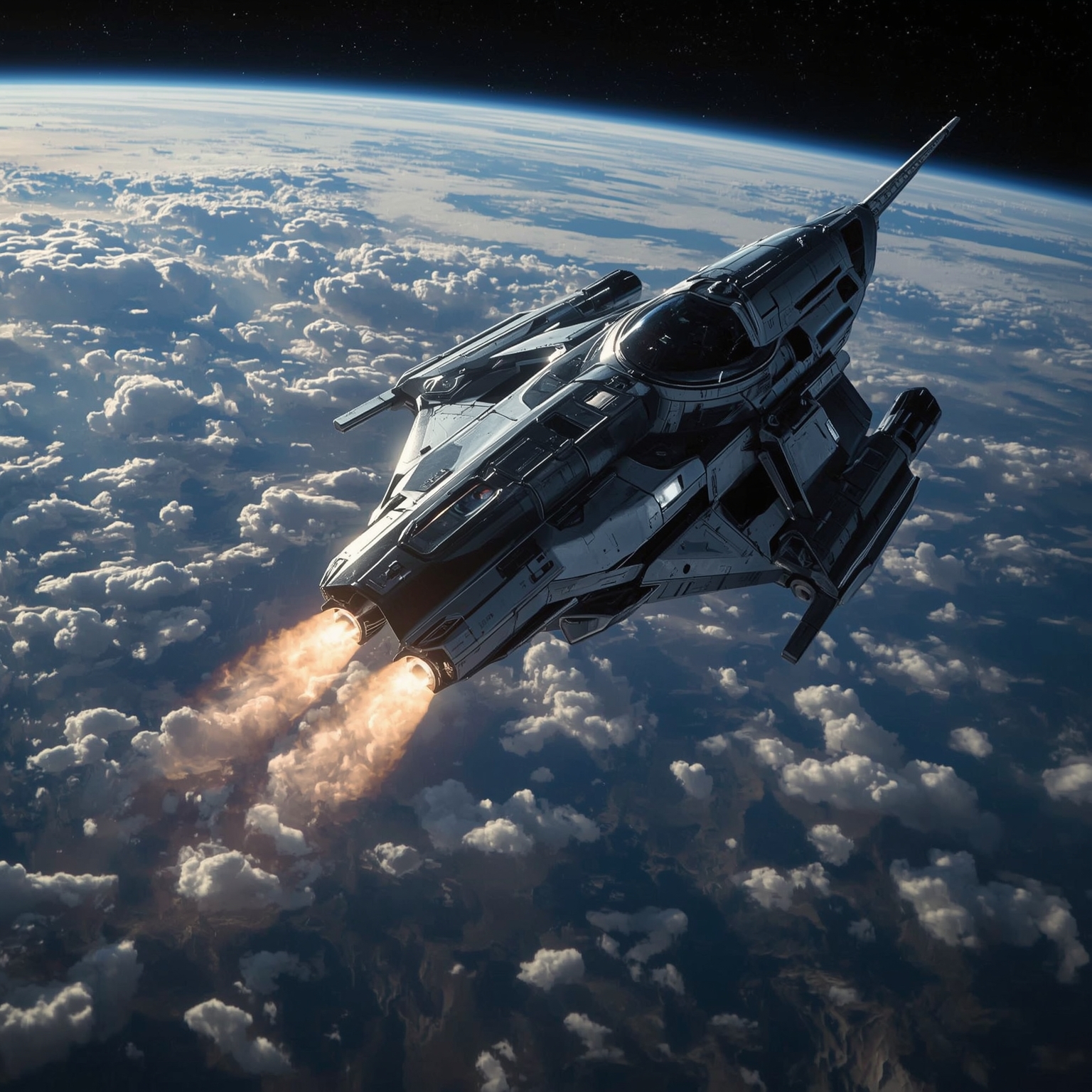
As Monday’s mission drew to a close, SpaceX’s Starship executed a dramatic and precisely choreographed sequence of movements that underscored the vehicle’s growing sophistication. In the final moments of flight, the spacecraft manipulated its aerodynamic flaps with remarkable precision, performing what engineers describe as a “dynamic banking maneuver” high above the Indian Ocean. This motion allowed the massive stainless-steel rocket to test its ability to control descent and attitude during reentry—an essential skill for safe returns from orbital velocities. Immediately afterward, Starship executed an intricate flip, rotating into an upright position before reigniting its engines to decelerate in preparation for splashdown. This complex procedure simulated the maneuvers the vehicle will need to carry out during future missions when it must return all the way to its launch site for full recovery and reuse. Perfecting this technique remains one of the most significant objectives for the next chapter of Starship’s ambitious test campaign, which SpaceX plans to initiate in the coming year.
For now, enthusiasts of the program will need to exercise patience as engineers transition from data analysis to hardware preparation. It will likely take several months before SpaceX is ready to attempt the next flight. At the company’s Starbase facility in South Texas, technicians are already hard at work assembling the forthcoming Super Heavy booster along with the first example of the upgraded Starship V3 spacecraft. Once these colossal components are integrated into a single launch stack, they will undergo an intensive series of evaluations, including cryogenic proof tests—where propellant tanks are filled with super-cold fluids to verify their structural integrity—and static-fire trials to validate engine performance. Only after these demanding procedures are successfully completed will the company proceed toward the next launch window.
In an official update, SpaceX explained that the team’s primary focus has already shifted toward building and testing the next generation of Starship and its companion booster, Super Heavy. Multiple vehicles are presently under active construction, each representing a step closer to a system designed for rapid reusability and routine operation. SpaceX emphasized that this new iteration will support the first fully operational orbital flights, carry payloads destined for space, enable propellant transfer demonstrations in orbit, and refine the design toward a spacecraft capable of sustained service to Earth orbit, the Moon, Mars, and eventually worlds even farther afield.
Starship V3 introduces several major enhancements over previous versions, representing a leap in technical capability. Its enlarged propellant tanks will grant the rocket greater lifting power, allowing it to transport heavier cargo or additional fuel for extended missions. At the same time, the vehicle will be equipped with an array of upgraded Raptor 3 engines—refined versions engineered to deliver higher efficiency, improved reliability, and simplified production. The payload section has also been redesigned to accommodate the deployment of functional Starlink satellites, marking a transition from test articles to missions with true operational significance. Of particular importance, this variant will conduct long-anticipated experiments in orbital refueling, a cornerstone milestone that SpaceX expects to reach sometime next year. Such in-space refueling capability is not a mere technical curiosity; it forms the essential foundation for missions to destinations beyond low Earth orbit.
The concept of transferring cryogenic propellant between spacecraft in orbit unlocks extraordinary possibilities for the Starship architecture. Without this ability, reaching distant targets such as Mars or conducting lengthy lunar missions would be prohibitively difficult. For CEO Elon Musk, the realization of orbital refueling is a critical step toward his longstanding vision of establishing a sustainable human presence on Mars—a vision that defines the very identity and long-term purpose of SpaceX.
Equally, the technique is a prerequisite for NASA’s lunar exploration ambitions. The agency has awarded SpaceX contracts totaling more than four billion dollars to adapt Starship into a variant capable of safely transporting astronauts to the Moon’s surface as part of the Artemis program. Achieving a valid orbital refueling demonstration represents one of the most crucial contractual milestones required before the Starship lunar lander can be certified for human flight. Swift progress on this front is of paramount importance to NASA, which has recently experienced delays in the Artemis schedule due in part to the complex technical challenges and development pace of Starship itself. Consequently, both SpaceX and NASA share a strong sense of urgency: completing this phase of work as soon as possible is not merely desirable—it is essential to ensuring that the next generation of human space exploration proceeds on schedule and with confidence.
Sourse: https://www.wired.com/story/spacexs-second-gen-starship-signs-off-with-a-near-perfect-test-flight/