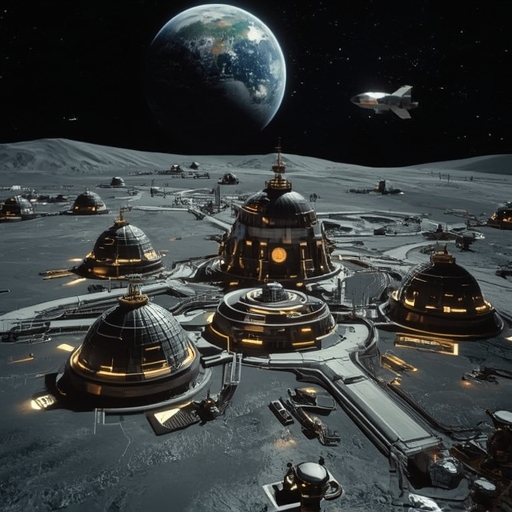
Only a year ago, the prevailing message from SpaceX echoed a sentiment of pragmatic focus—asserting that the Moon was, at best, a detour on the path to Mars. It was described as a “distraction,” implying that lunar exploration did not align with the company’s immediate interplanetary ambitions. Now, that rhetoric has evolved dramatically. SpaceX is no longer dismissing Earth’s natural satellite but instead envisioning it as the site of an extraordinary new development: a fully functional city on the Moon. 🚀🌕
This profound change in direction, whether born of long-term vision or near-term strategy, has sparked significant discussion across the aerospace community. Is this sudden embrace of lunar colonization a calculated move within a broader architectural plan for Mars, or has new technology—and perhaps new opportunity—reshaped the company’s priorities? Either interpretation reveals something striking: SpaceX’s capacity for adaptive innovation. The notion of transforming what was once a “distraction” into humanity’s next great destination underscores a strategic flexibility that few organizations can rival.
To call this pivot intriguing would be an understatement. It embodies the restless ambition that has long characterized SpaceX—an ambition that refuses to settle for incremental progress. The Moon, once sidelined as an outdated frontier, now becomes a staging ground for advancing deep-space logistics, refining life-support infrastructure, and testing the engineering principles that will one day sustain human life on Mars. By proposing a lunar city, SpaceX is effectively turning the Moon into a proving ground—a vast, silver-white laboratory orbiting within sight of Earth, yet distant enough to challenge every limit of human engineering and endurance.
What emerges, therefore, is a dual narrative—a marriage between visionary idealism and pragmatic execution. On the one hand, the allure of a lunar metropolis captures the imagination: sleek domed habitats illuminated under the perpetual twilight of a sun that rises and sets only once every month. On the other, it signals an undeniable strategic progression: before we can truly leap to Mars, we must learn to build, live, and thrive off Earth’s surface. The lunar city is more than a bold announcement—it’s a necessary rehearsal for the far greater play to come.
SpaceX’s shift in tone invites both admiration and analysis. It challenges the notion that innovation follows a straight trajectory, showing instead that flexibility and foresight often work hand in hand. Whether this initiative becomes a steppingstone to Mars or an enduring settlement of its own, it reflects humanity’s deepest instinct—to explore, to build, and to redefine what is possible. In that sense, the lunar race has indeed become more than a competition. It is a renewed expression of our collective imagination, now reignited with purpose and precision. ✨🌌 #SpaceX #Innovation #MoonCity #FutureOfSpace
Sourse: https://www.businessinsider.com/elon-musk-spacex-moon-base-city-manufacturing-quotes-2026-2