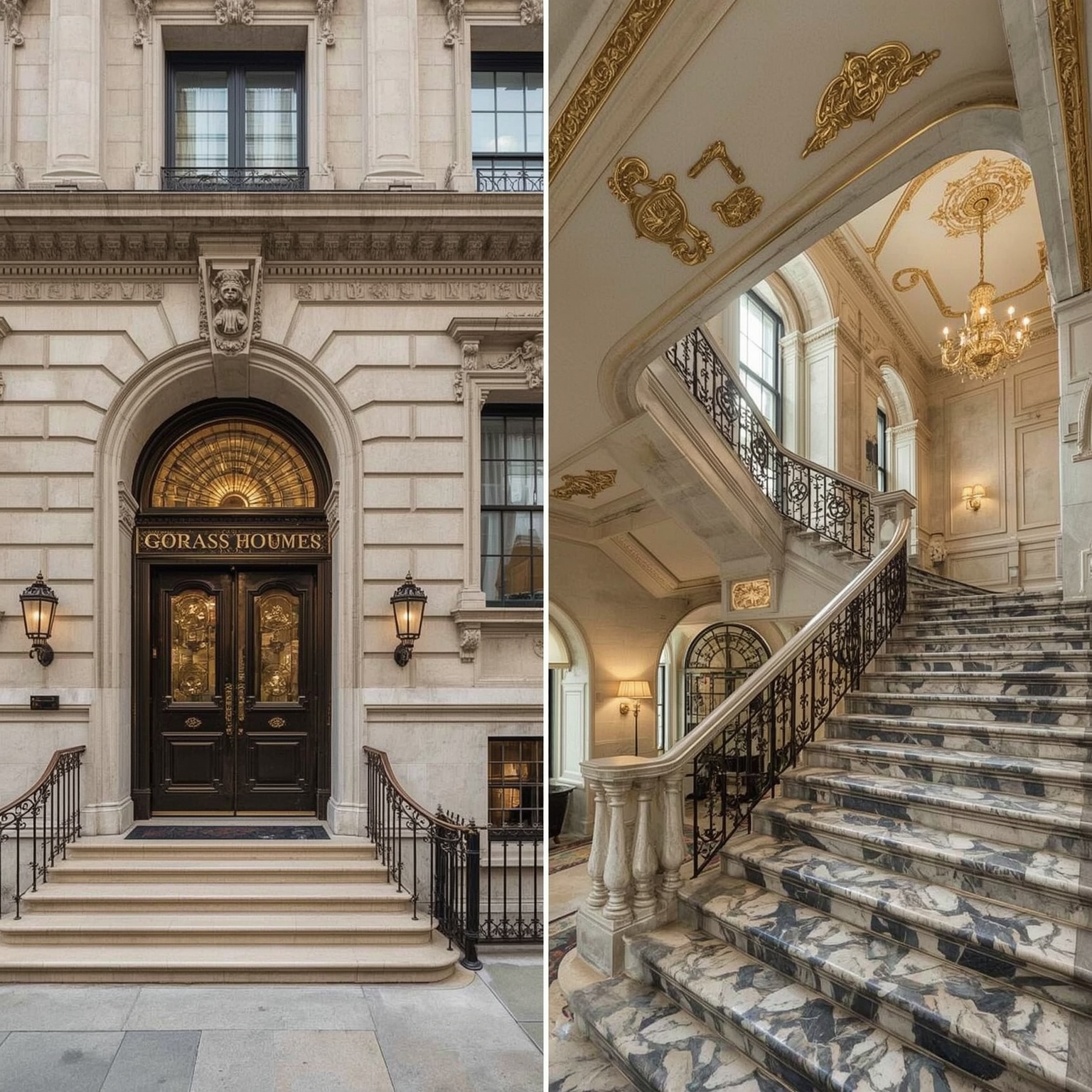
Although HBO’s acclaimed series *The Gilded Age* currently pauses between seasons—and the actual historical period so vividly depicted in that drama concluded roughly one hundred twenty-five years ago—the spirit of that transformative era continues to echo throughout modern-day New York City. Scattered across the metropolis are architectural relics and grand residences that still exude the wealth, ambition, and refined aesthetic that defined the dawn of twentieth-century America. Among the rare surviving examples of that opulent legacy stands a remarkable limestone mansion nestled discreetly between towering glass high-rises on Manhattan’s Upper West Side—a stately seven-bedroom, fourteen-bathroom showpiece that seems to resist the passage of time.
This distinguished 11,500-square-foot Beaux-Arts townhouse, currently represented by Lydia Sussek of Douglas Elliman, reappeared on the market in April with an asking price of approximately $29.75 million. While that figure reflects its modern-day prestige, the home’s history stretches far beyond its current listing. Originally commissioned in 1901, it was the vision of accomplished builder Joseph A. Farley, who entrusted the architectural mastery of the firm Janes and Leo to bring his concept to life. Constructed during an age when ornate façades and impeccable craftsmanship symbolized both social status and artistic pride, the mansion quickly became part of the city’s evolving architectural narrative. In the decades that followed, the property would pass through several illustrious hands. Its next notable owner, real estate magnate Samuel Borchard, maintained the estate until his death in 1930, as chronicled in his obituary published by *The New York Times*.
A new chapter unfolded during the 1940s when the residence was acquired by Prince Sergei Belosselsky-Belozersky, a Russian nobleman living in exile. In an effort to serve the émigré community displaced by political upheaval, the prince transformed the building into the headquarters of a charitable organization known as the House of Free Russia—a nonprofit dedicated to supporting Russian immigrants who had found sanctuary in New York. According to *The Real Deal*, this purposeful reinvention defined the mansion’s identity for half a century. However, following years of steady use and limited maintenance, the once-glorious home fell into disrepair, awaiting revival.
Its renaissance came in 1999 when investor Randall Rackson purchased the property and embarked on a complete restoration. He later recalled to *Mansion Global* that the structure he acquired was little more than an abandoned shell—an “empty building without a roof,” infested with rats and pigeons. Through extensive renovation and meticulous attention to architectural detail, Rackson returned the mansion to its former grandeur, reviving its soul while preserving its historical integrity. He has resided there ever since, though now, as he told *The New York Post*, he feels ready to downsize, ushering the residence toward yet another phase in its storied existence.
While New York has lost many of its Gilded Age mansions to demolition and redevelopment, this extraordinary home endures as a testament to that period’s architectural splendor. Its Beaux-Arts style—characterized by symmetrical forms, intricate carvings, and dramatic flourishes—radiates an elegance that remains striking even amid twenty-first-century skyscrapers. Visitors entering through its refined doorway are greeted immediately by a breathtaking spiral staircase that gracefully ascends the full height of the residence, soaring to the fifth floor. For those less inclined to climb, a private elevator discreetly offers access to every level, seamlessly balancing historical charm with modern convenience.
The third floor houses a beautifully appointed kitchen whose windows open toward a generous terrace, offering an almost pastoral retreat in the midst of Manhattan’s dense urban landscape. The terrace, designed with both comfort and spectacle in mind, features ample seating and an operational fountain—an unexpected luxury that enhances its gardenlike atmosphere. Throughout the interior, seven fireplaces imbue each principal room, from grand salons to intimate sitting areas, with warmth and a distinctly old-world ambiance. Ornate arches recur from room to room, creating visual harmony that ties together the home’s many spaces and architectural moods.
Across five expansive floors and an additional cellar level, the mansion contains seven bedrooms and fourteen bathrooms, each uniquely styled yet united by classical motifs. One room, thoughtfully adapted for entertainment, includes a built-in projector—perfect for hosting private film nights within the mansion’s sophisticated confines. The ground floor itself unfolds almost like a private club: a well-curated wine cellar invites connoisseurs to linger; nearby, a modern gym, game room, secondary kitchen, and multiple guest bedrooms combine utility with indulgence. Every corner of the home reveals both character and color—eschewing the monochromatic trend of contemporary interiors in favor of a rich, layered palette that celebrates individuality and history.
Today, this landmark property stands as much more than a luxury residence—it is a preserved chapter of New York’s architectural and cultural story. Its asking price of $29.75 million feels not merely an expression of market value but a tribute to the enduring splendor of an age when artistry, craftsmanship, and ambition converged to create homes that transcended time. To step inside this Beaux-Arts masterpiece is to step directly into the grandeur of the Gilded Age itself, reimagined yet everlasting.
Sourse: https://www.businessinsider.com/gilded-age-mansion-on-sale-upper-west-side-2025-10