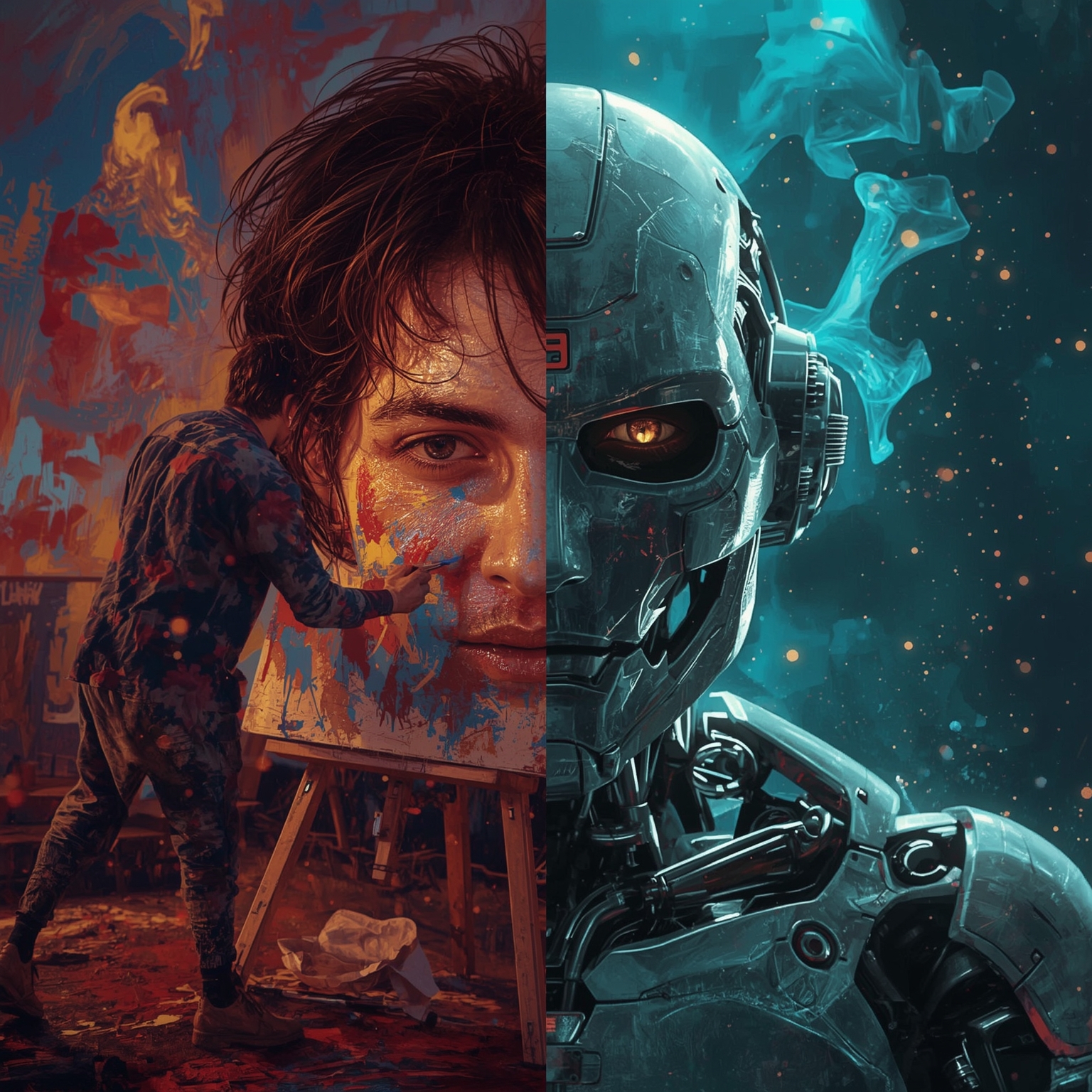
Stephen Colbert has made it clear that he remains deeply unconvinced by the notion that machines—or more specifically, artificial intelligence systems—are truly capable of producing art that resonates with the same human depth and authenticity as works created by people. During a conversation on the podcast *Possible*, released on Wednesday, the host of *The Late Show* argued that while AI technologies may be proficient at simulating or reproducing the outward appearance of art, they falter in transcending what he described as the perpetual trap of the “uncanny valley.” He went on to pose an unsettling question: will there ever come a time when algorithmically generated artwork ceases to feel fundamentally strange, foreign, or even alien to the human eye and psyche?
For Colbert, the irreducible essence of artistic creation lies within human beings themselves. True art, in his view, can never be understood solely as a clever arrangement of ideas, symbols, or aesthetic techniques; rather, it emerges at the intersection where intellectual concepts are infused with lived emotional experience. He explained that art must be understood as a uniquely human endeavor—created by people, intended for people, and ultimately about the human condition itself. In his words, art is not primarily about the sterile or abstract nature of ideas alone, because ideas, however brilliant, exist as conceptual frameworks or constructs, while human beings are not mere constructs but living, feeling organisms. Ideas matter, but they acquire meaning only when they are felt and embodied.
Elaborating further, Colbert pointed out that human beings do not simply generate ideas as abstract entities; they *encounter* them and respond to them emotionally, whether through joy, sorrow, wonder, or contemplation. This dynamic interaction, a unique blend of cognition and affect, is what transforms an intellectual notion into something with artistic weight, something capable of moving people in profound ways.
Colbert then widened his critique of AI beyond the sphere of art, employing an evocative culinary metaphor to illustrate what he perceives as artificial intelligence’s deeper shortcomings. He compared AI-mediated experiences to consuming processed food: while such food may technically provide the calories, proteins, or vitamins necessary to sustain life, it often lacks the subtler and more elusive qualities that fresh, complex nourishment provides. He suggested that there is an increasing suspicion—both on his part and in society more generally—that modern technologies such as AI deprive us of unseen yet essential “micronutrients” of human experience, elements we may not even know are missing until their absence becomes apparent.
And so, Colbert argued, these hidden “micronutrients” might in fact reside in the very imperfections, missteps, and asymmetries intrinsic to human interaction. Indeed, he contended that the flawed, messy, and often unpredictable nature of human-to-human connection is not a weakness but rather a vital and irreplaceable component of our lived world. Such imperfections carry emotional texture and existential truth, qualities that machines, by virtue of their design, cannot convincingly emulate.
Nevertheless, Colbert was careful to clarify that he is not categorically dismissing artificial intelligence as a whole. He acknowledged instances in which the technology could serve genuinely beneficial purposes, particularly in scenarios where human resources are scarce. For example, in healthcare deserts or underserved communities, the presence of a medical station staffed by AI tools might offer critical assistance—an improvement compared to having no medical support at all. That said, he remained deeply skeptical of claims positioning AI as an adequate substitute for the kinds of intimate, vulnerable, and empathetic exchanges that underpin human relationships, such as the deeply personal work of therapy.
Colbert declined to provide additional remarks when reached by *Business Insider* for comment, leaving his podcast statements to stand on their own.
Meanwhile, the conversation around AI’s role in art continues to expand across industries, particularly entertainment. The art world has already been significantly reshaped by machine learning tools, and Hollywood has been explicit about its growing interest in them. Large studios have promoted AI as a method of both reducing costs and streamlining production processes. Lionsgate, for instance, announced in September that it would explore the possibilities of AI in partnership with the company Runway. AMC Networks soon followed, conducting its own experiments with AI-driven tools. Similarly, Amazon has discussed using AI to craft summaries for television content and has even invested in Fable, a startup designed to empower individuals to produce entire shows with artificial intelligence.
Netflix has likewise entered the realm of AI-assisted filmmaking. Its co-CEO, Ted Sarandos, revealed that *The Eternaut*, a series released under the platform, included final footage containing shots entirely produced through AI. Praising the efficiency gains, he noted that a major visual effects sequence was finished at a speed approximately ten times faster than traditional VFX methods would have allowed, raising questions about both the opportunities and risks of shifting creative industries toward algorithmic solutions.
Yet where some see innovation and democratization, others raise alarms. When OpenAI unveiled its most recent image-generation model, the internet quickly erupted with a flood of Studio Ghibli-inspired memes. This outpouring of AI-created fan images also triggered intense debate about copyright law. While OpenAI’s CEO Sam Altman defended the technology by calling it a “net win” for society, emphasizing its ability to lower the barriers to artistic participation, critics continue to question both its ethics and legality.
The growing wave of legal disputes underscores this unease. In June, Disney and NBCUniversal jointly sued the AI platform Midjourney, accusing it of misappropriating and reproducing iconic characters such as *The Simpsons* and the *Minions*. Midjourney, on its part, denied the accusations in a formal response. Similarly, Amazon MGM Studios has been drawn into litigation over its *Road House* remake, with complaints that AI was allegedly used to replicate actors’ voices without authorization or union agreement. Amazon denied that AI voice clones had been used and argued that the lawsuit lacks merit.
Against this turbulent backdrop, Colbert’s reflections contribute to a larger cultural inquiry: as artificial intelligence becomes more capable and ubiquitous in creative fields, what do we risk losing in the translation between human experience and machine output? For him, art’s true power stems from its intimate tether to human emotions, vulnerabilities, and fallibility—qualities that no algorithm, however intricate, can authentically embody.
Sourse: https://www.businessinsider.com/stephen-colbert-hangup-ai-created-art-uncanny-valley-2025-9