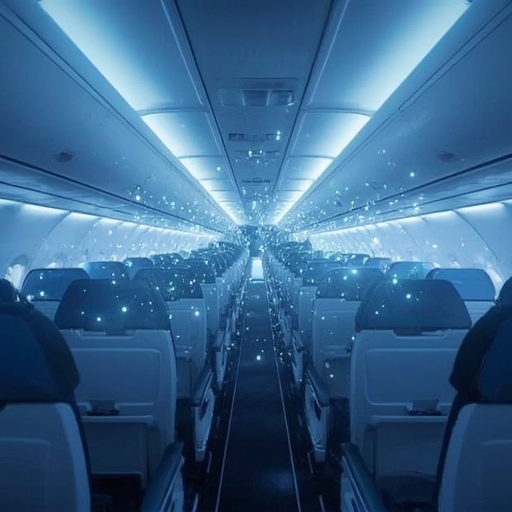
For anyone seeking to minimize the likelihood of falling ill, the instinctive response is often to avoid environments presumed to be teeming with germs—such as hospitals, where the sick congregate, or airplanes, packed with travelers sharing confined airspace. Yet a recent scientific investigation challenges this common assumption, demonstrating that the atmosphere within both medical facilities and commercial aircraft is actually far cleaner and less microbially threatening than most people imagine.
In this groundbreaking study, researchers undertook a systematic analysis of air quality by examining aircraft air filters in combination with face masks worn by airline passengers and healthcare professionals. Their findings, published in the journal *Microbiome*, reveal that these seemingly high-risk environments are predominantly inhabited by harmless microorganisms—microbes characteristically associated with human skin rather than infectious disease. This result counters the widespread belief that such enclosed spaces are overwhelming reservoirs of contagion.
Lead researcher Erica Hartmann, an environmental microbiologist at Northwestern University, explained that her team discovered an unexpectedly simple yet powerful method for studying airborne microbial exposure. “We realized,” she noted in a university statement, “that ordinary face masks could serve as inexpensive, easy-to-use air-sampling tools capable of capturing what people actually breathe in within these environments.” By extracting and analyzing DNA collected on the masks, the team identified bacterial species typical of indoor spaces—microbes that mirror those found on the surfaces and skin of the people who occupy them. Hartmann wryly summarized this finding: “Indoor air looks like indoor air, which also looks like human skin.”
In total, Hartmann and her collaborators cataloged 407 distinct microbial species, encompassing both common skin-dwelling bacteria and microorganisms originating from the surrounding environment. Only a negligible number of potential pathogens were detected, and none showed signs of active infection, reinforcing the conclusion that the air aboard planes and within hospitals is largely innocuous. The genesis of this study traces back to January 2022, during the height of the COVID-19 pandemic, when Hartmann initially secured funding to analyze airline cabin filters for traces of disease-causing organisms. The research concept soon evolved after the team recognized that high-efficiency particulate air (HEPA) filters, while impressively effective at removing airborne particles, are extremely costly and logistically difficult to access. Removing these filters requires taking an airplane out of service for maintenance—an exorbitant process that significantly disrupts operations.
At that point, the scientists recognized that face masks, already widespread due to pandemic conditions, offered a far more practical solution. Unlike HEPA filters, masks could passively collect microbial material in real time while being worn by volunteers, representing a low-cost, high-yield alternative. Thus, the researchers distributed masks to travelers on both domestic and international flights, requesting that participants also send control masks that had accompanied them but remained unworn. To establish a meaningful comparison, the team selected another enclosed, high-traffic location characterized by rigorously filtered air: hospitals. Healthcare workers provided their masks after completing standard work shifts, thereby allowing the researchers to contrast microbial samples from two distinct—yet similarly controlled—indoor environments.
Subsequent DNA analyses revealed that the microbial communities present on mask exteriors reflected a diverse but overwhelmingly benign mixture of airborne organisms. Both the hospital and airplane samples contained bacteria commonly linked with human presence—species typically derived from our skin and respiratory emissions rather than from pathogens circulating through the environment. The parallel findings from both contexts suggest that most microbes in these spaces originate from the people themselves, emphasizing that our own bodies, rather than the location, dictate the microbial composition of indoor air.
Interestingly, the study also identified the presence of some antibiotic-resistance genes corresponding to major antibiotic categories. Hartmann clarified, however, that this discovery does not indicate dangerous airborne bacteria, but rather underscores how pervasive genetic markers of resistance have become across environmental microbiomes worldwide. It serves as a reminder of the global spread of resistance rather than evidence of immediate risk.
Concluding their research, Hartmann emphasized that the project focused exclusively on what individuals encounter through inhalation. She reiterated that consistent hand hygiene remains an essential measure for preventing the transmission of pathogens via contact with contaminated surfaces. “We concentrated,” she explained, “on understanding what people breathe and are exposed to in the air, even when they are already practicing responsible handwashing.”
For anyone preparing to travel, the implications are reassuring: despite the crowded conditions and prolonged shared air in airplanes or the clinical intensity of hospitals, the actual risk posed by airborne microbes is considerably lower than many might fear. The study ultimately offers comforting news to those planning trips during the upcoming holiday season—suggesting that within both cabins and wards, the air around us is far cleaner, safer, and more carefully filtered than our imaginations would have us believe.
Sourse: https://gizmodo.com/germaphobes-rejoice-airplane-and-hospital-air-is-actually-pretty-clean-study-claims-2000695101