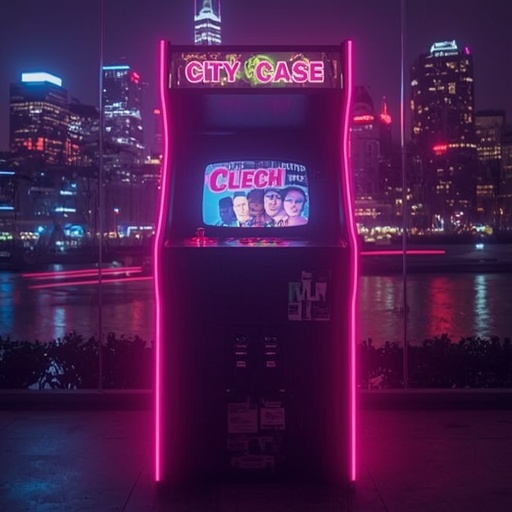
In an unexpected and delightfully bizarre fusion of political commentary and gaming nostalgia, Washington, D.C. has become the stage for a truly surreal artistic phenomenon. Out of nowhere, a collection of old-school arcade cabinets—crafted with striking attention to the tactile aesthetics of the 1980s—has appeared near prominent memorial sites. Yet, these are not mere replicas for those who yearn for joystick-driven simplicity. Instead, they serve as sophisticated instruments of satire, combining sharp political observation with immersive, skill-based gameplay that surprises even the most jaded of modern players.
Each cabinet seems to carry its own distinctive voice, blending caricature with critique and humor with genuine depth. Players find themselves not only competing for high scores but also navigating allegorical landscapes that mirror the absurdity and chaos of contemporary politics. The pixelated characters, whose exaggerated expressions and witty dialogue evoke laughter and reflection in equal measure, possess the unique ability to transform topical irony into interactive storytelling. What initially appears to be an irreverent parody evolves gradually into an invitation to think critically about power, influence, and the performative nature of modern discourse.
What makes the installation even more remarkable is how playfulness becomes a means of engagement rather than distraction. The designers—anonymous or perhaps intentionally silent—manage to balance entertainment with intellect, presenting a work that operates simultaneously as cultural commentary and communal pastime. The irregular placement of these machines across public spaces adds to their mystique: they feel half guerrilla prank, half contemplative art exhibit. The convergence of satire with genuine craftsmanship is what elevates this experience from novelty to brilliance; each coin inserted, each glowing pixel, becomes a moment of participation in an unwritten public dialogue.
Beyond the laughter and curiosity inspired by these cleverly coded cabinets, there lies a more profound realization about the evolving relationship between art and play. By taking the language of retro gaming—a language of quick reflexes, competition, and nostalgia—and intertwining it with biting sociopolitical critique, the creators have built a bridge between cultural eras. They invite us to consider whether the past can be resurrected not only as entertainment but also as introspection. Every chime of the digital soundtrack, every pulsating neon hue, becomes both tribute and question: how can satire shape understanding, and how might amusement fuel awareness?
Ultimately, this mysterious installation reminds onlookers and participants alike that art need not stand solemnly behind velvet ropes. Sometimes, it flickers alive through a cathode-ray screen, asks for a quarter, and dares its audience to laugh, fail, think, and try again. In its strange marriage of parody and play, this project reimagines the boundaries of creativity, demonstrating that even through simple mechanics, profound commentary can emerge—one game, one gesture, one gleaming pixel at a time.
Sourse: https://www.theverge.com/games/930605/operation-epic-fury-strait-to-hell-the-secret-handshake-trump