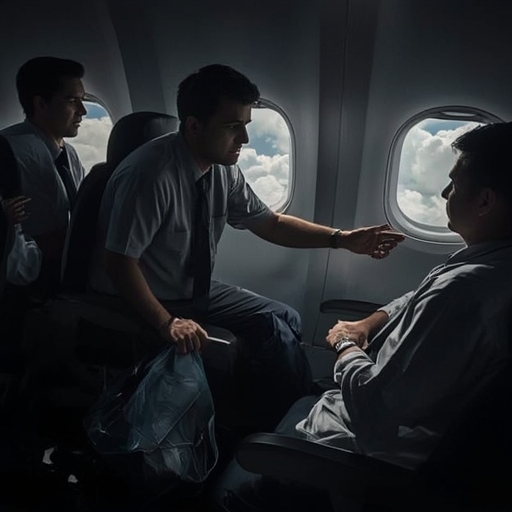
An Alaska Airlines flight transformed from an ordinary journey into a scene of high-altitude confusion and alarm when passengers were forced to restrain a man who allegedly attempted to open one of the aircraft’s emergency exits, according to details outlined in an official affidavit. The alarming episode occurred during Flight 87, which was operating last Wednesday on the short but significant route between Deadhorse, Alaska, and the state’s largest city, Anchorage—a trip that typically lasts about ninety minutes under normal circumstances.
Reports indicate that the situation began unfolding gradually after several travelers, uneasy about the erratic conduct of one individual later identified by police as Kassian Fredericks, deliberately changed their seats to create distance from him. Their intuition soon proved justified. Two passengers seated directly behind Fredericks later recounted to investigators that they overheard him speaking audibly to himself in a disjointed and unsettling manner. According to one witness, the man’s fragmented monologue referenced imaginary or ‘invisible’ people who, he claimed, were attempting to seize control of the airplane. Not long afterward, the witness observed him ingesting what appeared to be a pill before washing it down with a bottle of Gatorade, all of which contributed to growing tension within the cabin.
The Boeing 737 had been airborne for barely eight minutes, ascending through roughly eighteen thousand feet of altitude, when the flight deck received its first troubling communication from the cabin crew. They reported escalating concerns regarding a disruptive passenger whose behavior was becoming increasingly unpredictable. Almost immediately after that alert, a light on the instrument panel inside the cockpit illuminated—a signal indicating that someone was attempting to manipulate one of the emergency exit mechanisms. For any pilot, such a warning represents a critical potential threat, prompting urgent assessment and coordinated response.
Witnesses described a chaotic but remarkably coordinated sequence of actions in the moments that followed. Fredericks apparently succeeded in partially lifting the locking arm of the emergency door before another passenger reacted swiftly, seizing him and preventing further movement. Calls for assistance resounded through the cabin, and within moments two additional passengers rushed forward, working together to subdue him. According to the affidavit, Fredericks demonstrated unexpected physical strength, forcing all three men to exert considerable effort before finally overpowering and securing him in his seat. Their actions likely prevented further escalation, though investigators were quick to clarify a common misconception: while such incidents are frightening, physics itself would have made it impossible for Fredericks to actually open the cabin door at cruising altitude. The vast pressure differential between the aircraft’s interior—pressurized for passenger safety—and the thin air outside effectively seals the door shut, making forced opening unachievable while the plane is aloft.
After being restrained, Fredericks’s behavior reportedly continued to oscillate between agitation and confusion. He requested a cigarette—an impossible request aboard any commercial flight—then inquired about whether it would be feasible to break one of the aircraft’s reinforced windows. Moments later, his tone shifted as he said he wanted to contact his mother. When questioned by a near passenger about his motives for tampering with the exit, he purportedly replied that he needed fresh air and simply “had to get out of here,” suggesting a state of panic or disorientation rather than premeditated malice.
Faced with these unsettling developments, the pilot considered making an emergency diversion to Fairbanks, a closer airfield, but ultimately decided to proceed toward Anchorage, which was by then only eighteen minutes away. The situation appeared sufficiently contained thanks to the intervention of the passengers and attentive cabin crew. Upon landing, local law enforcement officers boarded the aircraft and immediately placed Fredericks under arrest. By this time, witnesses said, he appeared calmer and even expressed remorse, offering apologies to the flight crew as he was escorted from the cabin.
Subsequent court filings revealed that a federal grand jury later indicted Fredericks on a single count of interference with a flight crew—a serious charge that underscores the gravity of any disruptive behavior aboard a commercial aircraft. Conviction on this count can carry a maximum potential prison sentence of up to twenty years. Alaska Airlines, when reached for comment by Business Insider, did not provide an immediate response. Nonetheless, the event stands as a vivid reminder of both the unpredictability of human behavior under stress and the extraordinary composure ordinary passengers can display when confronted with potential airborne crises.
Sourse: https://www.businessinsider.com/alaska-airlines-passenger-tried-to-open-emergency-exit-midflight-2025-12