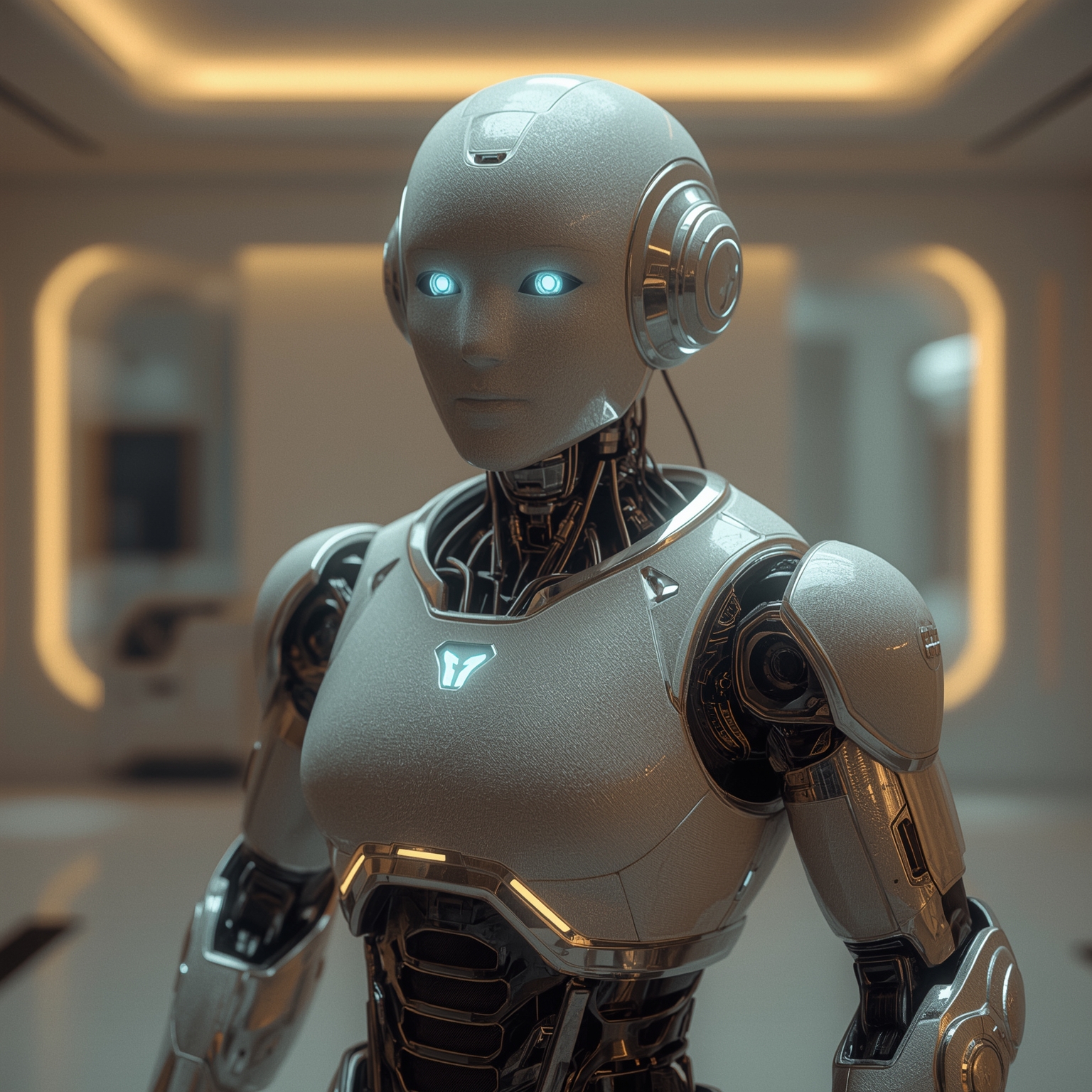
A Chinese electric-vehicle manufacturer is taking an unconventional yet captivating approach to the competitive field of artificial intelligence and robotics, wagering that emotional connection and physical comfort may help it challenge Elon Musk’s technological dominance. Xpeng, a rapidly evolving EV startup from China, recently revealed the newest iteration of its humanoid robot named *Iron*. During the official unveiling earlier this month, CEO He Xiaopeng articulated the company’s ambition to design bipedal robots that appear and behave in ways remarkably similar to humans. This objective, he emphasized, stems from the belief that the closer robots come to resembling people—not only in movement but also in tactile qualities—the stronger the bond and trust they will inspire among human users.
In a corporate earnings call held on Monday, He elaborated on this vision to financial analysts. He disclosed that Xpeng’s engineering teams had discovered a simple yet profound insight: integrating artificial musculature and a synthetic, so-called “bionic skin” into Iron made people markedly more comfortable interacting with the robot on a physical level. Participants who initially approached the machine with hesitation found themselves willing, even eager, to touch or gently embrace it. “This finding,” the CEO explained with visible enthusiasm, “is quite extraordinary, because the conventional industrial robot of the past was almost never regarded as something a person would feel compelled to hug. Traditional designs lacked warmth and emotional accessibility.” In other words, Xpeng’s experiment in humanizing robotic aesthetics could signal a meaningful shift in our perception of machines.
Unlike many competing humanoid robots produced by other technology firms, Xpeng’s Iron distinguishes itself through an anatomically realistic silhouette. It exhibits proportions and surface textures evocative of the human body, and the company has presented both male and female versions to underline this realism. Xpeng has additionally assured that individual users will be able to personalize their Iron units with different body shapes and configurations, tailoring the robot’s physical presence to suit various roles or personal preferences. During a particularly memorable demonstration at the unveiling event, engineers cut into the robot’s elastic artificial skin layer on stage—an intentional act meant to confirm that there was no hidden operator inside, only a meticulously constructed mechanical system simulating organic form and motion.
Further elaborating to analysts, He Xiaopeng revealed Xpeng’s near-term ambitions for full-scale commercialization of Iron. The company aims to commence large-volume production by the conclusion of 2026 and aspires to achieve an impressive annual sales target of around one million units by 2030. This bold projection reflects his conviction that humanoid robots could ultimately represent a market surpassing even the vast global automotive industry in scale and socioeconomic significance. Initially, he expects these human-inspired machines to find their footing in service-oriented environments—helping customers in retail settings, acting as informative tour guides, and serving as friendly in-store assistants designed to make commercial spaces more interactive and engaging. He indicated that the company intends to deploy the first Iron robots across its own retail locations as early as next year.
This steady intensification of Xpeng’s robotics program underscores a larger narrative emerging in global technology: that Tesla’s most formidable rival in humanoid robotics may rise not from Silicon Valley but from China’s innovation hubs. Meanwhile, Elon Musk’s Tesla continues to advance its own humanoid project, *Optimus*, with predictions of mass production beginning by late 2026. Musk has boldly proclaimed that Optimus could become Tesla’s most consequential product ever created—a machine capable of redefining the relationship between labor, automation, and consumer technology. Tesla’s head of artificial intelligence has even cautioned employees that 2026 may prove to be the most demanding and pivotal year of their professional lives, signaling the immense pressure to bring Musk’s grand robotic vision to fruition.
Founded in 2014, Xpeng has already gained considerable recognition as one of the few Chinese automotive startups capable of seriously competing with Tesla on home turf. Headquartered in Guangzhou, the company has shattered previous domestic sales milestones and now stands on the threshold of profitability—an achievement that demonstrates its operational maturity and growing consumer appeal. Building upon this momentum, executives announced that Xpeng intends to launch seven new vehicle models during the coming year, three of which will be dedicated robotaxi variants designed for autonomous urban transport. In addition, the company reaffirmed its ambitious plan to begin mass production of its $280,000 flying car by 2026, signaling its continuing commitment to redefining mobility both on the ground and in the air. Through these combined ventures, Xpeng positions itself not merely as an electric car manufacturer but as a multifaceted technology enterprise seeking to merge mechanical intelligence, human empathy, and futuristic design into one cohesive vision for the next era of innovation.
Sourse: https://www.businessinsider.com/xpeng-iron-robot-huggable-tesla-optimus-2025-11


