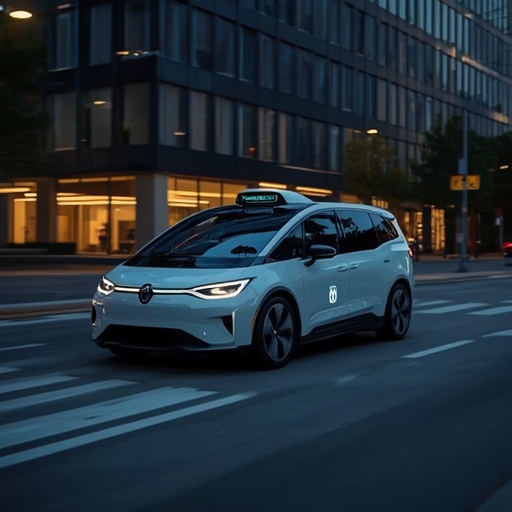
An X user recently captured a striking piece of footage on Sunday in Austin, Texas, depicting what appeared to be a Tesla Model Y moving confidently along the city’s streets without a single visible occupant inside—not even the customary human safety monitor who has, until now, been present during every test. Since Tesla first launched its much-anticipated robotaxi service in Austin in June, all of the company’s autonomous vehicles have consistently featured a human passenger seated beside the driver’s area, serving as a safeguard to intervene if necessary. The new video seemed to challenge that precedent, suggesting that Tesla may now be progressing into a new and riskier phase of experimentation.
The clip quickly sparked an intense wave of curiosity and excitement across social media platforms, particularly among Tesla enthusiasts and dedicated observers of the company’s technological developments. Many viewers, intrigued by what they had seen, immediately opened their Tesla apps in an attempt to summon a robotaxi themselves, hoping to verify whether their ride might also arrive without a human monitor. Their findings confirmed that current passenger rides still included the safety personnel, hinting that Tesla’s driverless testing may be restricted to internal trials rather than public operations.
Tesla’s CEO, Elon Musk, weighed in on the viral moment later that same Sunday. Responding directly to the original post on X, Musk revealed that the company had indeed begun limited testing of autonomous vehicles with absolutely no human safety operators present inside. However, he clarified by implication that these trials were not yet open to paying customers. “Testing is underway with no occupants in the car,” Musk wrote, indicating that Tesla’s engineers are now pushing the boundaries of the company’s self-driving software in real-world conditions, albeit under careful internal monitoring rather than public use.
The company’s own social media account responded to the video in trademark Tesla fashion with the succinct and somewhat cryptic remark, “Just saying,” a comment that fueled even more speculation and conversation online. Around the same time, Ashok Elluswamy, Tesla’s AI leader and the head of its Autopilot and self-driving division, also chimed in with an enthusiastic post: “And so it begins!” His brief statement reflected the tone of momentous initiation—an acknowledgment that Tesla was crossing another threshold in its pursuit of fully autonomous mobility.
According to Robotaxi Tracker, a monitoring platform managed by Austin-based automation enthusiast Ethan McKenna, the fleet of active Tesla autonomous vehicles in the Austin area has grown steadily—currently comprising thirty-one units, compared with twenty-nine just a month earlier in November. This incremental increase aligns with Musk’s previously announced goal, shared during an October appearance on the “All-In” podcast, in which he stated Tesla’s intention to ramp up the city’s robotaxi fleet to roughly five hundred cars by the close of the year. Such expansion would represent a dramatic escalation of scale and ambition, underscoring Tesla’s commitment to making autonomous transport not just an experiment but an integral part of urban mobility.
Further supporting this trajectory, Musk remarked during a video call at an xAI “hackathon” event held last week—an innovation-focused gathering tied to his artificial intelligence ventures—that Tesla planned to eliminate the need for human safety monitors altogether by year’s end. Reporting from Teslarati, a publication that closely follows news about Musk-led enterprises, quoted Musk as saying that Tesla robotaxis would soon operate entirely without human supervision, even eschewing the presence of an observer in the passenger seat. He was cited as claiming that within roughly three weeks, fully unoccupied robotaxis would be traversing the streets of Austin in test scenarios, signaling a tangible leap toward real-world autonomy.
Yet, despite these proclamations of progress, Tesla’s technology has not yet achieved flawless reliability. When Business Insider reporters conducted their own test of a Tesla robotaxi in Austin earlier in July, the autonomous vehicle still required several manual interventions from the onboard safety monitor to correct operational mistakes—most notably during an incident in which the car mistakenly began traveling against traffic on a one-way street. Such episodes highlight the lingering complexities and limitations inherent to self-driving systems, reminding observers that even the most sophisticated artificial intelligence models must still contend with unpredictable human environments.
At the time of publication, Tesla did not immediately issue an official response to Business Insider’s request for comment. Nonetheless, the convergence of Musk’s statements, employee reactions, and community observations unmistakably points to a pivotal and experimental stage in Tesla’s broader drive toward full automation. The video recorded in Austin may therefore stand as an emblem of a forthcoming transformation in transportation—one in which human oversight inside the vehicle gradually recedes into history, leaving the car itself as the sole driver of its journey through the modern cityscape.
Sourse: https://www.businessinsider.com/tesla-robotaxi-austin-safety-monitor-test-elon-musk-driverless-cars-2025-12