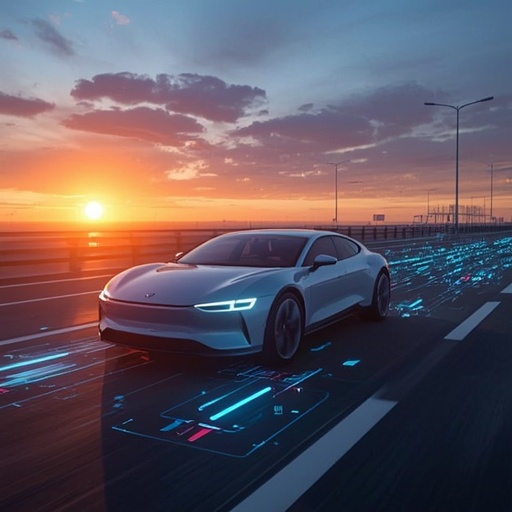
Tesla’s Full Self-Driving (FSD) fleet has officially surpassed an extraordinary and historic figure: more than ten billion miles driven under the supervision of its autonomous technology. This milestone does not merely represent another numerical benchmark in the company’s ongoing experiment with automotive artificial intelligence—it signals an important inflection point in the evolution of machine-assisted mobility. Elon Musk previously described the ten-billion-mile threshold as the critical volume of real-world driving data required to reach a level of performance that could, in principle, justify ‘safe unsupervised’ operation. In that sense, this achievement serves not only as a statistical triumph but as a conceptual bridge toward the long-envisioned moment when autonomous vehicles might reliably navigate the complexities of daily traffic without direct human oversight.
What makes this development so significant is the unprecedented scale of empirical learning embedded in those billions of miles. Each journey taken by an FSD-equipped Tesla contributes to a massive, continuously updated database—fuel for Tesla’s neural network, which learns to interpret road conditions, pedestrian behaviors, and vehicle interactions with increasing nuance. The accumulation of that data allows the system to adapt to a remarkably wide range of scenarios, from unpredictable weather events to chaotic city intersections. In effect, Tesla’s cars act as a global research fleet, converting every mile into actionable intelligence that refines both safety and efficiency.
Yet, even as this accomplishment pushes the company closer to the prospect of fully autonomous operation, it also raises complex questions regarding regulation, public acceptance, and moral responsibility. What constitutes “safe unsupervised driving” in a legal or ethical sense remains subject to debate. While Tesla enthusiasts herald this as the dawn of a new era for mobility—one characterized by reduced human error, optimized traffic flow, and enhanced environmental efficiency—critics caution that true autonomy will demand rigorous oversight, verifiable transparency in algorithmic decision-making, and clear accountability frameworks for when systems inevitably fail.
Nevertheless, the broader implications of Tesla’s milestone are transformative. It points to a world in which the boundary between human and artificial intelligence behind the wheel grows ever thinner. The company’s sustained investment in AI-driven perception, sensor fusion, and decision algorithms exemplifies the convergence of software innovation with traditional engineering. Each new iteration of FSD brings Tesla closer to fulfilling Musk’s long-stated vision of creating a vehicle that not only transports people from one destination to another but effectively learns, reasons, and communicates as an intelligent participant in the wider network of mobility.
In short, crossing ten billion autonomous miles is far more than a numerical triumph—it is a symbol of progress toward the redefinition of driving itself. Whether society reads this as the beginning of genuine autonomy or as a cautious preview of what still lies ahead, one truth is clear: the age of human-machine collaboration on the road has already begun, and Tesla stands at the forefront of that unprecedented transformation.
Sourse: https://www.theverge.com/transportation/922900/tesla-10-billion-miles-unsupervised-fsd-robotaxi-elon-musk


