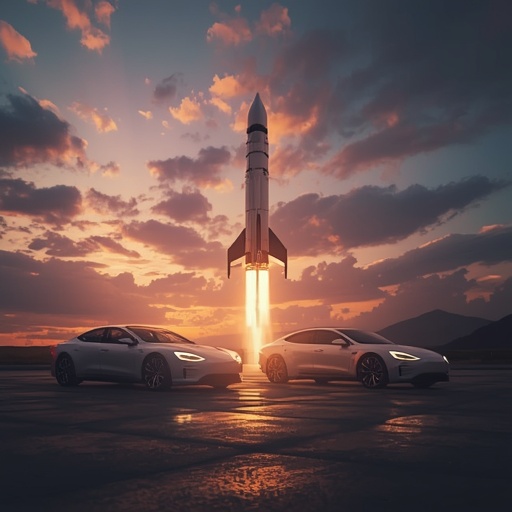
Following SpaceX’s astonishing $86 billion initial public offering, the financial and technological sectors have erupted with speculation regarding a potential merger between Tesla and its spacefaring counterpart. Investors, analysts, and industry observers alike are attempting to decipher what such a union might signify for the future of innovation across both terrestrial and extraterrestrial industries. The speculation is not merely idle curiosity—it stems from the recognition that uniting Tesla’s groundbreaking achievements in electric mobility with SpaceX’s awe‑inspiring advancements in aerospace engineering could represent one of the most profound convergences in modern industrial history.
For many market participants, the idea of integration between these two Elon Musk–led entities conjures a vision of seamless synergy where sustainable transportation meets interplanetary exploration. Tesla’s mastery of battery technology, autonomous driving, and renewable energy solutions could theoretically complement SpaceX’s capacity for space travel, orbital delivery systems, and satellite networking. Enthusiasts argue that combining strengths across these domains could enable unprecedented economies of scale, cost‑sharing efficiencies, and a unified technological roadmap pointing toward a sustainable multi‑planetary civilization.
Yet with such high‑stakes ambition come equally formidable questions about feasibility, governance, and shareholder alignment. Critics caution that merging two enterprises of this magnitude—each with distinct regulatory frameworks, investor constituencies, and operational focuses—could breed complexity that outweighs potential benefits. They highlight potential conflicts of interest, dilution of mission clarity, and the intricate task of managing dual strategic trajectories under one corporate structure.
The market’s response thus far oscillates between electrified optimism and cautious realism. Supporters view the rumored collaboration as a daring and visionary leap that could redefine the parameters of both mobility and aerospace technologies. Detractors, however, interpret it as a risky maneuver that might overextend resources and invite volatility into already ambitious undertakings. Nonetheless, few dispute the cultural and symbolic power inherent in even the possibility of such a union: the fusion of two enterprises that epitomize twenty‑first‑century innovation, each driven by a relentless pursuit of progress beyond conventional boundaries.
Investors, media commentators, and the general public are now left to ponder an intriguing question: if Tesla and SpaceX were to align more formally, could this convergence accelerate humanity’s transition toward sustainable energy and interplanetary existence, or would it expose the limits of even Musk’s audacious reach? Whatever the outcome, the speculation surrounding this potential merger has already elevated discourse about the intersection of technological evolution, market daring, and the human imagination.
Sourse: https://www.businessinsider.com/tesla-investors-spacex-merger-earnings-questions-elon-musk-2026-7