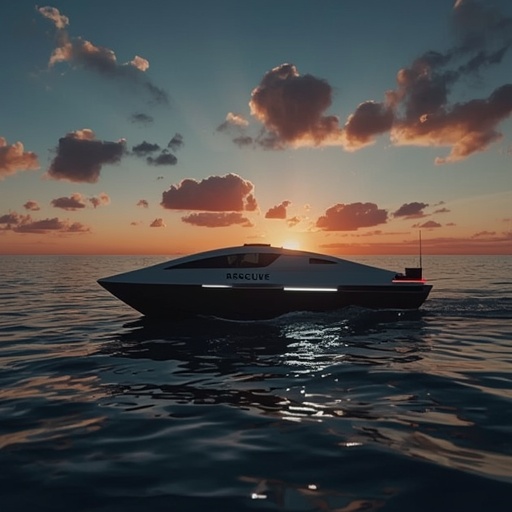
In a remarkable convergence of cutting-edge innovation and life-saving purpose, a pioneering maritime technology enterprise—valued at an extraordinary $9.3 billion—has set a new benchmark in oceanic rescue operations. At the heart of this transformative moment stands the company’s flagship creation, the unmanned Corsair vessel: an autonomous, highly sophisticated boat engineered to navigate and operate independently across some of the world’s most challenging waters. This vessel recently achieved a landmark feat by rescuing two aviators who found themselves stranded in the treacherous Strait of Hormuz, an area renowned both for its strategic global importance and its often perilous maritime conditions.
This event serves not merely as a successful rescue mission but as a vivid illustration of how technological progress can be harnessed for profound humanitarian outcomes. Traditionally, rescue operations at sea have relied on manned vessels and human crews working under extreme circumstances, with speed and weather conditions often determining the fine line between life and loss. The Corsair, however, demonstrates an evolution in this domain—showing that autonomous systems powered by artificial intelligence, advanced robotics, and intricate sensor arrays can make critical decisions in real time, acting with precision, efficiency, and minimal risk to human life.
What makes this development especially significant is how it embodies the shifting paradigm of maritime safety, where innovation no longer functions solely as a tool for convenience or cost reduction but as a fundamental instrument of survival. By integrating drone-based intelligence, data analytics, and robotic control systems, the Corsair effectively merges technological precision with human compassion. This synthesis reflects a future in which the boundaries between artificial mechanisms and humanitarian intent are not conflicting but harmoniously aligned.
Globally, the implications extend far beyond this single rescue. The success in the Strait of Hormuz underscores a broader movement toward automated, technology-driven rescue frameworks that promise to redefine how nations approach emergency response, crisis prevention, and maritime protection. It represents an era where the fusion of innovation and empathy at sea is not an aspiration but an emerging reality—one that inspires confidence in the extraordinary potential of human ingenuity applied through autonomous systems. The technology that once seemed speculative has now demonstrated its ability to save lives, setting the stage for a safer, more resilient maritime future powered by intelligent design and visionary engineering.
Sourse: https://www.wsj.com/tech/what-to-know-about-drone-boat-maker-behind-iran-helicopter-crew-rescue-aa55d445?mod=rss_Technology