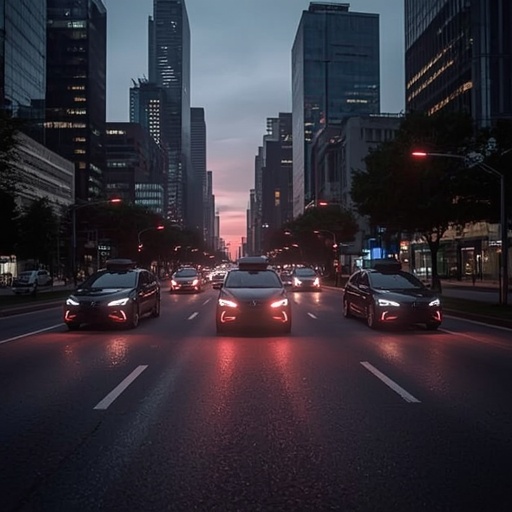
The accelerating future of Uber is moving at a remarkable pace, where technology and intelligence converge on the road ahead. CEO Dara Khosrowshahi has begun discussing how artificial intelligence promises to transform the entire structure of ride‑sharing — not merely through the automation of vehicles, but through a fundamental reimagination of how leadership, decision‑making, and operational systems function within the company. He envisions a landscape where the vehicles themselves become cognitive participants in a broader network of mobility, each connected by data flows that anticipate, adapt, and learn in real time.
At Uber’s recent GO‑GET event, Khosrowshahi shared a forward‑thinking vision that transcends the idea of automation as merely mechanical efficiency. Instead, he suggested, AI is beginning to redefine the essence of mobility itself — influencing not just how passengers move from one point to another, but how organizations orchestrate large‑scale systems where human and machine intelligence complement one another. This transition invites reflection on which aspects of leadership remain uniquely human, such as emotional intuition, ethical guidance, and creativity, and which can be elegantly delegated to algorithms capable of analyzing vast data ecosystems faster than any person ever could.
Uber’s exploration of self‑driving fleets exemplifies this delicate balance between innovation and human oversight. Each driverless prototype represents more than technological advancement; it symbolizes a shift in responsibility from individual operators to collective intelligence systems. As these systems evolve, they raise profound questions: What does accountability look like in a world where the driver might no longer exist? How can trust be cultivated when decision‑making is distributed across invisible neural networks rather than a human presence behind the wheel? Khosrowshahi’s comments urge both his teams and the public to see AI not as a replacement for human capability but as a catalyst that amplifies it.
On social and cultural levels, the integration of AI into transportation introduces an entirely new rhythm to daily life. The predictability and personalization that data‑driven intelligence brings could reduce congestion, improve sustainability, and make urban spaces more fluid. Yet, as he acknowledged, this same shift also demands that leaders remain vigilant about the ethical dimensions of innovation — safety, equity of access, and the preservation of employment opportunities in a changing economy. By inviting these difficult conversations, Uber positions itself not merely as a logistics company, but as a living experiment in how society will coexist with autonomous intelligence.
As Khosrowshahi posed to his audience, the real question facing the future of ride‑sharing and beyond is not whether AI will change our journeys, but how humanity chooses to steer that transformation. The path forward, he suggested, is more than automated — it is profoundly intelligent, adaptive, and intertwined with the human imagination itself.
Sourse: https://www.theverge.com/podcast/922909/dara-khosrowshahi-uber-drivers-ai-hotels-service


