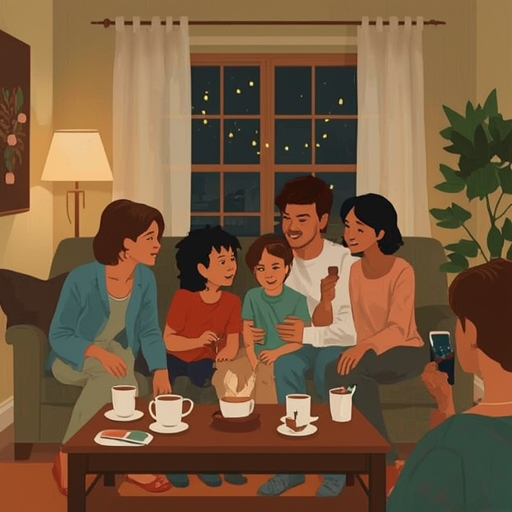
Not long ago, my daughter-in-law reached out to me with a cheerful phone call, inquiring about our family’s approach to Secret Santa. Her questions carried equal parts excitement and curiosity—she wanted to know whether every member of the family would take part, what small stocking stuffers might bring the most joy, and, with affectionate humor, if there was anything I personally desired other than the enormous, warehouse-sized jar of peanut M&Ms from Costco that I have mentioned, perhaps excessively, countless times. Her thoughtfulness made me smile; it reminded me how traditions evolve yet remain lovingly familiar.
Shortly after that conversation, my youngest son sent me a message filled with good news: he had managed to get three full days off from work for Christmas. He was planning to come home—and, much to everyone’s amusement, he would be bringing his cat along for the visit. We immediately decided that the cat, too, would be part of the celebration; everyone agreed to spoil her with treats. While making these plans, I envisioned our kitchen transforming into an aromatic hub of holiday cooking, filled with casseroles, batches of fresh cookies, and the sweet scent of overnight cinnamon rolls ready to bake on Christmas morning. We all agreed that the holiday ritual of watching Christmas movies—the true centerpiece of our shared time—should wait until everyone had arrived. Only then would the festivities feel complete.
This, I realized, is the essence of Christmas with adult children. It is a season of reconnection that feels more profound than I ever imagined. It’s the kind of Christmas I once feared when my four sons were small and I believed I had only a limited number of holiday seasons—eighteen at most—to capture the enchantment of childhood before it vanished forever. At that time, I assumed that the magic of the holidays existed solely in those early years, when the house overflowed with excitement, wonder, and wrapping paper torn in joyful haste.
I used to think those childhood holidays represented the pinnacle of motherhood—the golden years that could never be surpassed. That belief, I now understand, was part of a larger story society tells parents over and over: that Christmas belongs to children, that its sparkle fades once they grow older, and that the true joy of the season is reserved for the years of innocence. Because of that narrative, I tried relentlessly to capture and preserve every drop of holiday wonder, as if I could bottle the magic before it disappeared. I remember digging deep into every tradition—baking until midnight, stringing lights, crafting elaborate memories—not out of leisure, but out of a desperate determination to do it all just right.
I threw myself wholeheartedly into maintaining the illusion of Santa well past the point when most mothers would have given it up. I filled every December day with activity: baking endless batches of cookies, assembling intricate gingerbread houses, and showing up faithfully at every Christmas concert. I sought out matching family pajamas, collected personalized ornaments for each boy, and carefully packed them away every year so they could hang them once more. Those small rituals felt sacred; they were tangible proof of my devotion. Looking back, I can see how I idealized the holiday season, believing that a perfectly executed Christmas could somehow compensate for all the imperfections and shortcomings of life’s other months. I ignored my own exhaustion and stress, convincing myself that what mattered most was earning that invisible badge marking me as a ‘good mom.’
Only now can I admit the truth aloud: those years were incredibly hard. I can finally acknowledge how much weight I carried, not only as a single parent raising four boys but also as someone living close to the poverty line, constantly measuring whether magic could fit into the budget. Yet beyond those external challenges, the heaviest burden was internal—the belief that meaningful Christmases existed only while my children were small. I lived as though a silent countdown clock ticked within each passing holiday, a timer disguised with a shiny red bow. I thought I had to compress a lifetime of joyful memories into those fleeting years so that my sons would grow up remembering happiness, not struggle. The fear that they might someday recall their childhood as lacking drove me to push myself past reason.
If I could step back through time and speak gently to that younger, exhausted version of me, I would tell her to take a breath—that joy doesn’t depend on financial strain or relentless effort. I would reassure her that she could skip buying toys with the money needed for January’s bills, and her children would still grow up content. I would remind her that, though the shiny gifts felt urgent, most would fade from memory by the following year. More importantly, I would tell her that her future held even richer holidays ahead—ones not defined by grand gestures or picture-perfect traditions, but by peace, presence, and laughter shared among grown children who truly see her.
In fact, I would tell her something that might surprise her most of all: that Christmas with adult children can be even more fulfilling than the ones with little ones underfoot. The relentless pressure has dissipated. My sons are grown, forging their own paths, and I no longer carry the sole responsibility of conjuring and maintaining the illusion of holiday magic. They now understand what it took to create that feeling; they see behind the curtain—and they know that I was the one pulling the strings all along. And in that mutual recognition lies something even sweeter than the magic itself.
Today, they stand beside me. They share the weight and the wonder. Together, we head to the grocery store in cheerful disarray, picking up last-minute spices, cream for coffee, and extra napkins that we will inevitably forget the first time. They remind me not to worry, insisting that they will take care of things, that my role is simply to enjoy. The dynamic has shifted in the best possible way—I am no longer the keeper of Christmas all by myself. The responsibility and the joy are communal now, a collective act of love that brings its own quiet enchantment.
Our celebrations blend the cherished with the new. We continue beloved traditions from their childhood, but we also welcome change, allowing spontaneity to take root. Maybe we order Chinese takeout one Christmas Eve or experiment with homemade pizza the next, depending on everyone’s energy and work schedules. We sip coffee touched with a splash of Baileys while opening stockings, laughing at the small surprises tucked inside. The five of us—now joined by new partners who bring their own customs and festive quirks—create a mosaic of warmth, humor, and belonging. We stay up late, play card games, and listen to playlists that blend my old favorites with songs I’m hearing for the first time, discovering joy in that intersection between memory and novelty. I end each night at peace, falling asleep grateful and content.
Do I miss my boys being small? Absolutely—and part of me will always ache for that era of wide-eyed wonder. But when I look around at these capable, kind men and the partners who have become part of our family, I realize that this stage—the laughter echoing around the kitchen, the shared work, and the mutual understanding—is the true reward. This is not the end of the magic after all; it’s simply what the magic grows into when children become adults and home becomes a shared creation rather than something carried on one pair of shoulders.
Sourse: https://www.businessinsider.com/holidays-are-better-once-all-your-kid-are-adults-2025-12