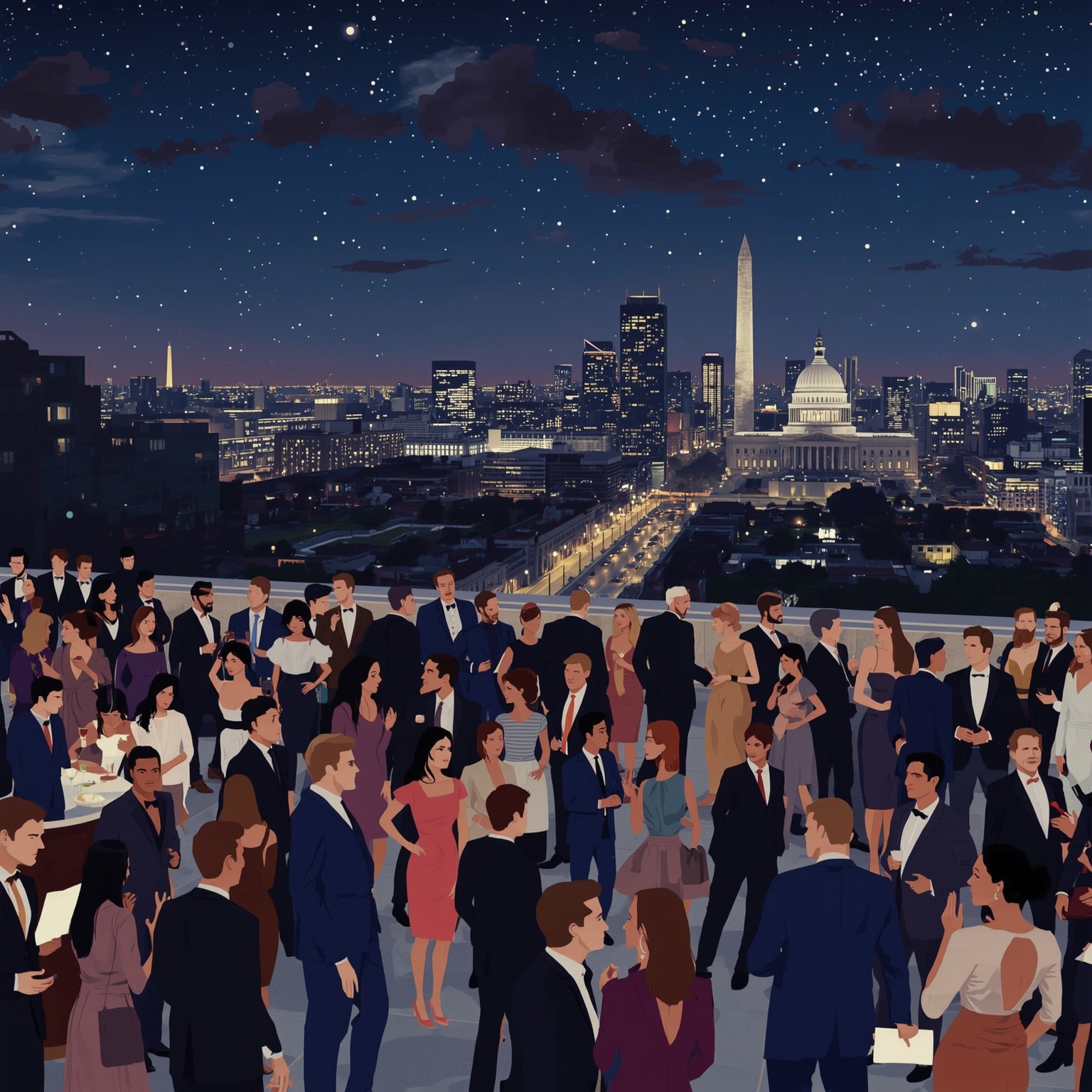
The Free Press promoted its highly anticipated Wednesday night gathering in Washington, D.C., as an intellectual deep dive—an elaborate exegesis devoted to exploring “the Future of American Power.” The event’s headliner was the iconoclastic entrepreneur Palmer Luckey, known both for his unabashed conservatism and for founding Anduril Industries, a cutting-edge defense technology and weapons manufacturing enterprise. Yet beneath the ostensible theme of analyzing geopolitical might, the evening also unfolded as something far more personal and symbolic: a moment of triumph and near-crowning for The Free Press’s cofounder and editor-in-chief, Bari Weiss, whose ascent has mirrored the publication’s transformation from a scrappy start-up into a major player in the American media landscape.
Just two days earlier, a seismic corporate transaction had solidified this transition when David Ellison, the Hollywood producer and son of tech mogul Larry Ellison, effectively baptized Weiss’s outspoken, contrarian media outlet as the new darling of digital journalism. Paramount’s acquisition of The Free Press for a reported $150 million not only conferred on the platform a formidable valuation but also positioned Weiss—now forty-one—as the newly appointed editor-in-chief of CBS News. The Luckey event, which he wittily described as part of his nationwide “I told you so” tour, became an unofficial test case for Weiss’s yet-to-be-implemented editorial vision: journalism that aspires to be, in her own words, “fair, fearless, and factual,” holding America’s two dominant political parties accountable under equal scrutiny. This mandate was laid out in a memo Weiss circulated to the CBS newsroom earlier that same week. Following the discourse, a somewhat restrained but still earnest afterparty awaited The Free Press faithful, eager to toast their outlet’s newfound prestige.
Over nearly two hours of conversation, Weiss and the 33-year-old tech founder traversed a wide spectrum of topics, from national identity and cultural decline to the peculiarities of contemporary media habits. Luckey, who has cultivated a public persona equal parts mischief-maker and futurist, engaged the audience with a mixture of humor and disarming candor. Declaring that “our culture is being destroyed by a pro-litigation, pro-nanny state,” he encapsulated his suspicion of regulatory overreach and bureaucratic paternalism. He also offered glimpses into his personal life, confessing a fondness for Jimmy Buffett’s Margaritaville—a place where, as a new parent, he quipped, he has found solace in tropical cocktails—and revealed himself to be an unrelenting devotee of the television show “Survivor,” though he lamented that his repeated applications to compete would never be accepted due to his billionaire status, which he acknowledged would make him a target no fellow contestant could allow to win.
The genesis of The Free Press dates back to 2021, when Weiss—disenchanted with what she perceived as the mainstream media’s abandonment of objectivity and intellectual pluralism—established her own digital publication. From its inception, The Free Press has championed vigorous debate, often publishing provocative or ideologically diverse viewpoints. Its homepage even warns readers, “You won’t agree with everything we run,” a slogan that doubles as both caveat and invitation. Consistent with this ethos, Weiss has enlisted contributors like Jed Rubenfeld, a Yale constitutional law professor known for his stringent views on free speech, and Tyler Cowen, a libertarian economist and academic at George Mason University celebrated for his eclectic analysis of cultural trends. The outlet’s youthful, primarily Gen Z staff has tackled an eclectic array of stories—ranging from computational deep dives into the social media footprint of New York City mayoral hopeful Zohran Mamdani, amassing sixteen thousand tweets, to exuberant firsthand accounts of the publication’s legendary “lit” office parties. In one recent instance, Cowen penned an ode to his favorite actress—a digital creation he described as an AI-generated paragon of innocence, underscoring the publication’s readiness to explore the edges of technological culture.
Both Luckey and Weiss share a recognizable narrative arc: each has endured professional exile from elite institutions only to later be, at least partially, embraced anew by the same establishment that once repudiated them. In Luckey’s case, his exile came after selling his pioneering virtual reality startup to Facebook (now Meta) in 2014. Three years later, reports circulated that his departure from the company was linked to his $10,000 donation to a pro-Trump meme-making group, a revelation that sparked controversy and allegations of politically motivated reprisal—claims Facebook and CEO Mark Zuckerberg have consistently denied. Yet, time appears to have softened any personal animus between the two; earlier this year, they rekindled their working relationship when Anduril announced a collaboration with Meta to develop an AI-powered headset. When Weiss asked whether partnering with Zuckerberg represented a pragmatic reconciliation, Luckey responded coolly, “I’m doing what’s best for my game,” reflecting his strategic approach to both politics and business.
Weiss’s own estrangement from old-guard media occurred in 2020, when she resigned from The New York Times, citing persistent “bullying by colleagues” and an institutional intolerance for dissent. Now, only a few years later, she has become the toast of the journalistic establishment, admired as both a disruptor and a newly minted insider. Onstage in Washington, she savored this reversal with confident humor: “I love D.C.,” she told the audience, “though not necessarily for the same reasons many of you do. I’m not exactly a policy wonk. But in New York, I’m maybe a three, and in D.C., I’m more like a seven and a half,” she said, a wry acknowledgment of her elevated stature amid the capital’s rarified social ecosystem.
The afterparty captured the restless energy of The Free Press’s eclectic fan base. Attendees ranged from Luckey enthusiasts and precocious congressional aides to suburban mothers from the D.C.-Maryland-Virginia corridor. The drinks—imaginatively titled The Free Press Fizz, the Get Luckey, and the Think for Yourself—mirrored the evening’s blend of self-awareness and irony. Among the crowd were individuals wearing slogan-heavy apparel: one woman sported a “Hot Girls for Capitalism” T-shirt (a brand recently featured on a Free Press writer’s Instagram); a man appeared in an IDF baseball cap; another guest, clasping a Modelo beer, wore a shirt proclaiming, “Free Speech Makes People Free.” DJ Q, who cheerfully admitted he had never heard of Weiss’s publication before being hired, played a buoyant “yacht rock” playlist that included era-spanning hits—among them “Love Train” and Vanessa Carlton’s turn-of-the-millennium anthem “A Thousand Miles,” a track appearing on Luckey’s public Spotify list. Despite the upbeat soundtrack, few people danced; instead, many reclined on plush red-velour Chiavari chairs, exchanging stories and affirmations about their admiration for Weiss and their shared sense of belonging to what one attendee jokingly termed “the Cult of Bari.”
Their devotion manifested in different ways. One attorney, insistent on being described only as “handsome, successful, and Jewish,” explained that his attraction to Weiss stemmed more from her forthright personality than her published reporting. The self-described libertarian in the “Hot Girls for Capitalism” shirt elaborated that she appreciated Weiss’s editorial philosophy, which encourages readers to oscillate between irritation and validation—an intentional blend of provocation and affirmation. Another attendee, an analyst working in finance at a research institution recently affected by federal budget cuts, confessed she subscribes because The Free Press provides perspectives on Trump absent elsewhere, remarking pointedly that “you don’t find anything positive about him in The New York Times.”
Still, amid the celebratory atmosphere lingered an undercurrent of ambiguity. For some longtime supporters, Weiss’s appointment at CBS cast uncertainty on what The Free Press’s insurgent identity would now represent. “When I wear my Free Press T-shirt, I feel like I’m giving the mainstream media the finger,” said subscriber Debbie Bharucha. “But now that Bari is CBS, I don’t know what that means anymore.” Others worried about potential dilution of focus: an early subscriber employed in the defense technology sector admitted a fear that the demands of network leadership might siphon Weiss’s attention away from the publication’s independent vigor.
Although Weiss has been photographed presiding over her parties with near-celebrity poise, she was notably elusive that night—no one I spoke to had actually spotted her past the main event. Earlier in the week, during her initial address to the CBS News staff, she reportedly exhorted her new team with a terse, emphatic directive: “Let’s do the f***ing news.” On that Wednesday evening in Washington, surrounded by skeptics, loyalists, and the merely curious, it seemed clear that there was indeed news in the making—news about the evolution of power, perception, and personality in American media itself.
Julia Hornstein, who covers venture capital and defense technology for Business Insider, contributed this analysis as part of the publication’s “Discourse” series, which aims to provide sophisticated perspectives on the most crucial issues shaping contemporary society, grounded in factual reporting and informed commentary.
Sourse: https://www.businessinsider.com/free-press-acquisition-party-bari-weiss-palmer-luckey-paramount-2025-10