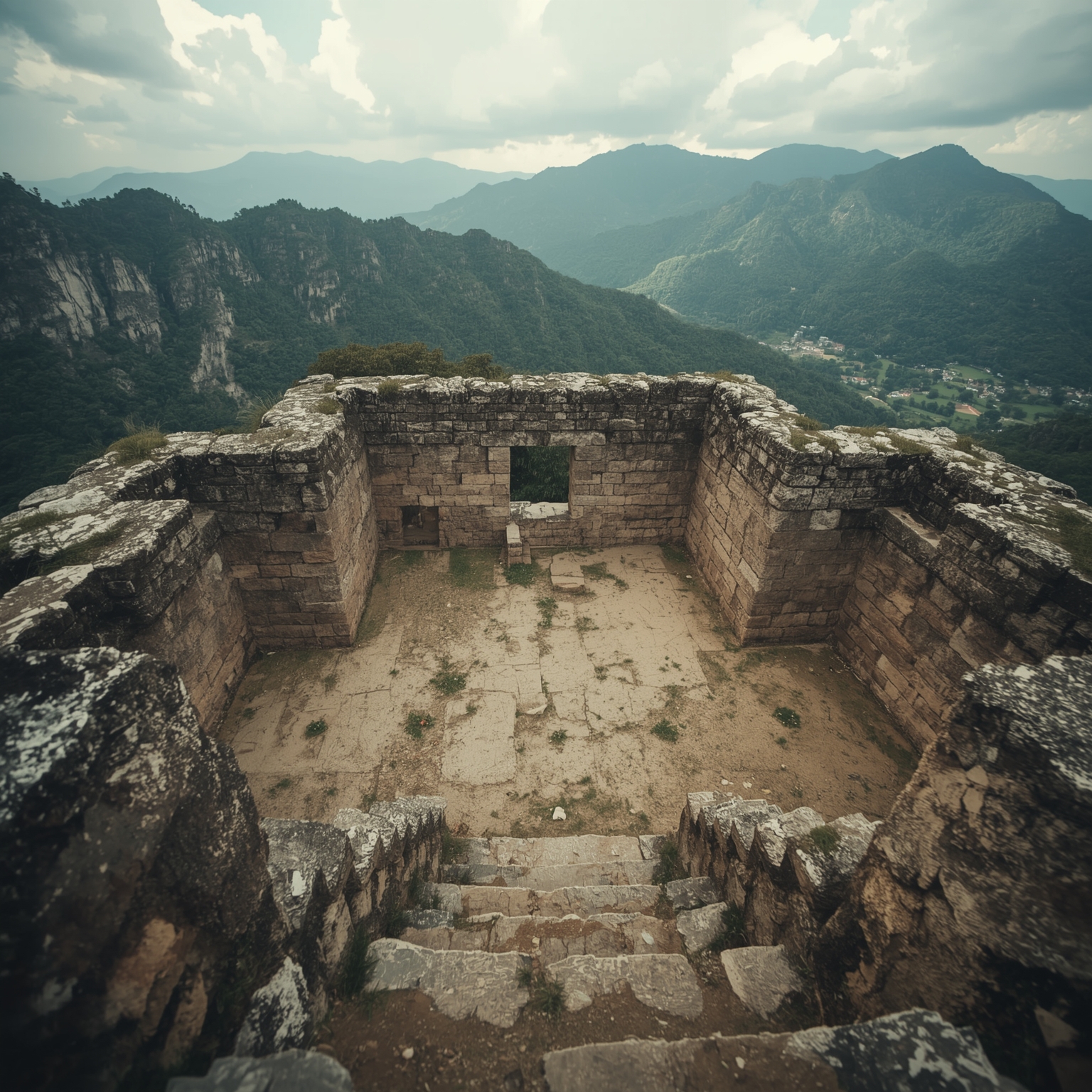
Hidden in the isolated town of Huaytará, tucked high within the Peruvian Andes, stands a seemingly modest building that shelters the Church of San Juan Bautista. Yet beneath its quiet religious exterior lies something far more extraordinary. The church was constructed directly over an enigmatic Incan edifice known as a *carpa uasi*—literally translated as “tent house.” This ancient, three-walled structure reflects a deliberate architectural choice that sacrificed some traditional notions of stability in exchange for a unique and perhaps startling purpose. What appears to be an architectural anomaly may, in fact, reveal a sophisticated understanding of acoustics and sensory experience within Inca culture.
Although the Inca Empire is globally celebrated for the breathtaking majesty of the fifteenth-century citadel of Machu Picchu, scholars are now turning their attention to other, less famous creations that nonetheless embody the empire’s nuanced mastery of environment and design. A group of researchers is currently studying the *carpa uasi* to investigate how its distinct structural arrangement might have affected sound. By examining its design and material properties, the team seeks to understand how this site connects to the broader Incan worldview—one that valued harmony between physical construction and ephemeral sensory experiences. Their work underscores the vital importance of looking beyond visual splendor when retracing the intellectual and cultural footprints of civilizations long gone. Indeed, history gains depth when we explore what cannot be seen but can be heard, felt, or sensed in subtler ways.
The *carpa uasi* itself presents a rare architectural form: a three-walled building deliberately open on one side. According to researcher Stella Nair, an associate professor of Indigenous arts of the Americas at the University of California, Los Angeles, this architectural asymmetry might not have been a mere structural quirk but an intentional acoustic innovation. As she explained in a university statement, her team is exploring the possibility that this partially enclosed arrangement allowed the space to amplify low-frequency sounds—such as the deep reverberations of drums—while minimizing lingering echoes. If this proves true, it would represent the first empirical evidence of what the Incas may have valued sonically within this sacred or ceremonial context. Through their study, Nair and her colleagues seek to reconstruct the auditory world of the Andean past and, by doing so, to recover elements of Indigenous knowledge that have long remained silent.
The Inca civilization, a pre-Hispanic empire that thrived during the fifteenth and early sixteenth centuries, extended majestically along the western coastline of South America—from what is now Ecuador to Chile. Known for their intricate stone masonry, remarkably precise city planning, and enduring roads and terraces, the Incas have often been celebrated primarily for their visual and structural achievements. Yet the *carpa uasi* introduces a compelling reminder that their mastery extended into less tangible realms. The open wall of this structure, oriented perhaps with purposeful alignment, may have served to direct and project sonic energy outward, allowing rhythmic drumming or ceremonial sounds to flow through the highland air toward listeners gathered beyond its threshold.
The very term *carpa uasi*, or “tent house,” encapsulates an architectural philosophy markedly different from the solid permanence of stone temples or fortresses. It implies openness, transience, and movement—qualities perfectly aligned with the dynamic and ephemeral nature of sound. Nair has emphasized that while many people marvel at the Incas’ skill in manipulating stone, this visible craftsmanship represents only the surface of their ingenuity. Beneath that surface lay a more ephemeral creativity: a sensitivity to sound, vibration, and impermanence. In her interpretation, the builders willingly accepted a degree of structural instability within the *carpa uasi* to achieve an acoustic richness that served ceremonial or spiritual aims. Sound, for them, was not merely incidental—it was sacred, a living element interwoven with architecture, ritual, and collective experience.
Although this particular structure has been known to archaeologists for years, Nair and her team appear to be the first to explicitly consider its acoustic function. This distinctive *carpa uasi* is moreover the only known surviving example of its kind. It has persisted for six centuries, its preservation unexpectedly aided by the later construction of the church that sits atop it. The combination of ancient stone and colonial architecture thus forms a rare physical dialogue between two historical epochs. Now, researchers are developing detailed models to simulate how sound waves would have traveled through and beyond the three walls, mapping the invisible soundscapes that once animated the site.
Nair concludes that the study of sound is indispensable to understanding ancient environments, for modern scholarship often privileges the visual. We tend to interpret both our world and our past primarily through what can be seen, drawn, or reconstructed visually. Yet human experience, she reminds us, is multisensory. Our comprehension of place, identity, and memory alters profoundly when we reintroduce hearing—and by extension, sound—into the historical narrative. By restoring the sonic dimension to our perception of Inca architecture, we rediscover a civilization that not only shaped stone with precision but also carved resonance from the air itself, designing spaces that continue, even now, to whisper across the centuries.
Sourse: https://gizmodo.com/the-inca-built-this-three-walled-building-to-shape-sound-study-suggests-2000676478


