In the lexicon of cinema, few techniques command the same level of admiration and technical reverence as the long take—the continuous, unbroken tracking shot often affectionately referred to as “the oner.” This cinematic maneuver, regardless of the name one chooses for it, stands as one of the most intricate and demanding feats a filmmaker can attempt. It marries meticulous technical coordination with artistic audacity, requiring flawless synchronization among camera operators, set designers, lighting technicians, and actors. In this type of sequence, every movement, gesture, and camera glide must be executed with absolute precision; even the smallest misstep can shatter the illusion of uninterrupted continuity and necessitate an exhausting reset. Thus, the true artistry of the long take lies not only in its visual grace but in the orchestration of countless creative and logistical details working seamlessly in real time.
Film history offers a handful of iconic examples that demonstrate both the ambition and the beauty of this technique. In Martin Scorsese’s *GoodFellas*, the legendary casino tracking shot allows viewers to glide alongside the characters through a vibrant, chaotic underworld, immersing them completely in the rhythm of the scene. Years later, Alfonso Cuarón’s *Children of Men* elevated the approach yet further, using carefully choreographed action sequences to convey urgency, realism, and emotional immediacy. Alejandro González Iñárritu pushed the illusion of continuity to its limits in *Birdman*, crafting an entire film that appears to unfold in one extraordinary, continuous movement. Even television has paid tribute to this cinematic artform—an episode of *The Studio*, self-referentially titled “The Oner,” both explores and replicates the difficulty of executing such a shot. Within it, Seth Rogen’s character proclaims the unbroken take to be the “ultimate cinematic achievement,” describing it as the perfect union of artistic imagination and technical discipline. His remark, laced with both admiration and irony, points toward the cultural mystique surrounding the technique—a fascination perhaps most fervently shared by those filmmakers and cinephiles deeply attuned to the craft behind the camera.
Yet, recent developments in world cinema suggest that the pursuit of the perfect long take is far from confined to Western auteurs. No contemporary practitioner embodies this artistic challenge more audaciously than the Chinese filmmaker Bi Gan. His latest work, *Resurrection*, a science-fiction odyssey set against the historical and emotional landscapes of twentieth-century China, culminates in a dazzling thirty-minute continuous tracking sequence. This monumental scene—executed as a genuine single take rather than digitally stitched together—demonstrates the director’s mastery of spatial storytelling and temporal immersion. Over its unrelenting thirty minutes, the camera escorts the audience from the shadowy docks of a nighttime confrontation through rain-soaked alleys and into a frenetic karaoke bar, before circling back to the harbor, where the central romance undergoes a shocking metamorphosis at sea. The sequence’s fluid transition from darkness to dawn not only captures an extraordinary technical accomplishment but also conveys a deep emotional and atmospheric transformation, leaving viewers dazzled and disoriented in equal measure.
For comparison, consider that Sam Mendes’s *1917*, often cited as a modern benchmark for the illusion of the one-shot film, includes its longest uncut segment at nine minutes—stitched together through seamless editing to simulate continuity. Bi Gan’s *Resurrection* surpasses such efforts not merely in duration but in conceptual unity: every frame genuinely unfolds in real time. Still, this breathtaking achievement should not surprise those familiar with Bi’s cinematic lineage. His debut, *Kaili Blues*, concluded with an already audacious forty-one-minute continuous journey across the misty, labyrinthine mountain village of Dangmai. Later, his dreamlike opus *Long Day’s Journey into Night* culminated in a nearly hour-long unbroken 3D sequence that fused the real and the surreal into one hypnotic continuum. For Bi, the long take is not a novelty but an extension of his central artistic philosophy—a tool for exploring time, memory, and consciousness through the camera’s unblinking gaze.
When speaking about his craft through an interpreter, the thirty-six-year-old director reveals both a deep intellectual curiosity and a mischievous charm. While he acknowledges that such sequences depend on the painstaking collaboration of cinematographers, designers, and numerous extras, he regards the long take as something quintessentially his own—a recurring signature of his artistic identity. Having refined his approach film after film, Bi has developed both a practical fluency and a poetic rationale for the method, one rooted in the relationship between cinematic time and human experience.
In conversation with *The Verge*, Bi elaborates that long takes significantly shape the audience’s perception of time. By allowing action to unfold in real duration without the fragmenting effects of cuts, viewers are compelled to experience time as something palpable rather than abstracted—a river flowing continuously rather than a series of disjointed snapshots. Traditional editing, with its jump cuts and temporal compression, encourages cognitive shortcuts; in contrast, Bi’s approach immerses the spectator in the rhythm of existence itself. As he explains, when one witnesses a story presented in an unbroken flow, the viewer’s understanding of cinematic time becomes more intuitive, almost meditative.
Interestingly, Bi insists that it is not essential for viewers to consciously recognize that what they are seeing is a single take. Yet he acknowledges that most audiences, attuned to the film’s fluid motion, will instinctively perceive the presence of an uncut sequence. What truly matters to him is not the detection of the technique but the sensation of continuous, compressed, and evolving time—the paradoxical feeling that time moves both freely and intensely within the frame.
This preoccupation with temporality extends beyond mere technique. In his earlier film *Kaili Blues*, Bi fused three distinct temporal layers—past, present, and future—within the space of one long take, effectively transforming time itself into a narrative terrain. Meanwhile, in *Long Day’s Journey into Night*, he applied a similar principle to memory, using the unbroken 3D shot to emphasize how recollection, though inherently fragmented, can feel strangely coherent when re-experienced through cinema’s artificially continuous lens. For *Resurrection*, however, Bi shifts that exploration of time toward a symbolic threshold—the final day of the twentieth century. Here, the long take becomes the most fitting vessel for depicting a moment of transition: two protagonists fleeing into the new millennium, their love transforming into something literally monstrous as they become vampires. This imaginative twist finds its perfect expression in a form that denies fragmentation; only the unbroken gaze of the camera can encapsulate both the intimacy and the epic scope of that metamorphosis.
The conception of this monumental shot emerged early in the creative process. Bi began with a chapter adapted from his own novel *UFO*, a story centered on two lovers eloping amidst uncertainty and transformation. Translating such emotional intensity from text to screen required what he describes as the search for the film’s purest “language”—the mode of expression uniquely suited to its spirit. During production, discussions with his longtime collaborators, cinematographer Dong Jingsong and production designer Liu Qiang, led to the decisive breakthrough. Dong introduced Bi to a painting by Mark Rothko dominated by resonant red hues gently mingling with subtler tones. The abstraction and emotional depth of that canvas inspired Bi to convey a similar sense of immersive continuity through motion, ultimately culminating in the decision to represent the story as a single, uninterrupted take. This decision was not taken lightly; the team approached the concept with the utmost care, refusal of gimmickry, and an awareness that the technique itself should serve the story rather than overshadow it.
When asked if he worries that audiences might come to expect a long take in all his future films, Bi responds with casual assurance. He sees himself as an artist unconstrained by formula or convention, unafraid to reinvent his methods as needed. His respect for film history is evident, yet he maintains that his use of extended takes is rooted less in homage to other filmmakers than in philosophical inquiry. From *Kaili Blues* onward, the long take has been, for him, a mode of thought as much as a cinematic device—a way to express his ideas about perception, continuity, and the nature of reality. He subverts expectations not by rejecting influence but by reconfiguring cinematic principles through his own metaphysical lens.
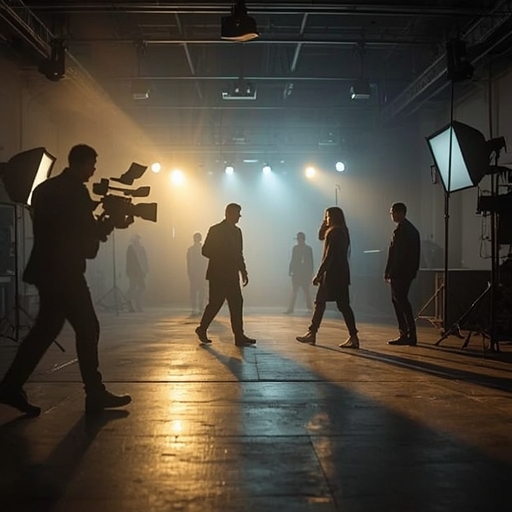
Planning one of Bi’s long takes proves an undertaking of daunting complexity. The script must be intricately action-based, emphasizing physical movement and spatial dynamics more than conventional dialogue exchange. The search for the right locations—docks, railways, karaoke bars, hospitals—requires both logistical flexibility and aesthetic imagination. A single setting must be able to accommodate multiple moods and narrative shifts without the benefit of edits. The process depends upon constant dialogue among the art department, the cinematography team, and the technical staff. Any obstacle encountered during rehearsal—a corner too narrow for a camera dolly, a light reflection breaking continuity—can prompt adjustments to the script itself. Through repeated technical rehearsals, these collaborators refine a choreography so intricate that it resembles dance as much as filmmaking. Once those foundations are in place, the actors join the process, rehearsing their movements within this living, breathing corridor of artifice.
Preparation for *Resurrection* consumed an entire month, operating primarily during nighttime hours to match the film’s setting. By day, cast members pursued specialized training—learning to pilot boats or perform karaoke scenes crucial to the story’s atmosphere. Even background performers were coached with exceptional attention to psychological realism. Bi provided them with a detailed historical and emotional context, reminding them that their characters exist on the final night of 1999. Encouraged to imagine their identities and motivations within that specific temporal moment, these extras lent authenticity to even the smallest gestures captured by the ever-roaming lens.
While modern technology allows digital stitching to fabricate the illusion of a continuous shot, Bi takes pride in insisting that *Resurrection*’s climactic sequence was captured in one uninterrupted take, free from concealed cuts. The care and patience behind such a feat are nearly unimaginable, especially considering that the team required only three complete takes to achieve the final version—an achievement that borders on the miraculous even by professional standards.
With *Resurrection*, Bi Gan reaffirms that the long take remains one of cinema’s purest expressions of collaboration and vision. It collapses the boundaries between technical mastery and poetic expression, between narrative time and lived experience. In witnessing such a sequence unfold, the viewer does not merely watch a story; they inhabit it—unchanging, unbroken, and utterly alive.
Sourse: https://www.theverge.com/entertainment/842881/resurrection-bi-gan-interview-tracking-shot