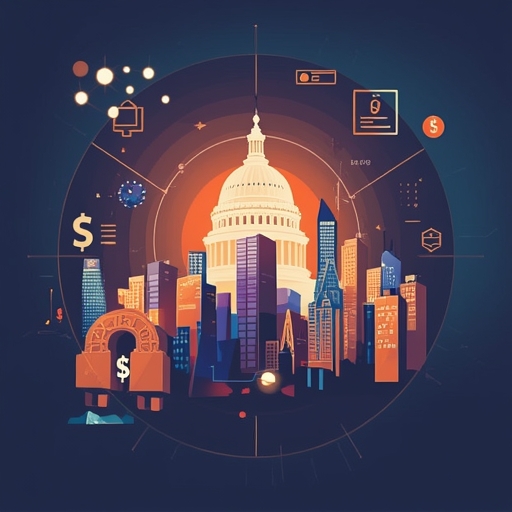
The United States appears to be stepping decisively into a transformative chapter of its economic history—an era in which the federal government is no longer confined to writing regulations or supervising markets from the sidelines, but is instead assuming a direct and strategic ownership role within private enterprise. What was once a distant notion—public authority intertwining with market competition—is now materializing through targeted federal investments that place government capital alongside private innovation.
This shift represents far more than a temporary policy adjustment; it signals a profound reconfiguration of the American capitalist structure itself. Traditional capitalism, rooted in minimal state interference and the primacy of market forces, is gradually giving way to a hybrid, mixed-market paradigm in which public and private interests are intentionally aligned to pursue common goals such as sustainable growth, technological innovation, and long-term national resilience. For instance, sectors like clean energy, semiconductor manufacturing, and infrastructure reconstruction are witnessing significant infusions of federal funding, transforming the government into not merely a regulator but a shareholder—one wielding influence over the direction and priorities of entire industries.
The implications of this evolution are complex. On one hand, such government participation could accelerate progress in areas where private investment alone has proven insufficient or risk-averse. It may enable the country to compete more effectively in global markets where state-supported enterprises, such as those in Asia and Europe, already dominate. On the other hand, it raises vital questions about accountability, efficiency, and the boundaries between public purpose and private profit. Could this partnership foster broader prosperity, or might it blur the lines of responsibility in ways that challenge transparency and competition?
Ultimately, what emerges is an economic environment in which government power and corporate ambition coexist in a delicate equilibrium. This synthesis may redefine what it means to create value—merging profitability with public interest, and market success with social responsibility. While uncertainties remain about how this experiment will unfold, one thing is clear: the conventional doctrine of laissez-faire capitalism is making room for a more collaborative, state-empowered model designed to meet the urgent challenges of the twenty-first century. The question before business leaders and policymakers alike is whether they are prepared to navigate, and perhaps even embrace, this remarkable reimagining of American capitalism.
Sourse: https://www.businessinsider.com/new-era-america-capitalism-socialist-trump-economy-2026-1