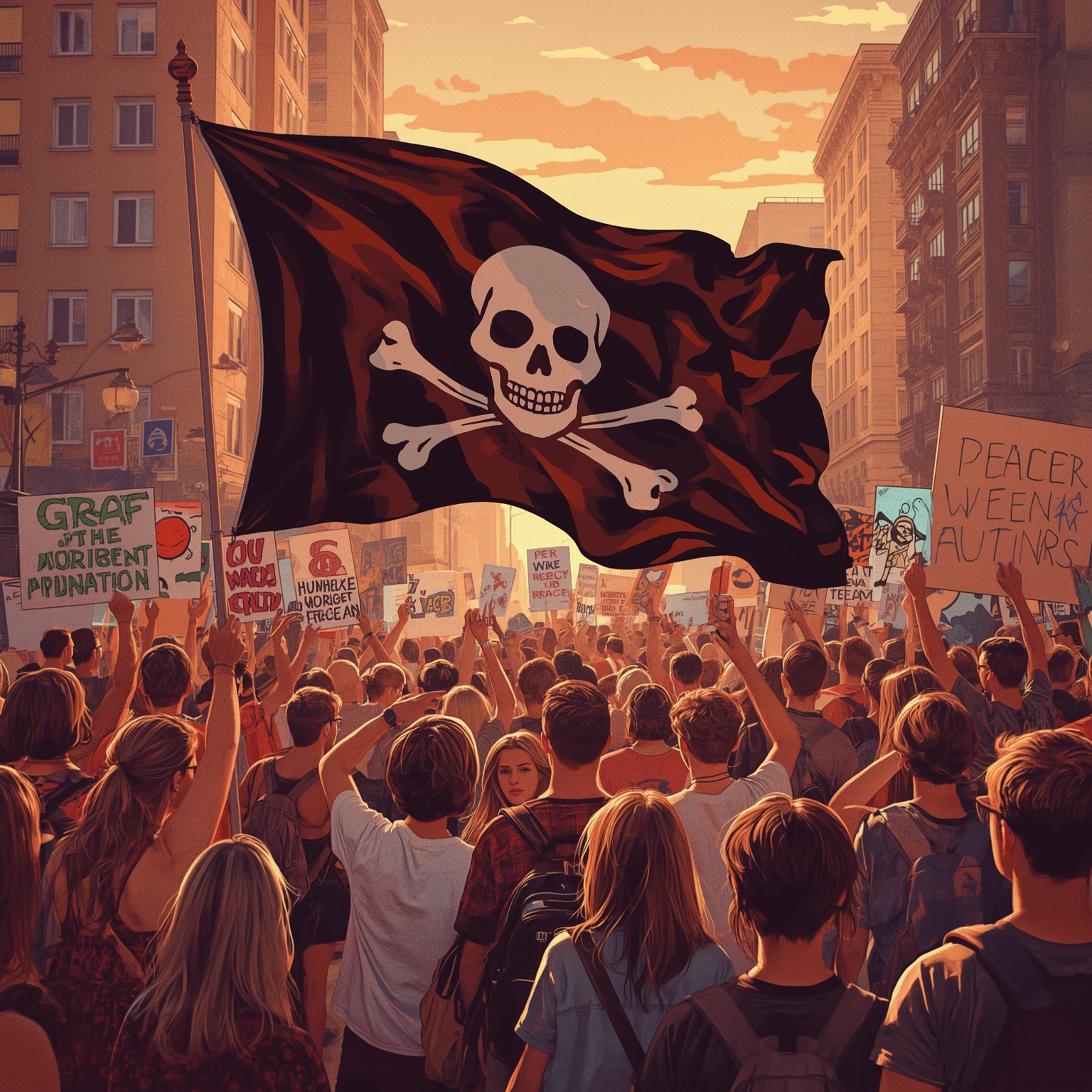
Why, one might wonder, were young protesters in Mexico—members of the so-called Generation Z—seen brandishing an anime-inspired banner emblazoned with a skull and crossbones topped by a jaunty straw hat? This curious sight appeared during a wave of demonstrations that erupted across a number of Mexican cities over the weekend, drawing significant domestic and international attention. According to Reuters, several participants in Mexico City, some wearing face-covering hoods, reportedly dismantled or destroyed portions of the protective fencing that had been erected around the National Palace, the official residence of President Claudia Sheinbaum. Meanwhile, in the United States, right-wing media outlets such as Fox & Friends invited two sharply dressed Spanish-language commentators who sought to frame the protests as an expression of what they called a “national awakening” — a public rebellion allegedly provoked by surging criminal activity and discontent with the country’s left-leaning leadership. These commentators pointed specifically to the recent assassination of an anti-cartel mayor—apparently murdered by organized crime operatives—as both the immediate catalyst for anger and the justification for their startling suggestion that foreign military intervention might be welcome. Yet, as The Economist, a centrist British publication, has noted, comprehensive crime data reveals that the overall rate of homicides in Mexico has significantly declined during Sheinbaum’s tenure, complicating the narrative promoted on partisan platforms.
In short, it may be premature to summarize these demonstrations as having a single, unambiguous cause. Until observers have the benefit of distance and further clarity, speculation should be tempered. Nevertheless, while a unified cause remains elusive, a unifying image has undoubtedly emerged—the Straw Hat Jolly Roger, the gleefully defiant pirate flag from the globally adored anime and manga franchise *One Piece*. This symbol, once confined to the realm of fictional adventure, appeared repeatedly throughout the protests, saturating both local footage and international news imagery. Its ubiquity has made it nearly impossible to dissociate the Mexican protest movement from the playful yet rebellious aesthetic of the Straw Hat Pirates.
But what, exactly, are the ideological or political connotations of *One Piece*? The work created by Eiichiro Oda stands as one of contemporary culture’s most expansive fictional universes, so extensive and intricately woven that it simultaneously captivates those who consume vast amounts of media and intimidates newcomers who can barely find an entry point. Its ensemble cast—the Straw Hat Crew—comprises an assortment of vibrant, determined adventurers, nearly all of whom carry deeply personal histories shaped by hardship and loss. Their leader, Monkey D. Luffy, with his signature wide grin and indomitable spirit, appears to live by an unconventional interpretation of liberty. His aspiration to become the “Pirate King” does not stem from a desire for conquest or tyranny but from his belief that true freedom lies in the uninhibited pursuit of friendship, self-determination, and the thrill of exploration. In that sense, his “freedom” manifests less as a political doctrine and more as a joyous philosophy of life unbounded by control.
Throughout the story, the narrative abounds with epic confrontations—battles that transcend mere personal ambition. Many of these conflicts symbolically mirror the eternal struggle between oppression and self-determination. The Straw Hat Pirates repeatedly challenge the authoritarian powers of the *World Nobles*, decadent global elites who inhabit the highest tiers of the fictional social hierarchy. These figures evoke the image of cruel, insulated rulers who maintain their privileges through systemic injustice—echoing depictions of tyranny found everywhere from eighteenth-century French political cartoons to dystopian franchises such as *The Hunger Games* and cult cinematic visions like *Zardoz*. Beneath the fantasy, *One Piece* structures its moral universe around a simple yet resonant idea: solidarity among the free against those who abuse power.
Who, then, are the Mexican demonstrators waving this flag, and why has this foreign pop culture emblem become their chosen banner? Parsing the identities and motivations of participants is difficult, particularly for observers located outside the country and attempting to follow developments filtered through translation. Reports from the Associated Press describe the gatherings as remarkably diverse in composition, attended by people of various ages. Among them were supporters of the slain mayor of Michoacán, Carlos Manzo, some of whom wore the traditional straw hats that had become synonymous with his political persona. Though Manzo was technically a millennial rather than a member of Generation Z, he fashioned his public image around working-class symbolism, favoring rustic straw cowboy hats that denoted humility and solidarity with ordinary citizens. After his death, one of these hats was even placed upon his coffin, a poignant gesture that underscored his connection to grassroots identity. Elsewhere, in Guadalajara, demonstrators were photographed hoisting an enormous straw hat aloft as they marched—yet visual evidence suggests few participants actually fit the Gen Z age bracket that international commentary emphasized. Still, the sight resonates with younger audiences familiar with *One Piece*, given that straw hats have become trendy accessories among the youth, especially visible during cultural festivities like Halloween.
What is especially fascinating is that the *One Piece* flag’s appearance in such contexts is not confined to Mexico. In recent months, similar imagery has surfaced in protest movements across multiple countries. For example, during demonstrations in Indonesia in August, described by the BBC as being driven by frustration over the rising cost of living and widespread resentment of political privilege, protesters unfurled the same skull-and-straw-hat flag. Inspired by grievances over parliamentary pay and housing perks, citizens reinterpreted the *One Piece* emblem as a potent symbol of sincerity and defiance. Indonesian researcher Kurniawan Arif Maspul traced the surge of this symbol back to the preceding month, noting its transformation from niche fandom icon into a generalized expression of anti-corruption and populist sentiment. Local interviews revealed a range of interpretations: a truck driver from East Java explained that he displayed the flag because “life is getting harder” and that “Luffy fights injustice, that’s what we feel too.” For many young Indonesians, the fictional flag had come to represent honesty, bravery, and resistance against a system perceived as exploitative—qualities that their national flag, while revered, no longer seemed to embody in daily life.
A similar symbolic metamorphosis occurred in the Philippines, where, according to *The Guardian*, demonstrations in September adopted the flag as a visual shorthand for youthful rebellion against oppression. Twenty-three-year-old organizer Eugero Vincent Liberato articulated this sentiment succinctly: the flag, he said, represents liberation and the determination to fight for a just and equitable future. These statements, though geographically distant from Mexican realities, unveil a shared emotional vocabulary—one that unites global youth through aesthetic and ideological resonance.
When viewed through this international lens, the straw-hatted pirate emblem begins to transcend its fictional origins. One prominent commentator on the Reddit community r/vexillology even dubbed it “the de facto flag of Gen Z,” proposing that its repeated appearance across continents constitutes a generational signature. In Mexico, as NPR correspondent Eyder Peralta reported, many of the protests were indeed organized by young people who identify as Generation Z, describing their activism as a stance against what they termed a “narcogovernment”—a perceived merger of political and criminal power. Thus, the image of Gen Z activists rallying behind an icon devised by a Generation X artist, in a movement catalyzed by the assassination of a millennial leader, epitomizes a remarkable cross-generational exchange of symbolism.
Yet political interpretation remains disputed. President Sheinbaum has asserted that these demonstrations are neither spontaneous nor grassroots, but rather coordinated and artificially magnified—“astroturfed,” as she put it—by right-wing interests within Mexico, allegedly supported by online bots. Such claims, regardless of their validity, remind observers that cultural symbols often drift free from their political hosts, morphing as they circulate through digital channels of meme and myth.
Indeed, this is not the first instance of pop culture imagery finding unforeseen life in political dissent. The three-finger salute drawn from *The Hunger Games* series served as a powerful gesture of resistance during the 2020 protests against the Thai monarchy. Phrases and motifs from *Harry Potter* were invoked by activists during the 2018 March for Our Lives to promote gun control awareness. Even earlier, in 2008, demonstrators opposing the Church of Scientology adopted the Guy Fawkes masks popularized by the film adaptation of Alan Moore’s *V for Vendetta*, a practice that soon spread to tens of thousands of protesters worldwide and evolved into a globally recognized cipher for digital-age rebellion.
In light of this history, the proliferation of the *One Piece* flag at marches and rallies may need no elaborate political rationale. Popular symbols frequently migrate out of their native contexts, acquiring new meanings through collective reinterpretation. What began as a whimsical emblem of fictional pirates now surges above real-world crowds, representing—in varying proportions—desperation, hope, irony, and unity. Perhaps that is explanation enough: in an age where identities are fluid and cultural references universal, even an anime flag can capture the shared longing for freedom that transcends nations, languages, and generations.
Sourse: https://gizmodo.com/gen-z-one-piece-flag-protests-2000686632


