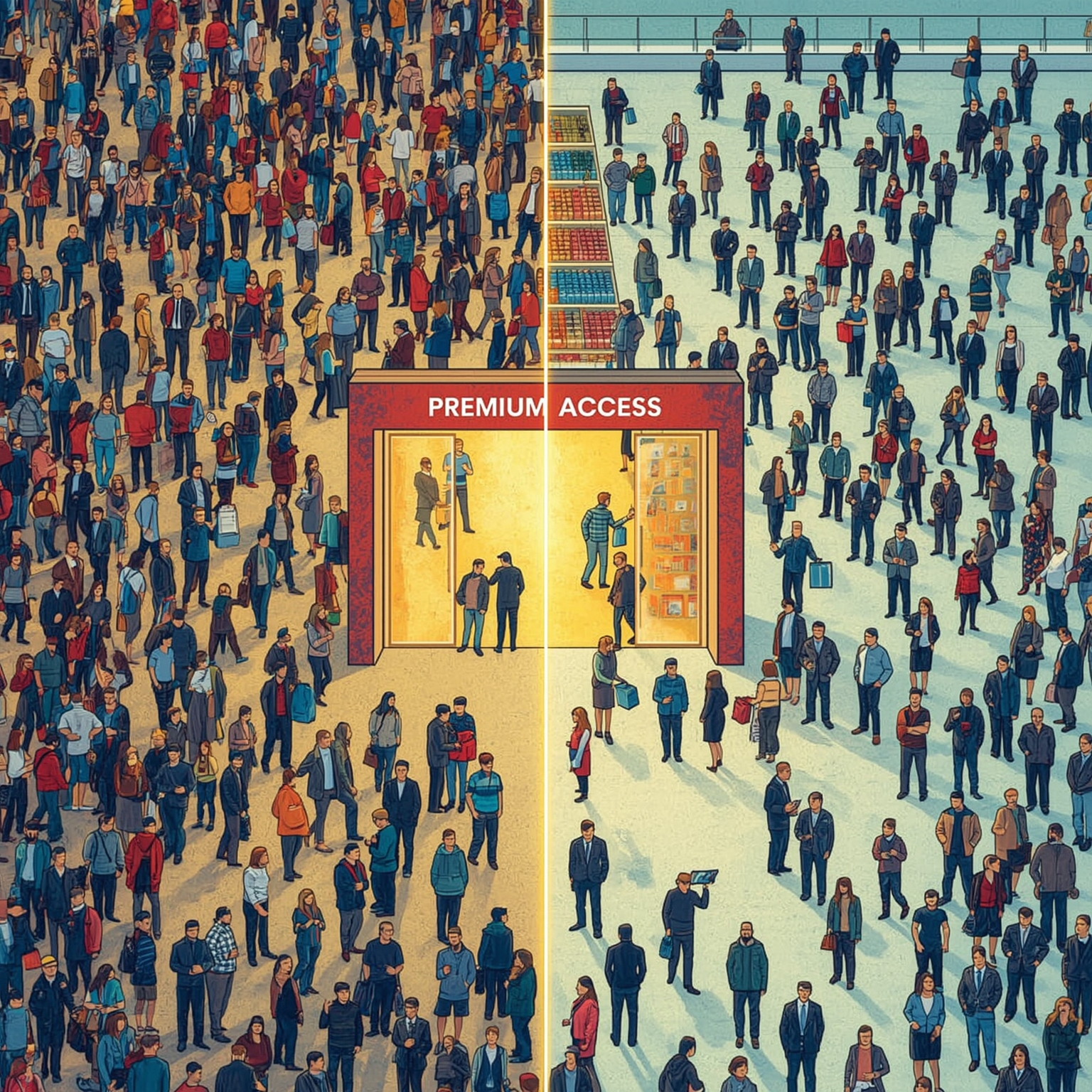
Consider the way airlines have meticulously disassembled the standard flying experience into dozens of small, chargeable fragments, effectively transforming what was once a unified service into a menu of costly upgrades. For example, simply checking a suitcase—an action that many travelers would consider fundamental to flying—now often results in an additional $50 charge. If greater comfort is desired, such as securing an extra six inches of legroom to avoid the claustrophobia of tightly arranged seating, passengers must often part with nearly $100 more. Boarding ahead of others, even though ultimately everyone ends up arriving at the same destination, is presented as a privilege accessible only to those enrolled in an elite loyalty program. This systematic separation of conveniences into purchasable add-ons creates an environment where passengers are divided into two broad classes: those who can afford to pay for comfort and efficiency, and those who must make do with the bare minimum.
Of course, this glowing portrayal is laced with sarcasm. Beneath the airlines’ cheerful justification—that customers benefit by paying only for the options they truly want—lies a harsher truth: the contemporary flying experience has become largely extractive and, for many, deeply unpleasant. No passenger *wants* to pay additional sums merely to avoid their knees pressing uncomfortably into the seat in front of them; these costs are acquiesced to, grudgingly, as the price of tolerable travel. Those relegated to the least comfortable, most crowded seats are simply enduring their situation rather than actively choosing it.
What is striking is that this “choose-your-own-expense” model has spilled far beyond the airlines, shaping practices across numerous industries. From retail to entertainment to digital platforms, companies are increasingly segmenting their customers, identifying precisely how much they can profit from each individual. Occasionally, this stratification yields advantages for consumers: for instance, Uber’s “wait-and-save” feature reduces fares for riders not in urgent need of transportation. Yet more often, these developments feel like losses. We now encounter fees for avoiding advertisements on streaming services, additional charges to bypass long amusement-park lines, and exclusive memberships that grant privileged shopping hours at bulk retailers like Costco. In nearly every sector, what once seemed like straightforward access has become tiered choice—choices that inevitably come at an added cost.
As marketing scholar Joseph Nunes succinctly observes, modern transactions no longer guarantee enhancements unless customers pay directly for them: while a purchase does not always ensure an optimal experience, it is increasingly certain that the absence of payment yields nothing extra at all.
My own recent trip to Costco illustrates this phenomenon. Entering with curiosity, I found myself alienated by the massive portions, the chilly warehouse atmosphere, and the sheer density of shoppers navigating crowded aisles. Still, I admit the complimentary samples—plentiful and varied—earned exceptionally high marks in my book. Yet despite my personal misgivings, I recognize that Costco’s model resonates with millions: its membership base surpasses 133 million worldwide. More tellingly, the company has cultivated a higher-tier “Executive” membership at double the cost of its basic plan. These elite members, paying $130 annually, receive benefits that now include exclusive morning shopping hours—one full hour on weekdays and thirty minutes on Saturdays—allowing them to browse among similarly privileged customers. For devoted enthusiasts, this exclusivity provides both tangible convenience and the intangible thrill of belonging to a select group.
Such strategies, explains Wharton professor Z. John Zhang, represent deliberate revenue generation tactics. Once a firm has committed to a foundational structure—in Costco’s case, selling memberships that grant access to low-cost bulk goods—it must continuously devise new avenues for growth, especially under the relentless scrutiny of shareholders. When product diversity plateaus and broader membership expansion slows, the next logical strategy is to divide existing customers into tiers and encourage upgrades through enticing privileges. Marketers often employ a “good-better-best” hierarchy, offering incremental advantages that push consumers to spend more, while simultaneously preventing a one-size-fits-all approach. Zhang anticipates that Costco will likely expand its tiered systems even further.
The underlying logic, as explained by both Zhang and Nunes, is grounded in the principle of price discrimination—the attempt to extract the maximum possible revenue from each consumer by adjusting the value proposition they are offered. Airlines pioneered this structure by detaching services from base fares, allowing them to sell elements that were once considered standard. Retailers now employ comparable unbundling, offering perks or surcharges to identify and capitalize on their most lucrative customers. As Zhang notes, such tiered pricing structures are virtually unavoidable across modern service industries because people naturally place different valuations on the same product or service.
In limited contexts, this stratification can offer genuinely beneficial outcomes. For example, if wealthier shoppers at Costco shoulder the burden of paying higher membership fees, the company may be able to maintain lower basic costs for others while simultaneously reducing congestion for its most active buyers. Similarly, ultra-discounted seating in airplanes may enable travel for those who otherwise could not afford the journey at all. Unfortunately, these more balanced possibilities are often overshadowed by practices that exploit customers’ limited choices and information gaps.
Modern data collection and artificial intelligence have supercharged these tactics by giving businesses extraordinary insight into consumer behavior. At the extreme, practices known as “surveillance pricing” allow companies to tailor prices individually, identifying just how much more a given customer is willing to spend. For instance, users browsing a travel website on premium devices, such as a MacBook, might be steered toward more expensive accommodations because the platform infers greater affluence. Similarly, new parents shopping online could encounter artificially inflated prices for baby products, predicated on the assumption that they will reluctantly part with the extra money. Even without direct manipulation, companies rely heavily on data-driven estimations about what people with similar habits and demographics are likely to tolerate.
Loyalty programs—ostensibly framed as perks for faithful customers—further expand businesses’ capacity to profile, categorize, and monetize consumers. By tracking individual purchases, companies learn exactly how much inconvenience or expense their customers will endure, what discounts successfully motivate transactions, and where frustrations push people away. As former Federal Trade Commission officials Sam Levine and Stephanie Nguyen emphasize, decades of refinement in advertising technology have provided firms with shockingly precise tools: they can now target not just broad age groups but hyper-specific micro-demographics down to a small age range within a single ZIP code and a narrow interest field. This same precision targeting, once aimed merely at ads, now increasingly informs how products and services are priced.
The trend reflects a broader economic evolution. Traditionally, companies set prices by adding a predictable margin to their costs—a straightforward cost-plus model. Over time, however, pricing has shifted toward “value-based” systems, in which the amount charged depends entirely on what customers believe the product to be worth, regardless of its underlying expenses. According to policy expert Lindsay Owens, many corporations have already trimmed labor, streamlined operations, and sought cheaper suppliers; consequently, further growth requires strategies beyond mere efficiency. The solution has often been “premiumization.” By introducing upgraded versions of goods or selectively downgrading standard versions, businesses create incentives for consumers to pay more, all while production costs remain relatively unchanged. Intriguingly, Owens notes that the presence of a premium offering can sometimes elevate the perceived quality of an entire brand, even if cheaper options remain exactly the same.
Demand for exclusivity is also driven by deeper human impulses. Beyond convenience and comfort, people yearn for recognition and distinction. Status, whether earned through accumulating loyalty points or purchased directly through memberships, appeals to these desires. As Shikha Jain, a consultant specializing in consumer behavior, explains, people are motivated both by tangible rewards and by the subtle prestige that comes from being treated as part of an exclusive group. Scarcity and special access intensify this effect, as seen with coveted airport lounges or elite retail hours. Businesses understand that offering higher tiers not only attracts premium revenue but also cultivates aspiration among those still positioned below.
Nevertheless, excessive stratification carries risks. If a company strips away too many core benefits from its entry-level services, it risks alienating broad swaths of its customer base and damaging brand reputation. Critics already argue that once-sacred spaces like airline lounges have become overcrowded, eroding the sense of exclusivity they were meant to guarantee. This disappointment then becomes fertile ground for competitors to introduce even more exclusive—and expensive—alternatives. While the upper tiers may initially prove most profitable, unchecked hierarchy is not without its backlash.
Ultimately, the trajectory of consumer economies appears irreversible. Companies from airlines to fast-food chains have already experimented with—and, despite occasional backlash, largely retained—dynamic and surveillance-based pricing models. Loyalty programs proliferate, often functioning more as tools of surveillance than as genuine rewards. For affluent customers, these strategies amount to a menu of purchasable conveniences: faster service, greater comfort, fewer irritations. For budget-conscious customers, the world still offers bare-bones access, though often stripped of the little comforts once gratuitously included. What vanishes is the reassuring simplicity of uniform pricing: a world where basic expectations were met without negotiation.
Inevitable as this may feel, its normalization is striking. Today’s younger airline passengers, for example, scarcely recall the days when boarding passes did not conceal startling seat assignments—a time when scoring an exit-row or window seat was a pleasant surprise rather than a separate profit center. As stratification spreads through retail, travel, and entertainment alike, we too may one day look back on the unhurried, uniform experience of shopping or traveling as a quaint relic of a bygone economic era.
Sourse: https://www.businessinsider.com/costco-new-hours-fees-changing-prices-tiers-customer-caste-system-2025-9


