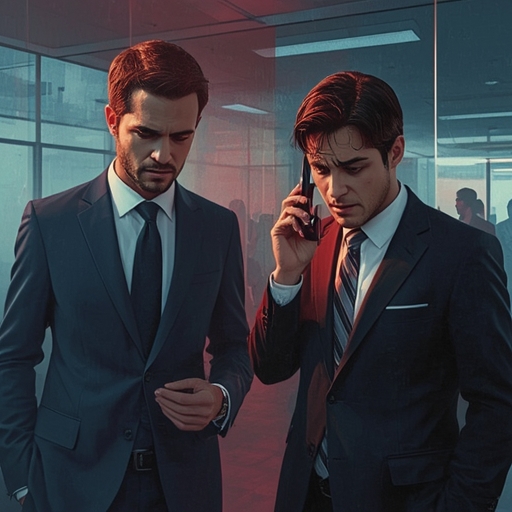
Paramount CEO David Ellison reportedly found himself in an awkward and revealing moment of silence during one of the most decisive phases of negotiations to acquire Warner Bros. Discovery (WBD). Industry insiders had speculated why Ellison’s outreach went unanswered, but recent disclosures have finally shed light on the reason behind this conspicuous lack of response.
On December 4, Ellison sent a text message directly to WBD CEO David Zaslav, emphasizing that Paramount’s acquisition proposal should not be interpreted as its “best and final” offer. This message, delivered in the critical hours before WBD officially accepted Netflix’s competing proposal, received no reply. As investors and analysts later learned, the absence of communication was not an oversight but rather a deliberate and considered choice during a sensitive juncture in corporate deliberations.
A newly released SEC filing from WBD detailed the rationale. The company explained that Zaslav refrained from responding because Ellison’s message did not introduce any materially improved or actionable proposal for evaluation. Moreover, according to WBD, engaging in such informal dialogue while the Board of Directors was actively deliberating the competing offers would have been inappropriate and risked disrupting an ongoing formal review process. In essence, Zaslav’s silence represented an adherence to procedural discipline rather than a personal slight.
The text itself, recently disclosed through Paramount’s own regulatory filing, displayed a tone of both professional respect and emotional earnestness. Despite containing a few typographical errors, the message conveyed Ellison’s desire to reassure Zaslav that Paramount’s bid could be refined to address WBD’s previously voiced concerns. Ellison underscored three core commitments: complete transactional certainty, a strong cash valuation, and an expedited path to closure. He pointedly reminded Zaslav that Paramount had purposefully withheld the phrase “best and final” from its submission, leaving room for further negotiation. The text concluded with a personal appeal, expressing admiration for Zaslav and WBD, and vowing that he and his father—tech magnate Larry Ellison—would stand by their reputation for loyalty and integrity if afforded the opportunity to become partners in ownership of WBD’s iconic entertainment assets.
WBD’s filing also indicated that a similar message had been sent from Centerview Partners, the investment bank advising Paramount, to its counterpart at Evercore, which represented WBD during the negotiations. These dual communications signaled Paramount’s intent to reopen a channel of last-minute dialogue, though they ultimately elicited no further response from WBD’s team.
For its part, Paramount noted in its filing that WBD did not engage in what it described as a “real-time, back-and-forth negotiation.” The company complained that Warner executives declined to provide detailed commentary on its proposal, refrained from marking up contractual drafts, and did not conduct a page-by-page review that might have opened the door for compromise. Paramount added that one of its representatives had called WBD’s leadership directly to request an update on the bid’s standing. According to Paramount, a member of Warner Bros.’ management responded courteously, assuring them that the submission had been received and would be addressed in due course, but no subsequent correspondence materialized.
Ultimately, following its internal review, WBD’s board unanimously reaffirmed its decision to reject Paramount’s overture, labeling the bid both inadequate and structurally uncertain. In an official letter to shareholders, the Board cautioned that Paramount’s offer relied on an “unknown and opaque revocable trust,” whose assets and liabilities could fluctuate, rendering the financing unreliable. Paramount, however, sought to dispel such concerns by clarifying that its proposal was fully backstopped by Larry Ellison—one of the world’s wealthiest individuals and a figure of immense stature in both technology and investment circles.
As the high-stakes corporate saga continues to unfold, Ellison and Paramount face a challenging strategic crossroads. Their next move will depend on whether Warner Bros. Discovery’s shareholders choose to side with Paramount’s vision for a potential merger or whether the company will once again modify its offer in pursuit of a more persuasive and acceptable proposal. Regardless of the outcome, this episode has already highlighted a crucial truth about executive communication: in the pressure-filled world of billion-dollar media transactions, silence can often be as revealing—and as strategic—as any spoken negotiation.
Sourse: https://www.businessinsider.com/warner-bros-david-zaslav-ignored-ellison-text-paramount-skydance-netflix-2025-12