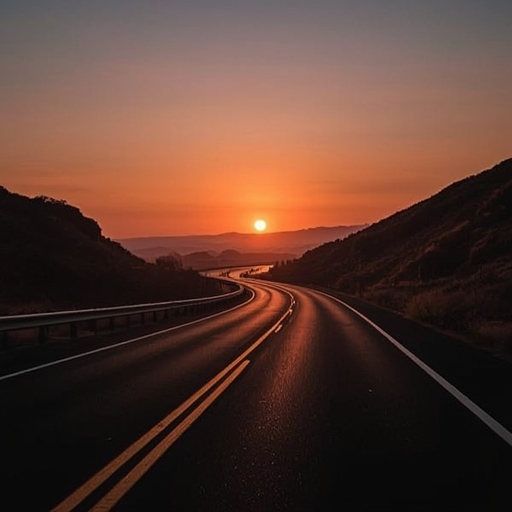
While scouting locations for the sweeping epic “One Battle After Another,” production designer Florencia Martin found herself driving through the barren expanse near the California-Arizona border alongside acclaimed filmmaker Paul Thomas Anderson. The two were engaged in what should have been a routine reconnaissance trip, surveying potential backdrops for the film, when an unanticipated discovery transformed their creative direction. Mile after mile of desolate asphalt stretched endlessly ahead, cutting through a monotonous desert plain that seemed to erase any sense of depth or variation. Then, quite suddenly, the terrain shifted. The land rippled upward into rugged formations, and the once-flat highway began undulating in sharp, almost surreal dips and crests—giant, wave-like sweeps of concrete that rolled toward the horizon in a mesmerizing rhythm.
The sight stopped them. Anderson, struck by the uncanny beauty of this geological curiosity, instinctively reached for his phone and began filming out of the window, capturing the hypnotic silhouette of the road as the car jostled through its dips. Martin later recalled to Business Insider that no one in the car understood, in that fleeting moment, that they had stumbled upon the eventual climax of their story—a serendipitous find that would define the film’s most breathtaking scene.
Anderson’s latest film, a sweeping and emotionally charged saga starring Leonardo DiCaprio, centers on an ex-revolutionary whose devotion to his estranged daughter Willa, portrayed by Chase Infiniti, pulls him unwillingly back into the conflict he thought he had escaped. Opposite him stands a menacing military officer, played by Sean Penn, whose obsession drives the narrative toward catastrophe. The culmination of these intertwined destinies unfolds in a fiercely kinetic car chase, where the road’s rollercoaster curves become both a strategic battlefield and a symbolic landscape reflecting the turbulence of the characters’ lives. This sequence, set against the haunting backdrop known locally as “The Texas Dip,” would never have existed were it not for coincidence and curiosity.
The episode was the result of an unexpected detour. Location manager Michael Glaser had originally driven Martin and Anderson on a lengthy journey from Los Angeles to the small desert town of Blythe, California, in search of a suitable site for the revolutionaries’ encampment. Their initial mission seemed narrowly focused—until, on the return trip, Glaser opted to take an alternative route. That spontaneous choice led the group through a little-known stretch of roadway near Borrego Springs. Locals referred to it endearingly as “The Texas Dip,” a name inspired by the road’s shockingly deep slopes that mimic the rise and fall of ocean swells. Within days of that discovery, Martin received a revised draft of Anderson’s screenplay, and there it was: the newly imagined finale of the film, now re-envisioned to culminate on that same serpentine road.
The climactic chase that followed would prove to be one of the most technically demanding sequences of the production. In this scene, Willa—cornered yet defiant—uses the undulating landscape and the harsh angle of the sun to outmaneuver a relentless assassin. Though deceptively simple in its premise, shooting the scene required an intricate understanding of the location’s natural conditions. Because the initial scouting had taken place in winter yet filming occurred in the punishing heat of midsummer, the team had to readjust their plans meticulously, recalculating lighting patterns and the sun’s trajectory to preserve continuity and realism. The desert’s hostility compounded the challenge: temperatures soared to 110 degrees Fahrenheit, winds whipped dust into every crevice, and fine sand infiltrated the delicate mechanisms of cameras, repeatedly jamming their gears. Crew members battled heat exhaustion, while the relentless sun tested endurance at every turn. Martin, whose filmography includes the lush period design of “Babylon” (2022) and Anderson’s nostalgic “Licorice Pizza” (2021), described these conditions as among the harshest of her career—a true endurance test of craftsmanship and commitment.
All that hardship paid off the first time Martin witnessed the completed sequence in a theater full of viewers. As the chase unfolded on the immense screen—dust clouds swirling, heat shimmering from the pavement, and the characters’ desperation made tangible by the environment—she felt a profound sense of satisfaction. The audience’s reaction confirmed the power of the moment: they gasped audibly, gripped by the raw realism that Anderson’s tactile filmmaking evokes. “What’s striking about Paul’s approach,” Martin explained, “is how authentically you experience the place itself. The dirt clings to Willa’s face, the glare pulses from the road—you can practically feel the temperature radiating off the screen.”
That authenticity has drawn remarkable comparisons. To Martin’s astonishment, critics and cinephiles alike have likened the film’s pulse-pounding finale to the great car chases immortalized in cinema’s history—from the gritty dynamism of “The French Connection” to the existential road fury of “Vanishing Point.” For any filmmaker, such associations are a profound tribute, situating their work within a lineage of legends. “It’s an incredible honor,” Martin said reverently. “To have our film mentioned alongside those classics we’ve admired for so long is beyond anything we expected.”
Now playing in theaters, “One Battle After Another” stands not only as Anderson’s latest cinematic achievement but also as a testament to how chance encounters on remote desert roads can shape the emotional and visual crescendo of a story. What began as an unplanned detour evolved into one of the most visually striking and emotionally charged endings in recent film memory—a moment born from the marriage of luck, landscape, and unrelenting creative vision.
Sourse: https://www.businessinsider.com/one-battle-after-another-car-chase-scene-location-2025-12