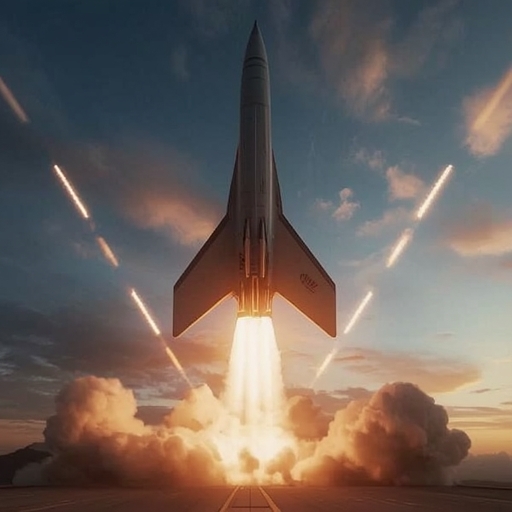
The United States Army’s ambitious Dark Eagle hypersonic missile program is rapidly approaching the critical stage of operational readiness, marking a significant leap in the evolution of military deterrence and precision-strike technology. Designed to deliver unprecedented speed — traveling at several times the velocity of sound — and long‑range accuracy, this system embodies the cutting edge of strategic weaponry that could fundamentally alter the landscape of twenty‑first‑century defense. As reports suggest that its initial deployment may coincide with a fragile ceasefire between the United States and Iran, the Dark Eagle has become more than a symbol of technological prowess; it represents a decisive shift in how modern powers intend to project strength, manage risks, and maintain global equilibrium.
From an engineering perspective, hypersonic missiles such as the Dark Eagle transcend the limitations of traditional ballistic or cruise systems. They are built not only for raw speed but also for maneuverability at high altitudes, allowing them to evade interception and dramatically shorten the time required to reach distant targets. This combination of attributes—stealth, agility, and rapidity—renders them both a strategic asset and a potential catalyst for geopolitical recalibration. Defense analysts have pointed out that acquiring the capacity to strike anywhere on the globe in minutes could transform military doctrines that have remained largely unchanged for decades. The psychological and tactical impact of such capability is considerable: adversaries must now plan for threats that offer almost no warning and leave little room for response.
The near-future deployment of the Dark Eagle also underscores the accelerating competition among global powers in the realm of hypersonic research and deployment. Nations such as China and Russia have already demonstrated corresponding capabilities, fueling an arms race reminiscent of earlier eras but magnified by today’s technological integration and cyber-enabled warfare. Consequently, the United States’ advancements in this sphere are not simply matters of defense but also of deterrence—aimed at maintaining parity and demonstrating that innovation remains central to national security policy. The Army’s collaboration with the defense industry and advanced research facilities illustrates a determination to ensure that these systems are not only operationally effective but also strategically sustainable.
At a broader level, the Dark Eagle epitomizes the delicate balance between innovation and responsibility. Hypersonic weapons hold transformative potential for safeguarding national interests, yet their deployment introduces new ethical and diplomatic challenges. Each advancement in speed and precision simultaneously compresses the window for negotiation and increases the risks of miscalculation. As global tensions fluctuate, particularly in regions where historic rivalries intersect with emerging technologies, the necessity for measured policies becomes increasingly evident. For decision‑makers and scholars alike, the Dark Eagle’s imminent readiness invites both awe and introspection—it is a triumph of modern engineering and a reminder of the profound consequences that accompany progress in military science. In essence, the weapon’s rise is not merely a technical milestone but a defining moment in the continuing dialogue between power, deterrence, and the fragile pursuit of peace.
Sourse: https://www.businessinsider.com/army-dark-eagle-hypersonic-missile-in-focus-4-26


