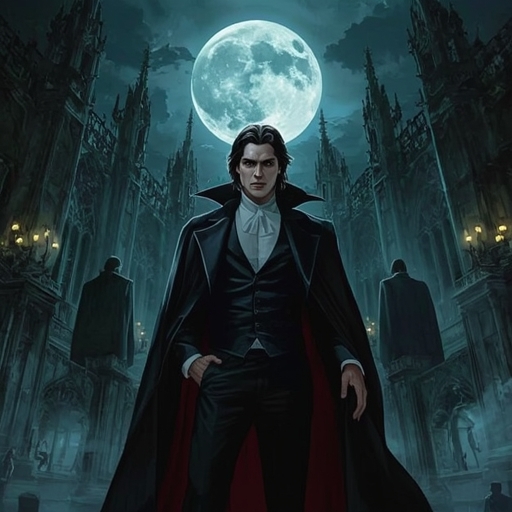
In the near future, audiences will once again be invited into the shadowy, seductive world of Anne Rice’s immortal beings, as Sam Reid’s portrayal of the enigmatic Lestat de Lioncourt finally claims the narrative spotlight. With its upcoming third season, AMC’s acclaimed adaptation *Interview With the Vampire* undergoes a significant transformation, reemerging under a new title—*The Vampire Lestat*. This rebranding signals a purposeful creative shift, repositioning the series to delve deeply into Lestat’s complex psyche, the contradictions that define him, and the turbulent existence he leads as a self-styled rock star in the modern era. The charismatic French vampire, long known for his flamboyance and moral ambiguity, now takes center stage not merely as a performer but as a man forced to confront the haunting echoes of his past.
Yet, this evolution in focus inevitably raises a vital question: what becomes of Louis de Pointe du Lac, once the emotional nucleus of the story and the central figure of the series’ first two seasons? Early footage teases Jacob Anderson’s continued involvement, revealing that Louis’s presence remains a potent and ghostly force throughout Lestat’s narrative—just as Lestat’s memory once tormented Louis. This intentional mirroring of their dynamic suggests that their relationship, defined by passion, betrayal, and eternal longing, will continue to reverberate through every scene. Showrunner Rolin Jones confirmed in an interview with *Entertainment Weekly* that Louis’s expanded part represents one of the most significant artistic departures from the Anne Rice novel serving as the foundation for this season. In the original text, Louis’s role is comparatively modest, but Jones, motivated by a deep admiration for Anderson’s performance, chose to craft a more intricate emotional journey for the character. He expressed confidence that this creative liberty would resonate profoundly with viewers, promising that Louis’s evolution would unfold as one of the season’s most affecting and carefully realized storylines.
“We wanted to provide a really good arc for Louis,” Jones revealed with enthusiasm, hinting that among the numerous interwoven plot threads this season, Louis’s story emerges as the most coherent, immediate, and poignantly human. He described it as luminous, almost transcendent in its emotional clarity—an intimately divine and heartbreakingly beautiful exploration of identity, loss, and unresolved devotion. This emphasis illustrates a conscious effort to maintain emotional continuity within the series even while its stylistic focus pivots toward Lestat’s internal reckoning.
A similar rationale underpins the decision to reintroduce Claudia, portrayed once again by the remarkable Delainey Hayles. In Rice’s source material, Claudia’s arc concludes long before the events that define *The Vampire Lestat*, leaving little room for further narrative development. However, Jones explained that Hayles’s portrayal breathed such authenticity and vitality into the character that the creative team felt compelled to extend her presence. He referred to her as “an absolute beauty of an artist,” crediting her with having “changed a lot about our show for the better.” While remaining tantalizingly cryptic about the specifics of the season’s plot, Jones promised that Claudia would demonstrate an even broader emotional and psychological range than before, suggesting new dimensions of her vampiric adolescence will be explored with artistry and pathos.
By amplifying the roles of both Louis and Claudia, the forthcoming *The Vampire Lestat* season seeks not only to honor its actors’ extraordinary performances but also to enhance the series’ exploration of its central antihero. Through their eyes—and through their continued presence within Lestat’s fractured world—the audience will gain a more profound understanding of just how conflicted and fragmented Lestat truly is. “He doesn’t want to examine himself, but is forced to,” Jones observed, encapsulating the torment at the heart of the narrative. Lestat’s attempts to shield himself behind layers of bravado, charisma, and emotional armor serve as both defense mechanisms and forms of self-deception. His refusal to confront his own vulnerability becomes the very source of his suffering, making that eventual self-awareness all the more compelling and tragic.
Fans can undoubtedly anticipate a season suffused with gothic grandeur, psychological intimacy, and the dark romanticism that has long defined this saga. Each returning character promises not only nostalgia but renewed purpose, weaving together themes of immortality, guilt, artistry, and redemption into a tapestry both sumptuous and sorrowful. When *The Vampire Lestat* returns to AMC in 2026, it will mark not just the continuation of a beloved story but its transformation—an invitation to witness the same myth from the other side of the looking glass, told now by the vampire who once refused to stay silent.
For those eager to stay immersed in every shadowed corner of speculative storytelling, io9 continues to provide comprehensive updates on forthcoming releases across the pop culture universe—from *Marvel* and *Star Wars* to *Star Trek*, the *DC Universe*, and even the ever-evolving world of *Doctor Who*. Whether in galaxies far, far away or beneath the gaslit streets of Rice’s New Orleans, these stories remind us that darkness and wonder are forever intertwined.
Sourse: https://gizmodo.com/the-vampire-lestat-showrunner-teases-louis-claudias-returns-2000702130