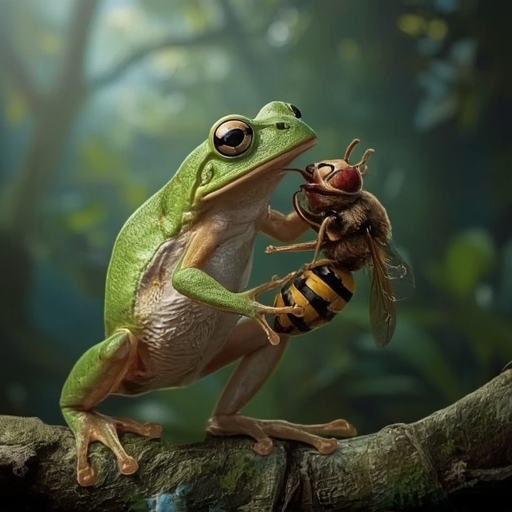
The next time you find yourself impatiently grumbling in a long queue at your favorite sandwich shop, take a moment to reflect on the fact that in the natural world, some creatures must confront challenges far greater than waiting for lunch. While we complain about slow service, certain animals brave life-threatening situations in order to secure a meal that is both satisfying and sustenance for survival. Consider, for instance, the remarkable behavior recently documented by scientists—an audacious feeding strategy employed by specific species of frogs that boldly target hornet-shaped prey, embracing danger as they wrap their sticky tongues around venomous insects.
In a newly published study, ecologist Shinji Sugiura of Kobe University in Japan investigated whether the black-spotted pond frog, known scientifically as Pelophylax nigromaculatus, deliberately hunts hornet wasps, including those infamously dubbed “murder hornets.” The research revealed that these frogs do more than casually snack—rather, they hungrily and repeatedly devour the insects, apparently unfazed by their venomous stings. What makes this observation extraordinary is not only the frogs’ appetite for such perilous prey but also their astounding ability to withstand venom that is notoriously lethal to many mammals, including humans. According to Sugiura, understanding the physiological mechanisms behind this natural resistance could one day enrich our own medical knowledge—perhaps even inspiring new approaches to pain management or inflammation control. As he explained in correspondence with Gizmodo, if pond frogs have evolved biological systems that numb pain or neutralize hornet venom, these natural defenses could illuminate paths toward innovative biomedical solutions.
This line of inquiry, however, emerged not from a preconceived experiment, but from an unexpected discovery. During Sugiura’s earlier research into how mason wasps defend themselves against predators, frogs were enlisted as test subjects to observe predator–prey interactions. To the scientists’ surprise, the black-spotted pond frogs readily consumed female mason wasps—despite their possession of venomous stingers. Only female wasps are capable of injecting venom, while males, as Sugiura’s prior findings amusingly revealed, may use their reproductive organs as non-venomous pseudo-stingers for defense. This peculiar observation captured Sugiura’s curiosity and propelled him toward a broader exploration of how these amphibians handle venomous threats.
Further evidence reinforced his hunch: adult hornets have been discovered inside the stomachs of several frog species, including P. nigromaculatus, which indicates that the consumption of hornets is not merely a laboratory anomaly but a natural behavior occurring in the wild. Yet one mystery persisted—do frogs attempt to avoid the sting entirely, or do they accept it as an inevitable cost of obtaining a meal? To answer this, Sugiura devised a meticulous experiment that resembled a miniature biological buffet. He collected multiple black-spotted pond frogs of varying sizes and introduced them to female worker hornets from three different species: Vespa simillima, V. analis, and the formidable Vespa mandarinia—the largest and most feared of them all, often sensationally labeled as the “murder hornet.” Although this nickname reflects their devastating impact on honeybee populations, their venom can occasionally prove fatal to humans. Once an invasive concern in North America, the species remains notorious for its painful and powerful sting.
The experiments yielded compelling results. Irrespective of the hornet species, the frogs demonstrated a robust eagerness to feed, evidently valuing a hornet meal more than their own comfort. Even when stung, they generally succeeded in overpowering and swallowing their prey whole. The lowest recorded success rate came from encounters with the massive V. mandarinia, in which 79% of attempts still ended in successful capture and consumption—an impressive figure given the risk involved. As Sugiura emphasized, his quantitative data, gathered from a substantial number of individual frogs, underscores that these amphibians can not only withstand hornet attacks but effectively ignore their formidable defense mechanisms. Hornet stingers, usually regarded as among nature’s most effective deterrents, appear to lose much of their power when faced with these resilient predators. His peer-reviewed findings were subsequently published in the journal Ecosphere.
Even more striking is the apparent indifference of the frogs to the venom itself. Despite multiple stings, they exhibited no visible distress, swelling, or behavioral impairment. The exact explanation for this immunity remains uncertain. One plausible hypothesis is that the biochemical composition of hornet toxins—potent though it is for mammals—may not interact with amphibian physiology in the same way. Alternatively, it is conceivable that over evolutionary time, frogs have developed adaptations that dull their pain response, alter their immune sensitivity, or simply neutralize venom at the cellular level. Whatever the underlying cause, this phenomenon offers scientists an intriguing opportunity to study how an organism can biologically disarm pain and toxicity so effectively.
Looking ahead, Sugiura intends to extend his investigations by exposing pond frogs to other venomous arthropods—ranging from stinging insects to spiders and scorpions—to determine whether their resistance represents a general trait or a hornet-specific adaptation. More precise experimentation in the future may even quantify just how much venom a frog can withstand before suffering ill effects, painting a clearer picture of amphibian tolerance thresholds. Beyond the scientific implications, Sugiura believes his findings illustrate a powerful ecological message: that even daunting predators like the so-called murder hornet are themselves subject to the inexorable laws of the food chain. “This discovery,” he remarked, “reveals a surprising truth for the public—that one of the world’s most fearsome insects is far from invincible.” Thus, in the quiet ponds of Japan, nature reminds us once more that life’s fiercest defenses often meet their match in unexpected places.
Sourse: https://gizmodo.com/these-frogs-dont-just-survive-venomous-murder-hornets-they-devour-them-2000694633