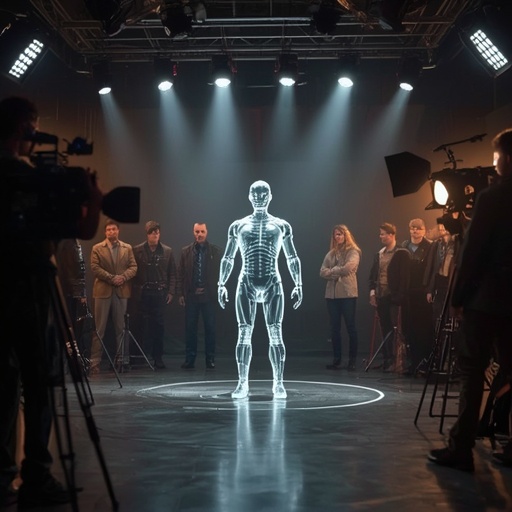
In today’s rapidly evolving entertainment landscape, a striking transformation is beginning to unfold within the micro-drama industry—a segment once celebrated for its accessibility and human creativity. Talented performers who have long dreamed of seeing their names attached to meaningful projects are now confronting an unexpected competitor: artificial intelligence. Increasingly, directors and producers are commissioning AI-driven digital performers to take center stage, introducing a new era where computer-generated actors can emote, improvise, and deliver performances that rival those of their human counterparts.
This paradigm shift has sparked equal parts fascination and unease. For many, the emergence of these virtual actors represents technological progress at its most dazzling—a glimpse into a cinematic future unconstrained by human limitations. Producers hail AI performers as cost-effective, tireless, and infinitely adaptable, capable of executing perfect takes without reshoots or scheduling conflicts. The speed and precision of AI tools streamline production cycles, revolutionizing how stories are told and distributed to audiences hungry for constant novelty.
Yet, beneath the enthusiasm lies a growing anxiety among human actors whose craft depends on authenticity, emotion, and the unique vulnerability that arises only from lived experience. For them, the question is no longer hypothetical: Will technology enrich artistic expression, or gradually render the human presence obsolete? The answer carries deep cultural implications. Acting, after all, is not merely about reciting lines—it is about the subtle interplay of empathy, memory, and imagination. Those irreplaceable human nuances risk being flattened into algorithmic predictions when creativity becomes data-driven.
The ethical dimension compounds the debate. If digital performers can replicate someone’s likeness or voice convincingly, where do we draw the line between homage and exploitation? Hollywood’s long history of valuing star power now finds itself at odds with the concept of ownership in the digital age. Legal frameworks struggle to keep pace with technology capable of resurrecting long-deceased artists or creating entirely synthetic celebrities programmed for perfection.
As artificial intelligence continues its ascent within the creative sectors, the micro-drama scene has become a vivid microcosm of the broader cultural reckoning ahead. It challenges everyone—from aspiring actors and screenwriters to audiences themselves—to reconsider what authenticity means when reality can be reinvented at will. Are we on the threshold of a thrilling new epoch of storytelling, or are we quietly witnessing the twilight of human artistry as algorithms learn to mimic our most intimate emotions?
The answer may depend on how society chooses to balance innovation with integrity. One thing is certain: the stage lights are still burning, but the faces under them are increasingly no longer flesh and blood. 🎭🤖
Sourse: https://www.businessinsider.com/actors-losing-jobs-to-ai-hollywood-micro-drama-industry-2026-6