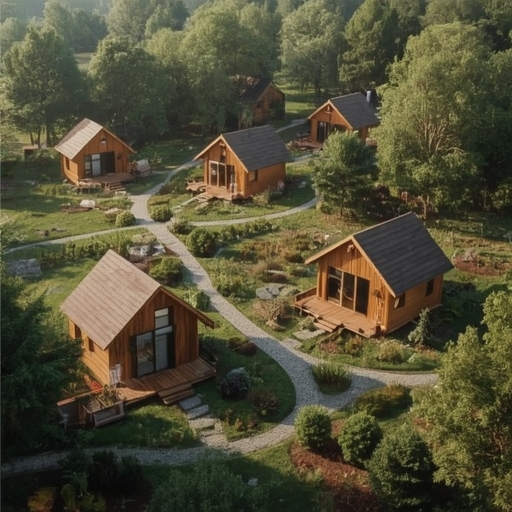
Before experiencing the Dutch tiny house village known as Minitopia, I carried a common assumption: that tiny homes represented a modest fallback, a minimalist solution for those unable to access traditional housing. Yet, upon walking through this innovative community of small-scale dwellings, my perception changed profoundly. What I encountered was not a story of compromise, but one of imagination, resilience, and a radical rethinking of how people inhabit space. Each compact home stood as a testament to creativity — uniquely crafted with sustainable materials, inventive layouts, and designs that balanced functionality with beauty.
As I moved through winding paths edged with flowers, gardens, and bicycles resting casually against hand-built facades, I realized that these residents had achieved something far beyond economic necessity. They had cultivated a living environment that emphasizes purpose over possession, connection over consumption. The air carried a distinct sense of freedom — not the kind that comes from vast estates and personal indulgence, but from stripping away the excess to reclaim a simpler, truer rhythm of life.
In conversation with community members, it became clear that a tiny home is less about reduction and more about expansion — not in physical size, but in possibility. Within these intimate spaces, people discovered how to live intentionally: generating less waste, depending more on one another, and enjoying a deeper communion with nature. Their lives were organized around shared experiences: evening gatherings, the exchange of ideas, and collective projects that made the village feel unified and alive.
Minitopia demonstrated that sustainability need not be a distant concept or a lofty ideal reserved for the privileged few. It can thrive in everyday settings when design, respect for the environment, and human empathy intersect. Each small house represented a microcosm of environmental mindfulness — equipped with solar panels, efficient insulation, upcycled furnishings, and inventive use of vertical space. It was a field study in how architectural restrictions can ignite ingenuity rather than suppress it.
This visit transformed my understanding of what a home truly signifies. I had expected minimalism to feel limiting, austere, and even restrictive. Instead, I encountered an abundance of color, creativity, and interpersonal warmth. The experience suggested that comfort and belonging do not necessarily depend on scale but on depth — the depth of one’s relationships, vision, and respect for sustainable existence. Tiny living, I realized, is not a retreat from modern life but an intentional refinement of it, revealing that well-being, beauty, and ecological responsibility can thrive within even the smallest frameworks. In essence, what Minitopia offered was not merely housing innovation, but a larger cultural insight: that freedom grows not from the size of our possessions, but from the clarity with which we define what matters most.
Sourse: https://www.businessinsider.com/minitopia-why-people-choose-tiny-homes-2026-5


