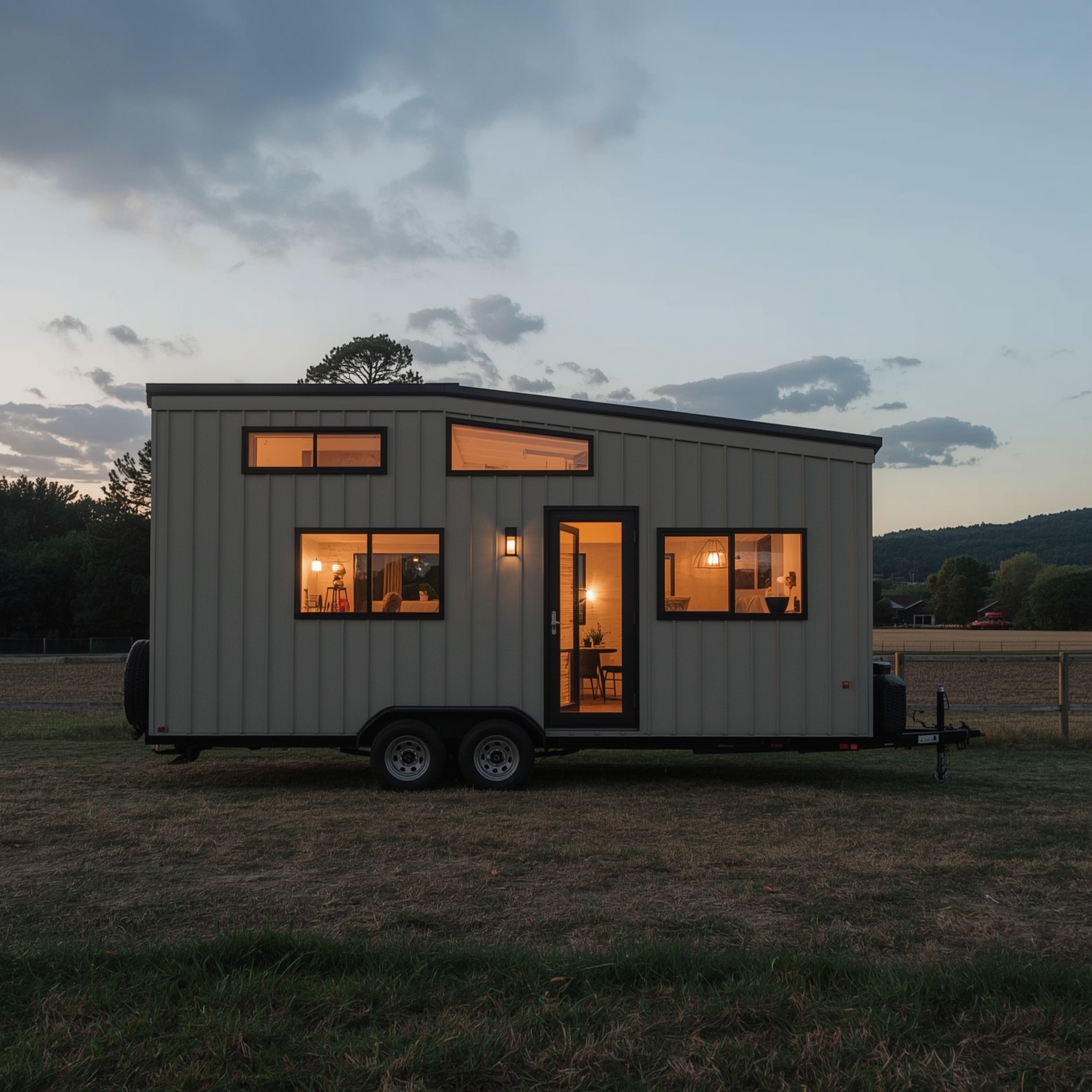
When Emilie Karas purchased an aging, dilapidated house sitting on a modest quarter-acre residential parcel in Portland, Oregon, at the beginning of 2020, she had no inkling that her decision would eventually lead to the construction of four separate dwellings ultimately housing nine individuals. Initially, her intentions were limited to rebuilding the existing property; however, midway through her renovation process, the city of Portland enacted a groundbreaking zoning reform. This new regulation permitted homeowners to construct as many as two accessory structures on residential land already containing a primary dwelling. In housing policy circles, these structures are formally termed “accessory dwelling units,” commonly abbreviated as ADUs—small, secondary homes designed to coexist with the principal residence. Not long afterward, the city advanced its permissiveness even further, adopting provisions that allowed property owners to accommodate one recreational vehicle or other mobile dwelling for use as a legitimate, full-time residence.
Recognizing a rare and transformative opportunity unfolding before her, Karas seized the moment with notable enthusiasm. In her backyard, she erected two ADUs positioned vertically—essentially a duplex configuration—maximizing the space while complying with local codes. Yet her ambition outpaced these accomplishments. She subsequently invested in a pre-fabricated, fully furnished “tiny home on wheels,” often called a THOW: an ingeniously compact structure, built atop an eight-by-twenty-four-foot trailer, allowing mobility without compromising modern comfort. Tiny homes on wheels straddle the conceptual boundary between recreational campers and fixed micro-houses; when their wheels are hidden, they can easily be mistaken for immobile backyard cottages. In actuality, they rest upon trailer chassis, granting them portability and making them functionally distinct from conventional houses anchored by permanent foundations.
According to Kol Peterson, a Portland-based advocate and contractor specializing in small-space construction, these diminutive vehicles represent “smaller, cuter versions of the archetypal American house.” Yet in the eyes of the law, their classification as vehicles rather than as dwellings spares them the elaborate regulatory maze that conventional homes must navigate—freeing them from intensive permitting, costly infrastructure fees, and extensive inspections. In a period when the United States faces an acute shortage of affordable housing, such legal recognition hints at a promising alternative. If other municipalities emulate Portland’s forward-thinking policies, THOWs could redefine what it means to attain a starter home for young or cost-burdened residents.
Peterson highlights that the appeal of tiny homes on wheels is not merely philosophical—though they do embody ideals such as minimalism, ecological responsibility, and freedom from mortgage debt. Underlying these lofty principles lies a more immediate practical motivation: economic necessity. For an expanding segment of Americans, these houses represent some of the last financially attainable forms of independent living.
Karas’s experience aligns with Peterson’s analysis. Compared with constructing traditional ADUs, she found the acquisition and installation of her THOW astonishingly straightforward and considerably less expensive—“like night and day,” she described. Building the ADUs required the same foundational work, engineering design, and compliance with local zoning and safety regulations as full-scale homes, incurring significant costs. In contrast, her THOW, deemed a vehicle by Portland’s jurisdiction, bypassed these burdens entirely. Without mandates for certification, inspection, or civic impact fees, she paid roughly $60,000 to purchase the completely furnished unit—manufactured and shipped from Florida—and just a few thousand dollars more to settle it onto her property.
Since then, Karas and her partner have occupied the principal house along with three roommates while renting out both ADUs and the tiny home on wheels. The THOW commands approximately $1,200 per month with utilities included, providing an affordably priced yet aesthetically pleasant living option. “It truly opens a door to dignified, safe housing for people with modest incomes,” she explained. “While everyone shares the same property, the community dynamic we’ve created is genuinely positive and supportive.”
Outside of Portland and certain RV parks, full-time habitation in mobile tiny homes remains largely prohibited by local zoning codes. Nevertheless, by officially recognizing THOWs as legitimate residences, Portland has enabled what Peterson describes as “a radical, inexpensive housing typology operating legitimately within a sector otherwise dominated by exorbitantly priced real estate.” Within Karas’s arrangement, she and her wife, Ellie Johnson, coexist with three roommates in their six-bedroom main house, one tenant residing in the THOW, and three additional occupants in the pair of ADUs—an illustrative microcosm of adaptive urban density.
The economic advantages of THOWs stem from their unique construction model. Much like recreational vehicles, many are manufactured entirely in factories, eliminating the need for permanent foundations. Their mobility enables relocation when desired, and some units are engineered for self-sufficiency, capable of operating off the grid without external utility connections. This flexibility, however, is secondary to their most striking feature: affordability. Peterson estimates that the total cost for purchasing and equipping a THOW—including hookups for water, electricity, and sewer—typically ranges between $50,000 and $150,000. Traditional ADUs, by contrast, often cost from $100,000 to $300,000 to complete, excluding time-consuming permitting processes. Alan Durning, executive director of the Seattle-based Sightline Institute, underscores this disparity: the sheer cost difference, combined with the magnitude of the nation’s housing shortage, will inevitably prompt many homeowners to consider THOWs as their most realistic route to property-based investment.
Despite this potential, widespread adoption faces formidable obstacles. Most U.S. jurisdictions impose restrictions on full-time occupancy of structures classified as vehicles, effectively limiting where THOWs can be placed. As Jonathan Palley, CEO of California’s Clever Tiny Homes, explains, “The majority of people interested in buying our products are prevented not by financial barriers, but by land-use laws forbidding such dwellings on most private lots.” His company attempts to bridge this gap by producing modular homes convertible between mobile and permanent forms.
Urban housing experts note that while tiny houses on wheels contribute meaningfully to the national conversation about affordability, they are but one piece in a multifaceted solution. Jenny Schuetz, vice president of housing at Arnold Ventures, emphasizes that cities must also commit to enabling higher-density construction—such as apartment buildings and mixed-use developments—particularly along transit corridors. She cautions, moreover, that affluent suburbs resistant to density are unlikely to adopt THOW-friendly policies: “It’s hard to imagine the elite enclaves of Boston or Connecticut welcoming mobile homes into their neighborhoods.”
Nevertheless, interest continues to grow. Jen McCarthy, founder of the Canadian THOW manufacturer Teacup Tiny Homes, has observed rising demand, especially during the pandemic years. What began as a trend favored by adventurous millennials has broadened to include older demographics—baby boomers and Generation X homeowners looking to simplify or house family members close by. One such resident, 59-year-old Julie Lennox of Montana, opted for a Teacup THOW set on her elderly parents’ fifteen-acre property near Missoula. After selling her former home, she sought a more economical, flexible dwelling. Now, as head of a nearby private school, she enjoys being debt-free, living close enough to assist her parents while maintaining independence. Her experience, she affirms, has proven both practical and emotionally rewarding.
Advocates champion THOWs not only as cost-effective investments but also as superior quality-of-life alternatives to conventional RVs. Unlike RVs, which prioritize lightweight materials for frequent travel, THOWs employ construction materials similar to standard housing, prioritizing durability and comfort over mobility. Manufacturers are adapting creatively to legal constraints: Palley’s company, for instance, builds models certified both as RVs and modular homes, allowing owners initially to register them as vehicles before later converting them into permanent ADUs. In California’s Eaton fire recovery zone, residents temporarily permitted to live in mobile dwellings can later choose to resell or reinstall their THOWs as lasting backyard residences—an example of agile policy application.
Looking ahead, proponents like Peterson and Durning envision broader legalization efforts at the state level in Oregon and Washington. These advocates regard THOW integration not as a novelty but as the next significant progression in urban infill development—a continuum starting with ADU acceptance and evolving toward fully mobile yet sustainable housing solutions. As Peterson puts it, “The ADU market represents the leading edge of affordable housing innovation; the tiny homes on wheels movement, however, is its evolving frontier—a bold leap toward accessibility, adaptability, and financial pragmatism for future generations.”
Sourse: https://www.businessinsider.com/tiny-homes-on-wheels-van-life-housing-shortage-starter-homes-2025-9