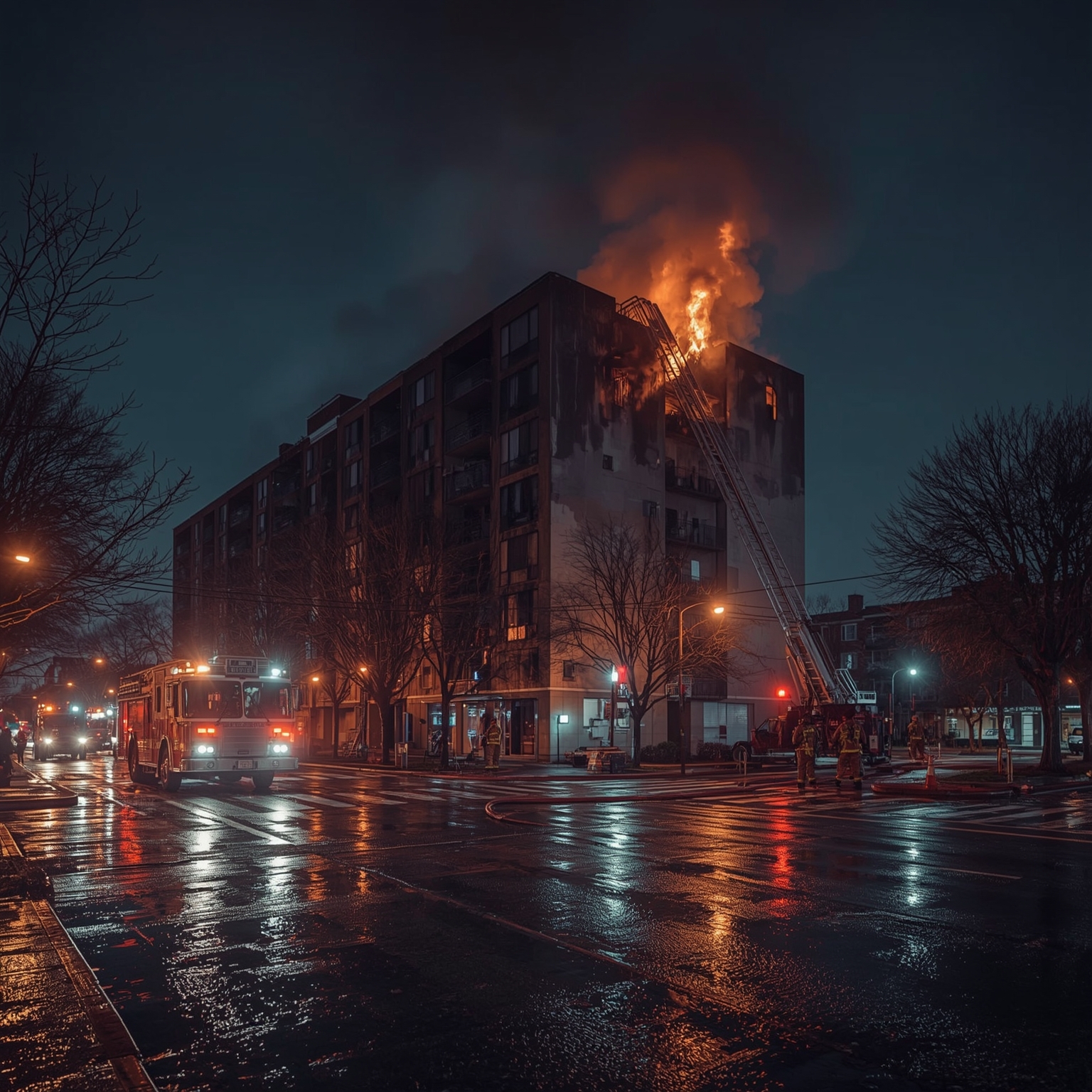
The catastrophic blaze that swept through the Wang Fuk Court apartment complex in the Tai Po district of Hong Kong has inflicted one of the most severe urban disasters in the city’s recent history. What began as a sudden eruption of flames on Wednesday afternoon, local time, rapidly escalated into a ferocious inferno that engulfed nearly the entire residential complex. The tragedy has not only resulted in a grievous loss of human life but also displaced countless families, shaken the community’s sense of security, and prompted significant legal repercussions for those allegedly responsible.
According to official reports released by Hong Kong authorities, at least seventy-five individuals have perished in the disaster, a staggering figure that underscores the fire’s unmatched ferocity. The blaze ultimately tore through seven of the complex’s eight towering residential blocks, leaving behind scenes of widespread devastation. Of the roughly 4,600 residents who called Wang Fuk Court home, nearly three hundred people remain unaccounted for, while seventy-six individuals have sustained injuries that range from minor burns to life-threatening trauma. Many survivors have lost not only their homes and possessions but also family members and neighbors, adding a deep emotional dimension to this calamity.
Among the wounded are eleven firefighters who risked their lives confronting the towering walls of flame and dense smoke in their efforts to save residents. Tragically, the Chief Executive of the Hong Kong Special Administrative Region, John Lee Ka-chiu, confirmed that at least one firefighter has succumbed to injuries sustained in the line of duty—a sobering reminder of the tremendous risks faced by first responders during such crises. Their courage and endurance in battling the inferno have since drawn public admiration and heartfelt praise across social and political sectors alike.
Authorities have since declared the fire under control, yet its aftermath continues to reverberate across Hong Kong and beyond. The scope of destruction places this event among the deadliest fires in the city’s modern memory, surpassing even the notorious Grenfell Tower fire in London in 2017, which claimed seventy-two lives. Comparisons to that earlier tragedy have reignited urgent discussions about construction practices, building materials, and the effectiveness of fire safety oversight in high-density urban environments.
Preliminary investigations have brought to light disturbing findings concerning the materials used in constructing the Wang Fuk Court complex. Hong Kong officials revealed that the exterior cladding and insulation layers of the building failed to meet established fire safety standards. This revelation has fueled public outrage, as it suggests systemic negligence in ensuring resident safety. In response, law enforcement authorities have arrested three senior executives from the construction firm responsible for developing the complex. These individuals now face charges of manslaughter, with investigators citing strong evidence of gross professional misconduct. “We have reason to believe that those in charge of the construction company were grossly negligent,” affirmed Senior Superintendent Eileen Chung during a press conference, highlighting the gravity of their alleged failures.
Further compounding the disaster’s severity were ongoing renovation works at the time of the fire. The outer walls of several towers had been encased in bamboo scaffolding—commonly used in Hong Kong’s construction industry—covered by a flammable safety netting. This combination, while traditional and cost-effective, may have acted as an accelerant, enabling the flames to spread upward and outward with astonishing speed, effectively trapping numerous residents before emergency teams could reach them.
The emotional and social aftermath of the incident extends well beyond the parameters of the devastated complex. Expressions of grief, compassion, and solidarity have poured in from across the globe. Locally, the tragedy has cast a somber shadow over public life, with various organizations and cultural institutions adjusting their plans in respect for the victims. The internationally renowned Mnet Asian Music Awards, a major K-pop event scheduled at a Hong Kong stadium on Friday evening, announced the cancellation of its red carpet ceremony while choosing to proceed with the main event, symbolically balancing mourning with resilience. On a broader scale, Pope Leo conveyed his condolences through a formal telegram addressed to the bishop of Hong Kong, extending spiritual comfort and prayers for those who perished as well as for the survivors who must now rebuild their lives.
In an effort to alleviate the immediate hardships faced by the displaced residents, the Hong Kong government has established an emergency financial assistance program. Through this initiative, each affected household is to receive approximately $1,300 in relief funding—a measure intended to assist families with basic necessities and temporary accommodation. However, this sum falls short of the city’s average monthly rent in the Tai Po region, emphasizing the immense financial challenges that survivors will continue to face in the weeks and months ahead. The government’s response, though rapid, has sparked ongoing discussions about long-term housing policies, corporate accountability, and the crucial need to uphold building safety regulations to prevent future catastrophes of similar magnitude.
Taken together, the Wang Fuk Court fire has laid bare the fragility of urban life in a metropolis celebrated for its architectural modernity and density. It stands as a stark warning about the consequences of overlooking safety standards and the profound human suffering that can arise from a single lapse in regulation or corporate ethics. As Hong Kong mourns, it also searches for meaning, accountability, and reform in the ashes of one of its darkest hours.
Sourse: https://www.businessinsider.com/latest-wang-fuk-court-fire-hong-kong-update-death-toll-2025-11